
Jamaica Mechanical Practice Test
$69.00
- Buy to unlock unlimited access to all Quiz questions and Answers in this Quiz.
- After purchase you can print a PDF of the whole quiz at any point. The PDF will contain the questions and the correct answers.
About this Exam
Master your preparation with our dedicated Jamaica Mechanical Practice Exam study guide.
This comprehensive resource is designed specifically for individuals aspiring to excel in mechanical roles across various industries in Jamaica.
It evaluates fundamental mechanical principles, practical knowledge, and safety procedures critical for success in this demanding field.
Whether you are looking to become an automotive technician, an industrial maintenance mechanic, or a mechanical engineer assistant, achieving a strong score on relevant practice tests significantly boosts your confidence and readiness.
Ready to test your knowledge?
Buy Now to Access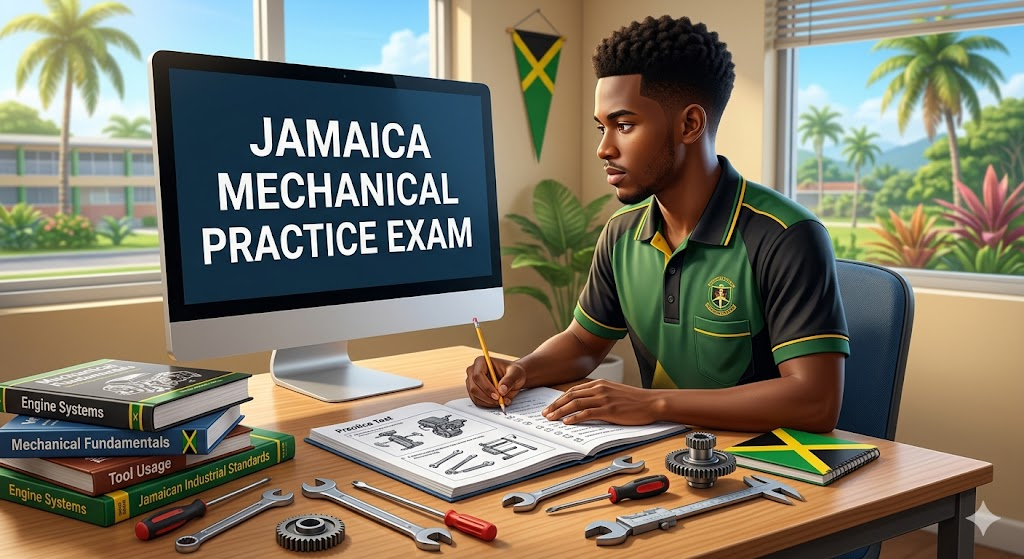
Additional Information
What the Course Entails and Exam Details
The Jamaican Mechanical Practice Exam covers a wide range of essential mechanical concepts.
It is structured to ensure you have a solid understanding of the foundational knowledge required for diverse mechanical positions.
Key topics typically include:
Mechanical Principles: Understanding forces, motion, simple machines, gears, and power transmission systems.
Tools and Equipment: Identification, safe usage, maintenance, and relevant measurements (imperial and metric) of common hand tools, power tools, and diagnostic equipment.
Engine Systems: Basic operation, components, fuel systems, ignition systems, cooling, and lubrication for various types.
Electrical Fundamentals: Basic circuits, components, reading wiring diagrams, and essential electrical systems.
Safety Regulations and Procedures: Comprehensive knowledge of workplace safety standards, proper handling of hazardous materials, and environmental practices in a mechanical setting.
Basic Calculations: Applying mathematical concepts to mechanical problems, including ratios, tolerances, and measurements.
What to Expect in the Final Exam
The Jamaica Mechanical Practice Exam is typically a multiple-choice examination, designed to test your knowledge efficiently across all covered topics.
While specific formats can vary depending on the exact source of your practice materials, common features include:
Number of Questions: Often ranging from 50 to 100 multiple-choice questions.
Time Limit: Students generally have between 90 minutes to 2 hours to complete the test, requiring both speed and accuracy.
Passing Score: Most relevant practice exams suggest aiming for a score of at least 70% to 80% to indicate strong preparation.
Question Distribution: Expect questions covering mechanical principles, tools, engine systems, electrical basics, and safety protocols in balanced proportion.
Special Rules: Basic, non-programmable calculators are sometimes permitted, but always check the specific test instructions.
Remember that practice tests aim to simulate the real exam experience, so treat them with the same seriousness.
How to Study and Exam Centers
Launching a successful mechanical career in Jamaica begins with thorough preparation.
Here are proven strategies for studying and accessing relevant practice exams:
Leverage Study Materials: Utilize diverse resources like dedicated study guides, textbooks, online courses, technical manuals, and specific training programs covering mechanical fundamentals.
Focus on highly recommended preparation guides and textbooks.
Take Multiple Practice Tests: Simulating the exam experience is essential.
Take as many reputable practice tests as possible to familiarize yourself with the question types, time management, and areas needing improvement.
Search online for practice tests specific to "Jamaican mechanical certification prep" or relevant international standards.
Focus on Weak Areas: Use practice test results to identify knowledge gaps and dedicate extra study time to understanding these concepts thoroughly.
Break down complex topics into smaller, manageable sections.
Join Study Groups: Collaborate with peers also preparing for mechanical exams.
Discussing concepts, sharing resources, and testing each other can enhance understanding and motivation.
Unlike an official certification, practice exams themselves are rarely taken at formal physical testing centers.
Instead, they are typically accessed online through educational platforms, test prep websites, or included in comprehensive study material packages from technical institutions or specialized providers.
Look for platforms offering timed, graded practice tests that mirror the real exam experience.
To take the actual final exam and get officially certified, you would typically need to schedule an exam session at authorized testing centers in Jamaica, often affiliated with technical vocational institutions (like HEART/NSTA Trust), community colleges, or professional engineering bodies.
You would need to check their respective websites or contact them directly for current schedules, locations, and registration processes for official mechanical certification exams.
Job Opportunities from the Course
Mastering your preparation with the Jamaica Mechanical Practice Exam significantly enhances your job prospects and overall employability in Jamaica's growing industrial and automotive sectors.
Successful preparation and eventual certification/employment in relevant roles can lead to a diverse range of rewarding careers, including:
Automotive Technician: Maintain, repair, and diagnose issues in cars, trucks, and buses across various specialized areas. This is a consistently in-demand role with ample opportunities.
Industrial Maintenance Mechanic: Install, maintain, and repair factory machines, industrial equipment, and production lines in manufacturing plants, power generation facilities, and mining operations.
Heavy Equipment Mechanic: Specialize in the service and repair of large construction, agricultural, and earthmoving machinery like excavators, bulldozers, and tractors.
Marine Mechanic: Service and repair engines, systems, and equipment for boats, yachts, and commercial vessels in the maritime and tourism sectors.
Mechanical Fitter: Read blueprints, assemble components, install machinery, and perform precise mechanical tasks in construction and engineering projects.
Maintenance Technician (General): Perform routine and preventative maintenance on building systems, HVAC, plumbing, and other mechanical infrastructure.
Mechanical Engineer Assistant/Technician: Work closely with engineers on complex projects, performing tests, taking measurements, and supporting the design and development processes for various mechanical systems.
This practice exam serves as a crucial launchpad for these and many other fulfilling mechanical careers within Jamaica.
Frequently Asked Questions
Reviews
5.0
Based on 0 reviews
Leave a Review
No reviews yet. Be the first to review!