
Jamaican Road Code Practice Exam
$69.00
- Buy to unlock unlimited access to all Quiz questions and Answers in this Quiz.
- After purchase you can print a PDF of the whole quiz at any point. The PDF will contain the questions and the correct answers.
About this Exam
Welcome to your essential resource for mastering the Jamaican Road Code Practice Exam. This guide is specifically designed for aspiring drivers in Jamaica who are preparing to take the first critical step toward obtaining their driver's license. The official Road Code Test is a mandatory evaluation of your knowledge of Jamaica's rules of the road, traffic signs, and road safety regulations. Passing this exam is a prerequisite for receiving your Provisional (Learner's) Driver's License. This guide, therefore, is for anyone, from teens to adults, eager to become a safe, responsible, and fully licensed driver on the island. We provide an overview, key details, and actionable strategies to ensure you are fully prepared and confident.
Ready to test your knowledge?
Buy Now to Access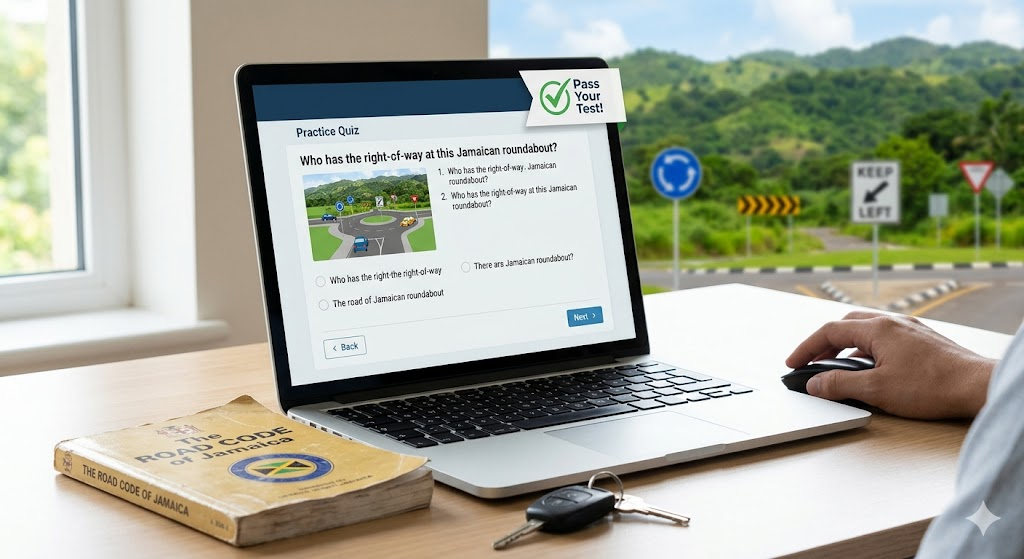
Additional Information
What the Course Entails and Exam Details
The Jamaican Road Code exam ensures that all new drivers possess a fundamental understanding of safe driving practices and legal requirements. Your study must encompass the entirety of the official handbook, 'The Art of Driving'. Key areas covered include:
General Rules of the Road: This includes the 'First Rule of the Road' in Jamaica—keeping well to the left—as well as rules for overtaking, right of way, speed limits for various road types (built-up areas vs. highways), parking distances from specific locations like bus stops and pedestrian crossings, and the correct sequence and meaning of traffic lights.
Road Signs and Markings: You will be tested on your ability to identify and interpret regulatory signs (prohibitory and mandatory), warning signs, and informative signs. A crucial component is also understanding road markings, including broken and continuous white lines, and what they indicate about overtaking and lane usage.
Road Safety and Ethics: This section covers best practices for night driving, driving in adverse weather conditions (wet or slippery roads), the correct use of hand signals, how to react to emergency vehicles, and a general code of conduct that promotes courtesy and safety for all road users, including pedestrians.
What to Expect in the Final Exam
The actual Road Code Test, taken at an Island Traffic Authority depot, is a straightforward but thorough assessment. Knowing what to expect will help ease any test-day nerves.
Format: The exam is a written (or sometimes computerized) multiple-choice test. It consists of 20 questions.
Content: All 20 questions are drawn directly from 'The Art of Driving' handbook, focusing on road rules, signs, and safety protocols as outlined above.
Passing Score: While specific passing percentages may vary, you are expected to demonstrate a high degree of accuracy. We recommend striving for a perfect score in your practice to allow for a small margin of error in the official setting.
Time Limit: The test is usually brief, designed to be completed in a fixed and reasonable amount of time, often around 20–30 minutes.
Specific Rules: You are not permitted to use any study materials, including the handbook or your smartphone, during the examination. It is a strictly independent test of your knowledge. Should you not pass on your first attempt, you are typically permitted to schedule a re-sit, often free of charge.
How to Study and Exam Centers
Preparation is the key to success. We recommend a multi-faceted approach to your study plan.
Study the Official Source: Your primary resource must be 'The Art of Driving' handbook. Read it thoroughly, multiple times. Pay special attention to illustrations of signs and road markings.
Use Free Practice Tests: Take advantage of free, authorized online Jamaican Road Code practice exams. These tests are excellent for familiarizing yourself with the multiple-choice format and testing your recall on key rules and signs in a simulated environment. We recommend using them repeatedly until you are consistently scoring 100%.
Create Flashcards: Make digital or physical flashcards for all traffic signs, their names, and their meanings. This is one of the most effective ways to commit visual information to memory.
Observation: When you are a passenger in a vehicle, try to actively identify signs, markings, and relevant rules as you travel. This practical application cements your theoretical knowledge.
The official Road Code Test must be taken in person. There is no option for a final online examination. You must visit an official examination center:
Island Traffic Authority (ITA) Examination Depots: These depots are located across Jamaica, with major centers in cities and towns such as Kingston (Swallowfield), St. Andrew (Constant Spring), Montego Bay, Mandeville, St. Ann's Bay, and Savanna-la-Mar. You will need to check with your local depot for their specific testing schedule.
Job Opportunities from the Course
Obtaining your Jamaican driver's license, which starts with passing the Road Code Test, opens the door to a wide range of career opportunities across various sectors. While the private license is the first step, it lays the foundation for specialized licenses later. Here is a list of job titles and career paths this certification can unlock:
Delivery Driver: For restaurants, courier services, auto parts stores, or local retail businesses.
Taxi and Public Passenger Vehicle (PPV) Driver: Operating a route taxi or a private hackney carriage (requires additional PPV certification and licensing after the private license).
Chauffeur: A personal driver for individuals or a professional corporate driver.
Sales Representative: Many field sales roles require the use of a company or personal vehicle to visit clients and deliver products.
Security Officer (Patrol): For mobile patrol duties that require driving between sites or within large complexes.
Personal Driver/Bearer: Assisting individuals with errands and transportation.
App-Based Ride-Share Driver: For platforms operating in Jamaica, which require a valid PPV license.
Commercial Truck Driver (First Step): While requiring a general/commercial license, passing the initial road code is the first mandatory hurdle on this high-demand career path.
Logistics and Distribution: Positions that involve vehicle fleet operation or warehouse-to-store transportation.
Emergency Services (Driver): For roles within the police, fire, or ambulance services, where driving is a core component (often requires specialized operational training).
We wish you the very best of luck in your study and look forward to seeing you safe on Jamaican roads.
Frequently Asked Questions
Reviews
5.0
Based on 0 reviews
Leave a Review
No reviews yet. Be the first to review!