
Java Technical Interview Practice Test
$69.00
- Buy to unlock unlimited access to all Quiz questions and Answers in this Quiz.
- After purchase you can print a PDF of the whole quiz at any point. The PDF will contain the questions and the correct answers.
About this Exam
The Java Technical Interview Practice Test is a crucial preparation tool designed for aspiring and professional software developers aiming to secure roles involving Java technologies.
This rigorous simulation is specifically engineered to bridge the gap between theoretical knowledge and the practical problem-solving skills demanded by modern hiring managers.
This assessment is designed for a broad audience, ranging from recent university graduates looking to kickstart their careers to experienced mid-level engineers seeking to validate their advanced proficiency before high-stakes job interviews at top-tier technology firms.
By engaging with this practice test, candidates can expect a realistic preview of the questioning styles and technical challenges they will face in real hiring scenarios, allowing them to identify critical knowledge gaps in a low-stakes environment.
Ready to test your knowledge?
Buy Now to Access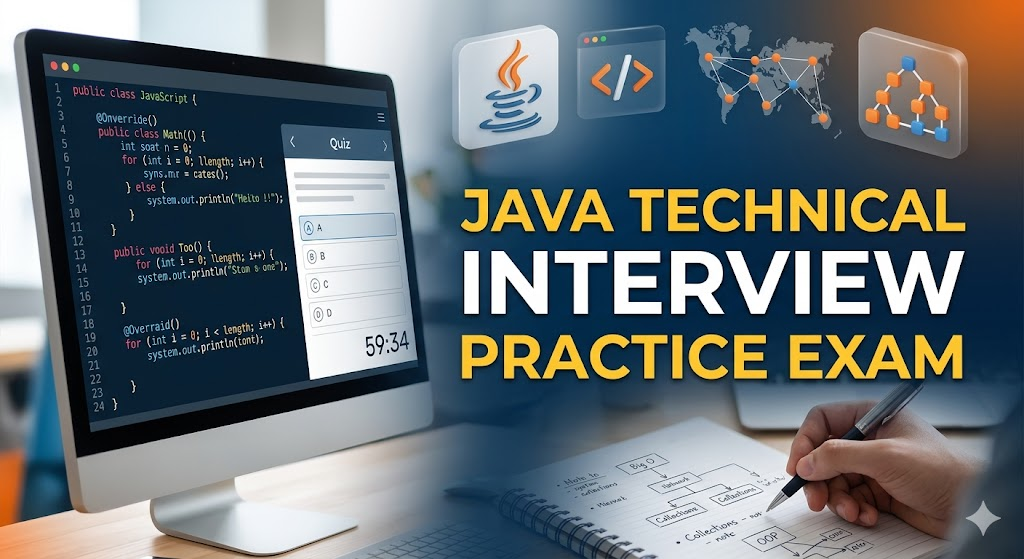
Additional Information
What the Course Entails and Exam Details
This comprehensive assessment covers the critical domains necessary for success in a modern Java-based development environment.
The syllabus is meticulously crafted to test candidates on fundamental syntax as well as complex engineering principles.
The core modules tested include, but are not limited to:
Java Language Fundamentals: Deep understanding of data types, variables, operators, and control flow statements.
Object-Oriented Programming (OOP): Rigorous application of abstraction, encapsulation, inheritance, and polymorphism.
The Java Collections Framework: Detailed knowledge of Lists, Sets, Maps, and Queues, and knowing when to use which implementation (e.g., ArrayList vs. LinkedList).
Exception Handling and Assertions: Best practices for writing robust, error-tolerant code using try-catch-finally blocks.
Concurrency and Multithreading: Understanding the complexities of threads, synchronization, locks, and the Executor framework.
Java Virtual Machine (JVM) Architecture: Comprehensive grasp of memory management (Heap vs. Stack) and Garbage Collection mechanisms.
Database Connectivity and Frameworks: Familiarity with Java Database Connectivity (JDBC), Java Persistence API (JPA), and general awareness of popular frameworks like Spring or Hibernate.
What to Expect in the Final Exam
While this is a practice test, it is built to mirror the structure and constraints of actual technical screenings utilized by major tech companies.
The exam usually follows a mixed-format structure to test different levels of cognitive skill.
Format and Time Limit
You can typically expect a time-boxed environment, often ranging from 60 to 90 minutes.
The assessment is divided into multiple components:
Multiple-Choice Questions (MCQs): These target theoretical knowledge, edge cases, and interpreting the output of specific code snippets. These require rapid recall and precise knowledge.
Coding Challenges: This is often the most significant portion of the test. You will be required to write clean, executable Java code to solve complex algorithmic problems. These test your ability to implement data structures, optimize algorithm complexity (Big O notation), and write maintainable code under time pressure.
Short-Answer/Explanation Questions: You may be required to explain how certain Java features work, such as the difference between the '==' operator and the '.equals()' method, or the mechanics of a specific design pattern.
Passing Score
Because this is a diagnostic tool, the definition of a "passing" score can vary depending on the provider.
However, to consider yourself truly competitive for high-demand developer roles, you should aim for a score of 75% to 80% or higher.
How to Study and Exam Centers
Preparation for a Java technical interview requires a dual focus on intense conceptual review and hands-on coding practice.
Effective Study Strategies
Review Core Concepts: Revisit standard texts and documentation. Do not just memorize syntax; ensure you understand why the language behaves the way it does.
Practice Coding Daily: Platforms like LeetCode, HackerRank, and Codewars are essential tools. Focus on solving problems with specific constraints (time and memory). Practice translating your logic from English to Java code efficiently.
Mock Interviews: Conduct mock technical interviews with peers, focusing on articulating your thought process aloud while you code (often referred to as 'whiteboarding').
Focus on Design Patterns: Study common Creational, Structural, and Behavioral patterns and know when to apply them in a Java context.
Exam Centers and Access
As this is a practice examination, it is primarily administered online.
Access is provided through various platforms:
Online Education Portals: Many code academies and online learning platforms host these practice exams as part of their Java interview preparation courses.
Direct Web Access: Several websites offer standalone practice assessments that you can take directly through your web browser without formal registration.
There are no physical testing centers required; you can access this exam from the comfort of your own home, provided you have a stable internet connection and a conducive testing environment.
Job Opportunities from the Course
Successfully mastering the concepts covered in this practice test signifies readiness for a wide range of career opportunities.
Demonstrating proficiency in Java—the language that powers countless enterprise systems, Android applications, and backend architectures—is a powerful differentiator in the job market.
A strong understanding of the topics assessed in this test is the gateway to the following professional roles:
Junior/Entry-Level Java Developer
Associate Software Engineer (Backend)
Java Application Developer (Android)
Mid-Level/Senior Software Engineer (Java)
Full Stack Developer (with Java/Spring Backend)
Quality Assurance (QA) Automation Engineer (using Selenium with Java)
Technical Lead / Solutions Architect (Java Focus)
Frequently Asked Questions
Reviews
5.0
Based on 0 reviews
Leave a Review
No reviews yet. Be the first to review!