
JBL Airway Practice Test
$69.00
- Buy to unlock unlimited access to all Quiz questions and Answers in this Quiz.
- After purchase you can print a PDF of the whole quiz at any point. The PDF will contain the questions and the correct answers.
About this Exam
The JBL Airway Practice Test is a critical preparatory tool for students and current medical professionals who want to master airway management skills. Developed by educational leader Jones & Bartlett Learning, this practice material is specifically designed for a wide range of providers, including Emergency Medical Technicians (EMTs), Paramedics, and nurses. The practice test helps reinforce theoretical knowledge and assessment skills, allowing users to build confidence before facing official certification or competency exams. By taking this test, learners can identify knowledge gaps, better understand exam formats, and ensure they are thoroughly prepared for the critical responsibilities associated with airway management.
Ready to test your knowledge?
Buy Now to Access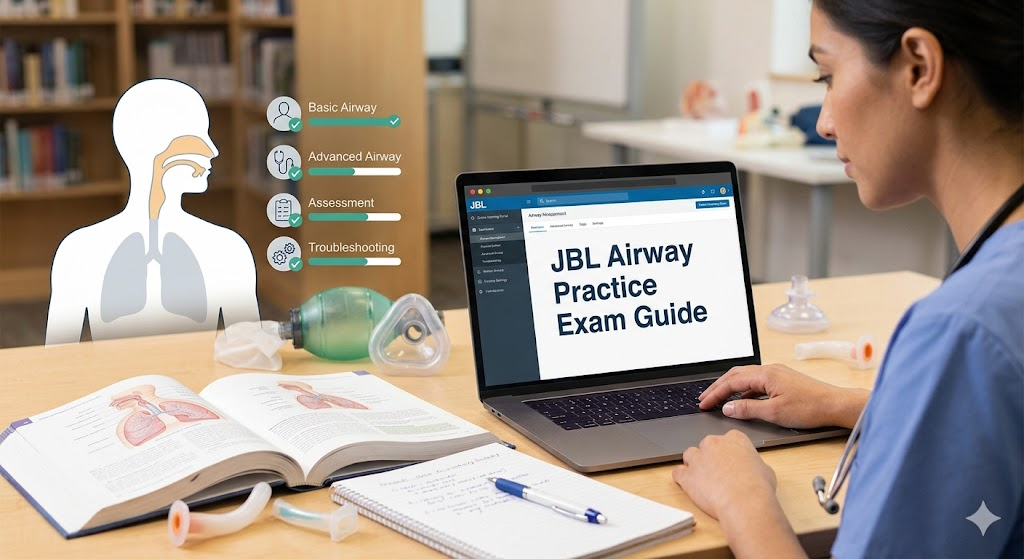
Additional Information
What the Course Entails and Exam Details
This practice test typically covers a broad spectrum of fundamental and advanced airway management topics. The underlying educational content it prepares for often includes:
Airway Anatomy and Physiology: A deep understanding of the upper and lower airway structures.
Patient Assessment: Techniques for recognizing airway distress and failure.
Basic Airway Management: Skills like opening the airway, suctioning, and utilizing basic adjuncts (Oral and Nasal Airways).
Oxygenation and Ventilation: Using devices from nasal cannulas to Bag-Valve-Mask (BVM) ventilation.
Advanced Airway Management: Principles and techniques for endotracheal intubation and the use of supraglottic devices (like the King Tube, Combitube, and LMA).
Troubleshooting and Complications: Managing difficult airways and common complications.
The practice test itself is usually accessible through an online learning platform associated with JBL course materials. It is a digital assessment tool that provides multiple-choice and potentially scenario-based questions that mirror the type and content depth of actual certification exams, allowing for focused and effective review.
What to Expect in the Final Exam
While the JBL Airway Practice Test itself is a preparatory study aid, the final, official exams it helps you prepare for (such as NREMT cognitive exams, state licensure tests, or critical care competency assessments) have distinct features you should expect:
Format: Typically standardized, computer-based multiple-choice examinations. These can sometimes be Computer-Adaptive Tests (CAT), where questions adjust to the test-taker's ability. Practical skills stations are also a component of many airway and medical certification processes, though separate from a written practice test.
Time Limits: Full certification exams are generally timed, often ranging from 1.5 to 3+ hours, depending on the complexity of the exam and the specific role (e.g., Paramedic exams generally allow more time than EMT).
Passing Score: Each certifying body sets its own passing standard. This is usually expressed as a percentage (often 70% or 75%) or a simple pass/fail based on reaching a predefined level of competency.
Specific Rules: Expect standard professional testing regulations: proctored sessions (either in-person or online, where permitted), identification requirements, and prohibitions on external study aids during the actual test.
How to Study and Exam Centers
Effective study and knowing where to take your test are essential for success:
Use JBL Materials: The practice test is most effective when used in conjunction with the official JBL textbook, online lectures, and learning modules that it is designed to reinforce.
Simulate Exam Conditions: Take the practice test in a quiet, dedicated space without distractions and within a self-imposed time limit to mimic the real exam experience.
Review Explanations: Critically review not just the correct answers, but also the detailed explanations for every question (especially those you answered incorrectly). This is where deep learning occurs.
Practice Hands-On Skills: Where possible, especially if your ultimate goal is a comprehensive airway certification, complement your written studies with hands-on practice in a simulation lab. This will enhance understanding of device use and the practical flow of airway management algorithms.
Practice Test vs. Exam Centers: Understand the difference! The JBL Airway Practice Test itself is typically accessed online through a user portal on the JBL platform, or sometimes within an accredited course environment. The final actual certification exam is taken at professional testing centers like Pearson VUE for national certifications, or at authorized physical locations determined by state boards or educational institutions. Always confirm the exact location and platform with your actual certifying body.
Job Opportunities from the Course
Successfully preparing for and achieving certifications that include airway management, often with the support of preparatory materials like the JBL test, can lead to diverse and impactful career paths:
Emergency Medical Technician (EMT): Essential first responders who rely on solid airway knowledge.
Paramedic: Advanced pre-hospital providers performing complex medical procedures, including advanced airway techniques.
Emergency Department Nurse (RN or LPN/LVN): Critical hospital roles where rapid and competent airway management is frequent.
Critical Care Nurse (RN): Providing life-saving care in intensive care units, managing unstable patients and advanced airway equipment.
Respiratory Therapist (RT): Specialists dedicated to all aspects of respiratory care, from diagnostics to managing ventilators and advanced airways.
Anesthesia Assistant/Technician: Assisting anesthesiologists with patient care and airway procedures.
Firefighter (especially in combination roles): Many fire departments require personnel to also be certified as EMTs or Paramedics.
Flight Paramedic/Nurse: Providing critical care during emergency medical transport.
Note: The specific job roles available will depend heavily on your complete educational background, full certifications, and licensure.
This study guide provides a comprehensive overview of the JBL Airway Practice Test, from its educational foundation to practical tips for success and the rewarding career opportunities that strong airway management skills can unlock. Stay professional, remain encouraged, and use this resource to its fullest potential as you pursue your goals. Good luck!
Frequently Asked Questions
Reviews
5.0
Based on 0 reviews
Leave a Review
No reviews yet. Be the first to review!