
JEE Main Integration Practice Test
$69.00
- Buy to unlock unlimited access to all Quiz questions and Answers in this Quiz.
- After purchase you can print a PDF of the whole quiz at any point. The PDF will contain the questions and the correct answers.
About this Exam
The JEE Main Integration Practice Exam is a specialized resource designed specifically for students preparing for the challenging mathematics section of the Joint Entrance Examination (JEE) Main in India. This comprehensive practice test focuses exclusively on Integration, a critical sub-topic within Calculus. A strong grasp of integration is fundamental for success in the engineering entrance exam. This practice test is designed to evaluate understanding, identify weak areas, and build speed and accuracy in solving integration problems. It is an invaluable tool for aspiring engineers aiming to secure top ranks in the JEE Main, giving them a detailed preview of the level and types of integration questions common in the actual exam.
Ready to test your knowledge?
Buy Now to Access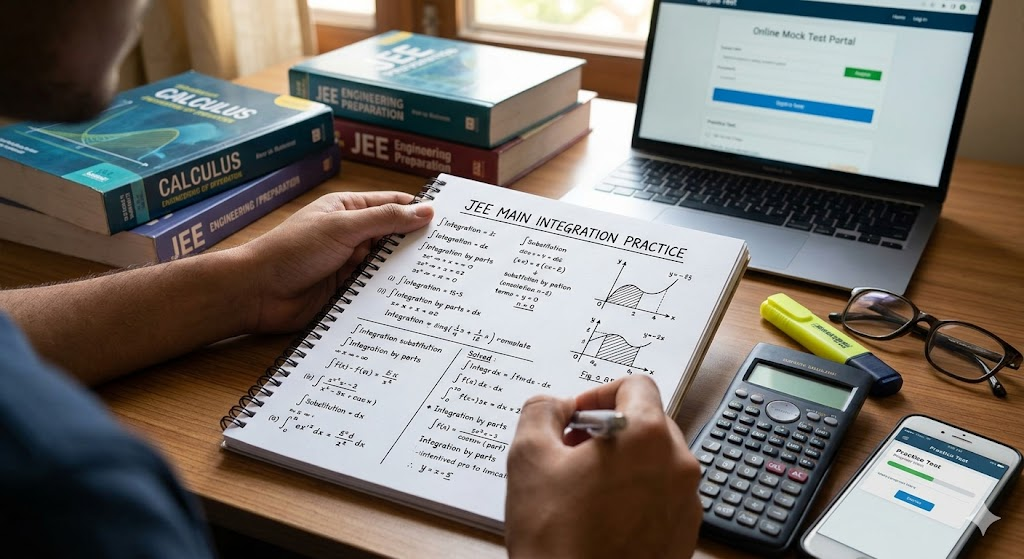
Additional Information
What the Course Entails and Exam Details
This practice test delves deep into the core concepts and applications of Integral Calculus as outlined in the official JEE Main Mathematics syllabus. It rigorously covers a wide array of topics, including:
Indefinite Integrals: Mastering standard integration formulas for various algebraic, trigonometric, exponential, and logarithmic functions.
Integration Techniques: Evaluation of integrals using standard methods such as substitution, integration by parts, integration of rational functions using partial fractions, and integration of irrational and trigonometric functions.
Definite Integrals: Understanding the fundamental theorem of calculus and its applications.
Properties of Definite Integrals: Applying specific properties of definite integrals to solve complex problems efficiently, including problems involving periodic functions and evaluation as limits of sums.
Applications of Definite Integrals: Calculating area bounded by curves, using integration techniques to determine the area under simple curves, especially lines, circles/parabolas/ellipses (in standard forms), and the area between two curves.
The practice test is designed to replicate the style and difficulty of questions asked in the JEE Main, providing a comprehensive assessment of a student’s preparation in this specific area.
What to Expect in the Final Exam
While not an official government exam, this practice test simulates the experience and style of the JEE Main section dedicated to integration. Students can typically expect the following:
Format: The test usually consists of multiple-choice questions (MCQs) and numerical value questions, similar to the format of the mathematics portion of the real JEE Main.
Scoring: Standard marking schemes apply, replicating the actual exam's structure where correct answers are rewarded, and incorrect MCQs may involve negative marking. The practice test aims to provide an estimated score to benchmark readiness.
Time Limits: It is often a timed assessment, encouraging students to manage their time effectively across integration problems.
Content: Questions will range from basic formula applications to multi-step problems requiring deep conceptual understanding and application of multiple techniques simultaneously. Problems often integrate multiple mathematical concepts.
The goal is to prepare students to tackle diverse integration problems with confidence and precision within the time constraints of the actual engineering entrance exam.
How to Study and Exam Centers
Successfully conquering integration in the JEE Main requires dedicated effort and consistent practice. Effective study strategies include:
Solidify Fundamentals: Begin with a strong understanding of all standard integral formulas and concepts from NCERT and other preparatory material.
Master Techniques: Deeply learn various integration methods—substitution, integration by parts, partial fractions—and practice applying them to numerous diverse problems.
Previous Year Problems: Extensively solve past JEE Main and Advanced problems specifically focusing on integration. This familiarizes you with the question patterns and difficulty levels.
Practice Mock Tests: Regularly taking specialized practice tests like this one and full-length mathematics sectionals helps develop speed and accuracy.
Review Mistakes: Analyze incorrect answers and understand the errors in concept or calculation to prevent repeating them.
As a specialized practice test, it is typically taken via online portals and educational platforms specializing in competitive exam preparation for engineering entrances. Coaching institutes may also offer physical mock tests on their premises or through their digital platforms. These practice resources are accessible through authorized online assessment tools.
Job Opportunities from the Course
A high score on the JEE Main, supported by mastery in critical areas like integration, is the gateway to admission into premier engineering institutions in India. A successful engineering degree unlocks numerous prestigious career opportunities. Some specific paths and titles open to engineering graduates through successful performance in JEE Main include:
Software Engineer/Developer
Civil Engineer
Mechanical Engineer
Electrical Engineer
Electronics and Communication Engineer
Chemical Engineer
Aerospace Engineer
Automotive Engineer
Computer Systems Analyst
Robotics Engineer
Data Scientist
VLSI Design Engineer
Telecommunications Engineer
Environmental Engineer
Nuclear Engineer
Petroleum Engineer
Project Manager (Engineering)
Research and Development Engineer
Manufacturing Engineer
Quality Assurance Engineer
Securing a top rank in JEE Main opens doors to these and many other specialized engineering fields, both in India and globally.
Frequently Asked Questions
Reviews
5.0
Based on 0 reviews
Leave a Review
No reviews yet. Be the first to review!