
Jeppesen Private Pilot Stage I Practice Exam
$69.00
- Buy to unlock unlimited access to all Quiz questions and Answers in this Quiz.
- After purchase you can print a PDF of the whole quiz at any point. The PDF will contain the questions and the correct answers.
About this Exam
The Jeppesen Private Pilot Stage I Practice Exam is an essential tool for student pilots enrolled in a Jeppesen-based flight training curriculum. This guide is specifically designed to help students prepare for their first major ground school milestone: the Stage I Final Exam. The initial phase of pilot training focuses on the foundational knowledge required for safe and efficient flight. This exam is ideal for anyone embarking on their journey to becoming a certified private pilot, providing a realistic assessment of their understanding before they sit for the official computerized test that permits them to advance to Stage II of their training.
Ready to test your knowledge?
Buy Now to Access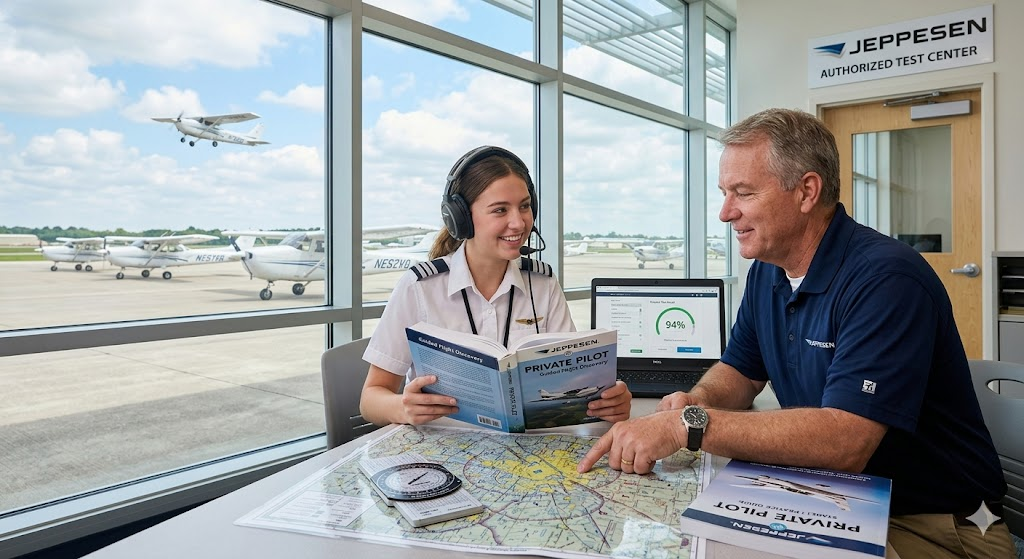
Additional Information
What the Course Entails and Exam Details
The Jeppesen Private Pilot Stage I course, also known as the Ground School portion of the first stage of flight training, introduces the fundamental concepts of aviation. It covers a broad syllabus from Jeppesen's Guided Flight Discovery (GFD) system, a comprehensive approach integrating textbooks, videos, and online resources. The material is meticulously structured to build a safe and proficient pilot from the ground up.
The core topics and detailed exam syllabus for Stage I typically include:
Airplane Systems: In-depth knowledge of the powerplant (engine, fuel, oil, electrical systems, propeller) and flight instruments (pitot-static and gyroscopic systems).
Aerodynamic Principles: Understanding the four forces of flight, stability, maneuvering, load factor, stalls, and spins.
The Flight Environment: Safety considerations, right-of-way rules, minimum safe altitudes, airport markings, lighting, aeronautical charts, and airspace classification.
Communication and Flight Information: Proper use of the radio, radar services (including transponder operations), and critical sources of information like the Aeronautical Information Manual (AIM) and advisory circulars.
What to Expect in the Final Exam
While the practice exam helps build confidence, knowing what to expect in the actual Stage I Final Exam is crucial for success. The final exam, which is a computerized test taken at your flight school, will determine your readiness to proceed.
Here are the standard expectations for the Jeppesen Private Pilot Stage I Final Exam:
Format: The exam consists of multiple-choice questions. These questions are designed to test not just rote memorization but your application of knowledge to real-world flight scenarios.
Time Limits: It is a timed test, requiring students to demonstrate proficiency under time constraints, similar to the official FAA Knowledge Test. The exact time may vary by institution but is generally around one hour.
Passing Score: Students must achieve a minimum score of 80% to pass and progress to Stage II. Scoring below this requires further study and a re-test.
Rules: Standard testing conditions apply. You must complete the test independently, though your instructor will review all incorrect answers with you to ensure a complete understanding before you continue your training.
How to Study and Exam Centers
Effective preparation is key to conquering the Jeppesen Private Pilot Stage I exam. Students should adopt a multi-faceted study strategy to ensure comprehensive knowledge and practical application.
Here are actionable study strategies:
Utilize the Jeppesen Ecosystem: Your primary resource is the Jeppesen GFD Private Pilot Textbook. Accompany this with the GFD video series, which follows the syllabus exactly, and the online test preparation (such as JeppPrep or FliteSchool software).
Take Practice Exams: Dedicate regular time to taking multiple practice exams. The purpose is to identify your weak areas, get familiar with the wording of FAA-style questions, and improve your speed and accuracy.
Instructor Reviews: Never skip the review process. After every practice session or chapter quiz, analyze your wrong answers. Use this as a learning opportunity with your flight instructor to clarify concepts.
Create Flashcards and Study Groups: Group study and self-testing with flashcards for key acronyms, regulations, and instrument readings can reinforce memory and accelerate learning.
Where and how to take the exam:
The Jeppesen Private Pilot Stage I Final Exam is not a national exam taken at a dedicated facility like Pearson VUE; rather, it is a course completion milestone. It is administered directly at authorized flight schools that use the Jeppesen Private Pilot Syllabus (which is approved by the FAA under Part 141 and often Part 61). You will take the computerized test on site, and your results will be recorded in your training record. Speak with your Chief Flight Instructor or school administrator to schedule your exam once you have completed all Ground Lessons for Stage I.
Job Opportunities from the Course
A Private Pilot License (PPL) is the foundational step towards a career in aviation. While the PPL itself does not allow you to fly for compensation (which requires a Commercial Pilot License and usually an Instrument Rating), it unlocks a range of exciting pathways and professional roles that you can eventually pursue. Consider this exam your passport to a wide world of aviation careers.
Here is a list of job titles and career paths this certification unlocks (with additional advanced training):
Recreational Pilot
Certified Flight Instructor (CFI) – after obtaining Commercial License
Corporate/Business Pilot – after obtaining Commercial License
Charter Pilot (Part 135) – after obtaining Commercial License
Cargo Pilot – after obtaining Commercial License
Airline Pilot (Part 121) – after obtaining Airline Transport Pilot (ATP) Certificate
Agricultural Pilot (Crop Dusting/Application)
Aerial Survey/Mapping Pilot
Law Enforcement Pilot (Police/Border Patrol)
Search and Rescue Pilot
Firefighting Pilot
Air Ambulance/Medevac Pilot
Volunteer Pilot (e.g., Angel Flight)
Glider Tow Pilot – requires endorsement and minimum hours
Personal and Executive Transport
Frequently Asked Questions
Reviews
5.0
Based on 0 reviews
Leave a Review
No reviews yet. Be the first to review!