
JFHMS Quality Assurance Practice Exam
$69.00
- Buy to unlock unlimited access to all Quiz questions and Answers in this Quiz.
- After purchase you can print a PDF of the whole quiz at any point. The PDF will contain the questions and the correct answers.
About this Exam
The JFHMS Quality Assurance certification is an essential milestone for students, primarily designed to validate foundational knowledge in quality management principles. This course and exam are tailor-made for individuals aspiring to enter fields like manufacturing, technology, and service management, providing a crucial understanding of how organizations ensure their products and services consistently meet customer expectations. By earning this certification, students demonstrate a proactive commitment to operational excellence and a deep understanding of the systematic processes that drive quality. It serves as an impressive starting point on a career and technical education (CTE) pathway, positioning students for advanced studies and high-demand roles in an increasingly competitive global m
Ready to test your knowledge?
Buy Now to Access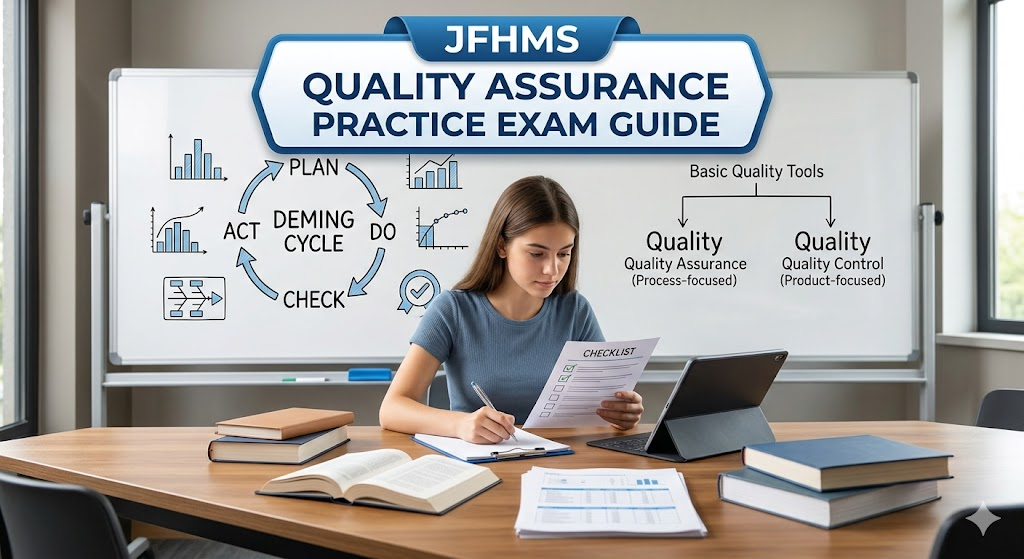
Additional Information
What the Course Entails and Exam Details
The JFHMS Quality Assurance course equips students with a comprehensive toolkit of quality management concepts, taking them from core definitions to practical application. The curriculum focuses heavily on distinguishing between Quality Assurance (QA) and Quality Control (QC), and implementing continuous improvement strategies.
Key areas of study and skills covered in the course include:
Understanding Quality: Defining quality from multiple perspectives, including product-based, user-based, and value-based dimensions.
Quality Assurance vs. Quality Control: Developing a clear, actionable understanding of the proactive process-oriented nature of QA and the reactive product-oriented nature of QC.
The Deming Cycle (PDCA): Mastering the Plan-Do-Check-Act cycle as a foundational framework for process improvement.
Continuous Improvement (Kaizen): Exploring the principles of making small, ongoing, positive changes at all levels of an organization.
Key ISO Standards: Introduction to international standards, particularly the ISO 9000 family, and their role in establishing a Quality Management System (QMS).
Core Quality Tools: Gaining familiarity with tools like histograms, Pareto charts, and cause-and-effect (fishbone) diagrams to identify and analyze problems.
The Impact of Poor Quality: Understanding the financial and reputational consequences of defects, including rework, scrap, warranty claims, and lost customer trust.
What to Expect in the Final Exam
The JFHMS Quality Assurance Final Exam is a rigorous assessment of the knowledge and skills acquired throughout the course. Students should be prepared for a comprehensive evaluation that requires both recall of factual information and the application of concepts to real-world scenarios.
Exam Format: The final exam typically consists of multiple-choice and true/false questions designed to measure understanding of terminology, principles, and specific quality tools.
Passing Score and Time Limit: To successfully earn the certification, candidates must achieve a passing score, which is generally 70% or higher, though students should confirm the exact requirement with their course instructor. The exam is typically a timed assessment, often with a duration of 60 to 90 minutes, depending on the number of questions.
Specific Rules: This is typically a closed-book examination. Students must adhere to all academic integrity policies set by JFHMS, which includes no access to external resources, notes, or unauthorized assistance during the test.
How to Study and Exam Centers
Preparation is the absolute key to success on the JFHMS Quality Assurance Final Exam. The following actionable strategies are proven methods to solidify your understanding and build confidence.
Effective Study Strategies:
Master the Difference: The most critical part of the exam is correctly distinguishing between Quality Assurance (proactive, process-focused) and Quality Control (reactive, product-focused). Create comparative charts, use flashcards for specific techniques, and quiz yourself on new examples.
Practice with Real Quizzes: Seek out multiple practice exams and quizzes. Time yourself to simulate actual exam conditions, which helps with time management.
Review Class Materials: Your core syllabus, lecture notes, and textbook are your primary resources. Review all key diagrams, including the PDCA cycle and cause-and-effect diagrams, understanding how and why they are used.
Teach Others: Explaining concepts like Kaizen, statistical process control, and ISO standards to a study partner or family member is one of the most effective ways to reveal gaps in your own knowledge.
Exam Centers and Access:
The JFHMS Quality Assurance exam is an internal assessment.
Authorized School Location: For students currently enrolled, the exam is proctored directly at J. Frank Hillyard Middle School. Specific times and locations, such as computer labs or dedicated classrooms, will be announced by the program coordinator or teacher.
Online Student Portal: In some instances, particularly for distance learning or make-up exams, the test may be administered via an authorized online educational platform. Students will receive specific login credentials and instructions on how to access and complete the exam securely from a designated environment.
Job Opportunities from the Course
A strong performance on the JFHMS Quality Assurance Practice Exam is a fantastic indicator of future success. It provides the essential foundational knowledge that unlocks a wide array of career paths and opens doors to more advanced educational opportunities in high-demand technical fields. While additional training, certifications, and experience will be necessary for senior roles, this course sets the stage for a rewarding career.
Potential Career Paths and Job Titles:
CTE Pathway to Specialization: This is the direct entry point into vocational-technical programs and advanced high school CTE courses focused on Advanced Manufacturing, Engineering Technology, and Business Management.
Quality Assurance Technician/Inspector: In manufacturing or technology, entry-level QA technicians test products, document results, and inspect materials to ensure they meet specifications.
Quality Control Analyst: QC analysts work in laboratories or on production floors, taking samples, conducting measurements, and identifying and quarantining defective products.
Production and Operations Associate: A fundamental understanding of QA principles is invaluable for every production worker, making them a more aware and effective member of any operational team.
Process Improvement Coordinator: This pathway focuses on analyzing workflows, identifying inefficiencies, and implementing Kaizen and Six Sigma methodologies to optimize production and reduce waste.
Client Services and Support Specialist: In the service industry, QA is about customer experience. Understanding dimensions of quality ensures you are equipped to measure and improve customer satisfaction.
Frequently Asked Questions
Reviews
5.0
Based on 0 reviews
Leave a Review
No reviews yet. Be the first to review!