
JFS MQF Fire Support Team (FIST) Certification Practice Exam
$69.00
- Buy to unlock unlimited access to all Quiz questions and Answers in this Quiz.
- After purchase you can print a PDF of the whole quiz at any point. The PDF will contain the questions and the correct answers.
About this Exam
The JFS MQF Fire Support Team (FIST) certification is a specialized and rigorous validation process for military personnel assigned to a Fire Support Team. It is designed to evaluate a candidate's mastery of the techniques, procedures, and coordination necessary to effectively integrate indirect fires and close air support with maneuver unit operations. This certification is critical for individuals in the 13F (Fire Support Specialist) and 13A (Field Artillery Officer) Military Occupational Specialties (MOS) within the U.S. Army, as well as their counterparts in other service branches. The goal of the JFS MQF FIST program is to ensure that every certified FIST member can provide accurate, timely, and responsive fire support on the modern, multi-domain battlefield.
Ready to test your knowledge?
Buy Now to Access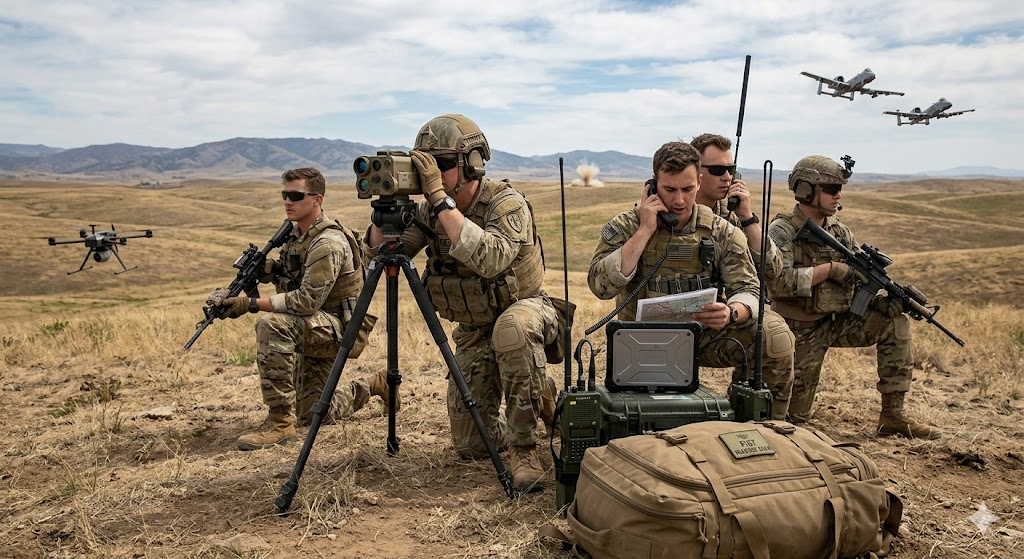
Additional Information
What the Course Entails and Exam Details
The JFS MQF FIST program covers a wide range of critical fire support skills and knowledge areas. It is deeply rooted in joint and service-specific doctrine, requiring a comprehensive understanding of:
Joint Fire Support Principles: The fundamentals of planning, coordinating, and executing fires from multiple service components (Army, Navy, Air Force, Marine Corps) to support a ground commander.
Observed Fire Techniques: Mastery of target location, identification, and the "Call for Fire" (CFF) procedure for artillery, mortars, and naval surface fire support.
Close Air Support (CAS): Procedures for requesting, controlling, and integrating fixed-wing and rotary-wing attack aircraft, including the use of Joint Terminal Attack Controller (JTAC) and Joint Fires Observer (JFO) protocols.
Target Acquisition and Communication: Proficiency with advanced targeting systems, laser designators, and the establishment and maintenance of critical communication nets.
Fire Support Coordination Measures (FSCMs): The use of permissive and restrictive measures (e.g., Coordinated Fire Line, No-Fire Area) to facilitate the rapid attack of targets while protecting friendly forces and non-combatants.
Fratricide Prevention and Situational Awareness: Techniques to maintain a clear picture of the battlefield and ensure all fires are safe and legally compliant.
The certification process involves two primary components: a comprehensive written exam based on the JFS MQF and a practical, scenario-based evaluation administered by a Fire Support Master Gunner.
What to Expect in the Final Exam
The written portion of the JFS MQF FIST certification is a high-stakes assessment that must be passed prior to practical evaluation. While the practical phase is scenario-dependent, the written exam has specific standards:
Format: The written exam consists of 50 multiple-choice questions. These questions are randomly selected from the master pool of hundreds within the JFS MQF and cover all knowledge areas outlined above.
Passing Score: The exam requires a minimum score of 80% to pass. This high threshold reflects the critical nature of the information and the zero-margin-for-error environment of fire support operations.
Time Limit: Candidates typically have 60 to 90 minutes to complete the written exam. This time limit is designed to test recall speed and efficiency.
Practical Phase: Upon successful completion of the written exam, candidates undergo a hands-on evaluation. This practical phase is scenario-based, often conducted in a virtual simulator like the Supporting Arms Virtual Trainer (SAVT) or a live field environment. It requires candidates to demonstrate their ability to plan, call for, and adjust fires under stress, while integrating various fire support assets and adhering to established FSCMs and safety procedures.
How to Study and Exam Centers
Preparation for the JFS MQF FIST certification must be comprehensive and methodical. The key to success is a deep and thorough study of the designated master question file and its underlying doctrine.
Actionable Study Strategies:
Master the MQF: Obtain a copy of the JFS MQF. While it may not contain answers, it is your definitive roadmap. Systematically research the answer to every single question, using official publications to ensure accuracy.
Study Key Doctrine: Revisit core fire support publications. Your primary focus should be on:
ATP 3-09.32: Joint Application of Firepower (JFIRE).
FM 3-09: Field Artillery Operations and Fire Support.
ATP 3-09.30: Techniques for Observed Fire.
Use Practical Simulators: Take every opportunity to use available fire support simulators. They provide invaluable, stress-free practice on the CFF procedure and CAS integration.
Form Study Groups: Collaborating with other FIST members is highly effective. You can quiz each other on MQF questions and discuss complex coordination scenarios.
Testing Procedures and Locations:
This certification is not offered through commercial test centers. It is an internal military qualification process. The written exam is administered via secure military networks at authorized schoolhouses, such as the U.S. Army Fires Center of Excellence at Fort Sill, Oklahoma, or within your assigned unit, under the direct supervision of a certified Fire Support Master Gunner. Successful completion is recorded in official military personnel files and is a requirement for key leadership and technical positions within a Fire Support Team.
Job Opportunities from the Course
A JFS MQF FIST certification is a significant milestone that unlocks a range of critical roles and sets the stage for further advanced qualifications. It validates your technical expertise and makes you a highly valued asset to any maneuver unit.
Job Opportunities and Career Paths:
Company Fire Support Officer (FSO): As a certified FSO, you will be the principal fire support advisor to a maneuver company or troop commander, responsible for planning and integrating all fires.
Fire Support NCO (FSNCO): This key role involves leading and mentoring a FIST, ensuring its operational readiness, and managing the critical communication and targeting systems.
Joint Fires Observer (JFO): The certification is a prerequisite for advanced JFO training, enabling you to provide timely and accurate targeting data to a JTAC or attack aircraft.
Forward Observer (FO): A certified FO is the 'eyes' on the battlefield, skilled in calling for fire and adjusting rounds with precision, a vital link in the fire support chain.
Fire Support Master Gunner: Success in this certification is the foundational step toward becoming a Master Gunner, the expert responsible for training, evaluating, and certifying other FIST members and advising commanders on all fire support matters.
This certification is more than just an exam; it is a key component of operational effectiveness on the multi-domain battlefield.
Frequently Asked Questions
Reviews
5.0
Based on 0 reviews
Leave a Review
No reviews yet. Be the first to review!