
JIBC Emergency Medical Responder (EMR) Practice Exam
$69.00
- Buy to unlock unlimited access to all Quiz questions and Answers in this Quiz.
- After purchase you can print a PDF of the whole quiz at any point. The PDF will contain the questions and the correct answers.
About this Exam
The Emergency Medical Responder (EMR) course at the Justice Institute of British Columbia (JIBC) is a foundational, entry-level healthcare program designed to provide students with the essential knowledge and skills required to respond to life-threatening medical conditions and traumatic emergencies. It is an intensive course that serves as a primary stepping stone for individuals aspiring to have a career in paramedicine, or for those seeking to work in other emergency response, public safety, and private industrial roles in British Columbia, Canada. The certification ensures that graduates have attained the core competencies defined by the Paramedic Association of Canada (PAC) at the EMR level, making them proficient first responders capable of providing high-quality pre-hospital care.
Ready to test your knowledge?
Buy Now to Access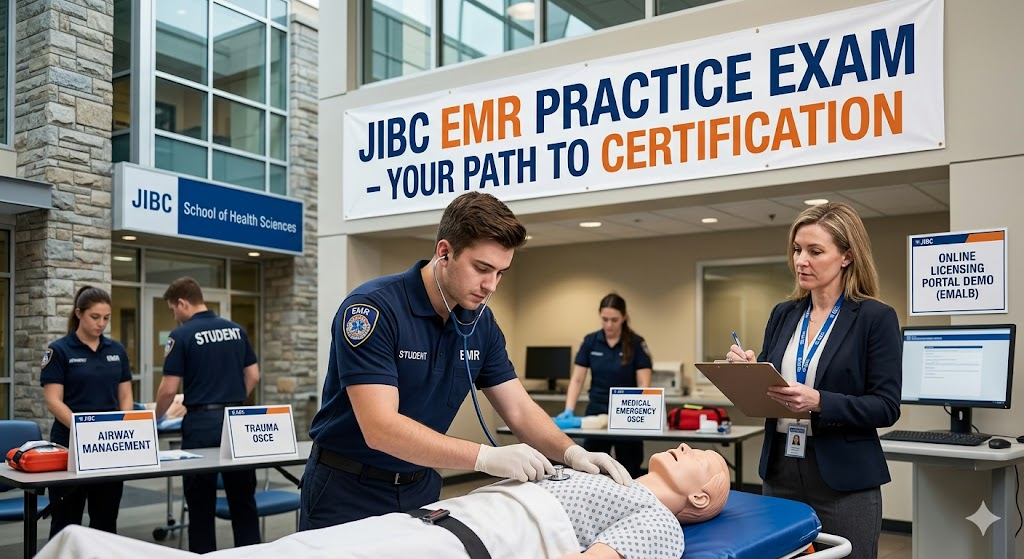
Additional Information
What the Course Entails and Exam Details
The JIBC EMR curriculum offers a comprehensive blend of theoretical knowledge and hands-on practical training. Students dive into foundational education in anatomy, physiology, pathophysiology, and pharmacology to understand the body's systems and how they respond to illness, injury, and medical interventions. The training rigorously covers current best practices in trauma life-support and follows specific patient treatment guidelines for various medical emergencies. A significant focus is placed on enhancing situational management skills, decision-making, and communication within the high-pressure context of pre-hospital care. The course structure involves a series of assessments to gauge student proficiency in both written understanding and practical skill application throughout and at the culmination of the program.
What to Expect in the Final Exam
To successfully complete the JIBC EMR program and receive your Associate Certificate, you must achieve a minimum passing grade of 72% (B) in all final evaluations.
The final examination process at JIBC is not a single test but a series of formal components designed to evaluate your readiness for real-world scenarios:
Final Comprehensive Written Exam: This is a comprehensive test that covers all theoretical aspects of the course. It is designed to test your knowledge retention and critical thinking across the entire syllabus.
Practical Objective Structured Clinical Exams (OSCEs): You will need to successfully pass five practical OSCEs. These stations will assess your ability to perform assessments and interventions under pressure, including a dedicated trauma/medical practical exam. This is where you demonstrate the integration of your knowledge and physical skills, such as performing a proper primary assessment, managing an airway, and handling a trauma patient.
Basic Life Support (BLS): You must also complete both a written and practical BLS exam.
Rules and Remedial Action:
JIBC provides a single remedial opportunity. If a student is not successful on a formal assessment, they may be given one chance to retake the test. However, the highest possible grade on any retest is capped at the minimum passing grade of 72%.
How to Study and Exam Centers
Effective preparation for the JIBC EMR exams requires a balanced approach of studying theory and refining practical skills.
Actionable Study Strategies:
Master the Assessments: Create scenarios to practice your primary and secondary patient assessments until they become second nature. Memorize the order and flow of checks to ensure you never miss a step in a chaotic environment.
Leverage Practice Questions: Utilize quiz banks to test your knowledge on a wide range of topics, from burn management and spinal injuries to interpreting vital signs and applying sample histories (SAMPLE, AVPU). Regular practice will build your testing stamina and help identify areas needing review.
Team Study and Role-Playing: Work with your fellow classmates. Practicing practical skills with peers, taking turns acting as the lead responder and the patient, is one of the most effective ways to build confidence and muscle memory for the practical OSCEs.
Review Legislation and Guidelines: Don't neglect the required reading, especially the Emergency Health Services Act and EMA Regulation. These legal and regulatory frameworks are critical knowledge for any licensed EMR in British Columbia.
Exam Centers:
It's important to understand there are two distinct phases for your exams and certification:
JIBC Course Finals: Your final comprehensive written and practical exams are typically held at the specific JIBC campus where you completed your training or at an authorized partner school location (e.g., New Westminster, Okanagan, Chilliwack, Van Island).
Provincial Licensing: Successfully passing your JIBC program is only the first step. To legally practice as an EMR in BC, you must subsequently challenge and pass the Emergency Medical Assistants Licensing Board (EMALB) examinations. This separate process includes an online Jurisprudence exam, an online Written exam (accessed through a provincial portal using a basic BCeID), and an in-person practical exam, with locations available across the province for you to choose from.
Job Opportunities from the Course
A JIBC EMR Associate Certificate opens up a diverse array of challenging and rewarding career paths, primarily focused on emergency medical services and safety.
Graduates with this certification can pursue employment in the following roles:
BC Ambulance Services: As a foundational qualification, many graduates begin their career here, often as a stepping stone.
Fire Departments: Many municipalities require or highly value EMR certification for their firefighting personnel, who are frequently first on scene.
Industrial First Aid Attendant: Work on large industrial projects, remote sites, mines, and forestry operations that require certified medical responders.
Ski Patrol and Search and Rescue: Provide critical care in outdoor and wilderness settings.
Lifeguarding: Enhanced medical training is a requirement for advanced lifeguard positions.
Private Ambulance Services: Private companies often require EMRs for patient transport and event medical cover.
Event Medical Staff: Work at concerts, festivals, and sporting events.
Remote Workplace Medical Support: Provide on-site care for companies in remote locations.
The EMR certification is a crucial first step and prerequisite for further studies, unlocking advanced training opportunities to become a Primary Care Paramedic (PCP) and eventually an Advanced Care Paramedic (ACP).
Frequently Asked Questions
Reviews
5.0
Based on 0 reviews
Leave a Review
No reviews yet. Be the first to review!