
JIBC Thoracic Trauma PCP Practice Test
$69.00
- Buy to unlock unlimited access to all Quiz questions and Answers in this Quiz.
- After purchase you can print a PDF of the whole quiz at any point. The PDF will contain the questions and the correct answers.
About this Exam
The Justice Institute of British Columbia (JIBC) Primary Care Paramedic (PCP) program is a rigorous and highly respected educational pathway for aspiring emergency medical professionals.
A critical component of this curriculum is the Thoracic Trauma module, which trains students to respond to life-threatening chest injuries.
This specific certification and its accompanying exams are designed for paramedic students, emergency medical responders, and healthcare professionals seeking to upgrade their acute trauma care skills.
Mastering this module ensures that you have the critical thinking and hands-on abilities required to save lives in high-pressure pre-hospital environments.
Ready to test your knowledge?
Buy Now to Access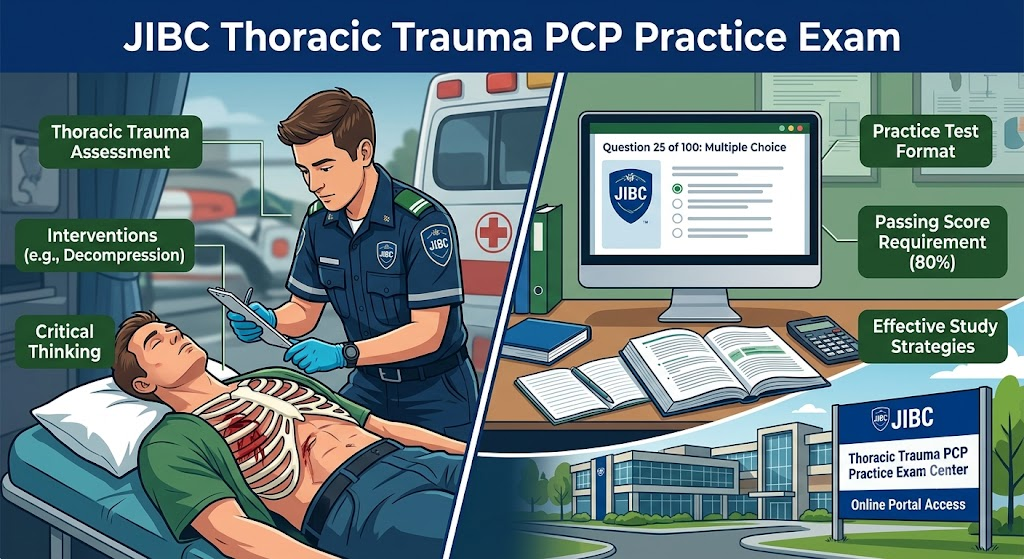
Additional Information
What the Course Entails and Exam Details
The thoracic trauma portion of the PCP program delves deep into the anatomy, physiology, and pathophysiology of the human chest cavity.
Students comprehensively cover the mechanisms of injury for both blunt and penetrating chest trauma.
The syllabus entails mastering the identification and emergency pre-hospital management of critical conditions such as tension pneumothorax, massive hemothorax, flail chest, and cardiac tamponade.
Furthermore, the course focuses on advanced airway management, oxygen therapy, and precise rapid trauma assessments.
Candidates are expected to seamlessly integrate theoretical medical knowledge with practical, protocol-driven interventions approved by provincial emergency health services.
What to Expect in the Final Exam
The final evaluation for the JIBC Thoracic Trauma module is rigorous to ensure absolute competency in the field.
Students should expect a comprehensive multiple-choice exam that tests theoretical knowledge, diagnostic reasoning, and protocol application using realistic clinical scenarios.
In addition to the written component, candidates typically undergo an Objective Structured Clinical Examination (OSCE) or practical simulation.
During the practical portion, you will be required to physically demonstrate trauma assessments and life-saving interventions on medical mannequins or simulated patients.
Time limits are strictly enforced, generally allowing one to two hours for the written test and specific minute-by-minute countdowns for practical scenarios to simulate real-world urgency.
A passing score usually requires a minimum of 75% to 80%, reflecting the high stakes and precision required in paramedic practice.
How to Study and Exam Centers
To succeed in the thoracic trauma exam, active recall and practical application are your best strategies.
Begin by thoroughly reviewing the official JIBC PCP manuals and provincial pre-hospital treatment guidelines.
Create flashcards for critical vital sign thresholds, trauma scores, and step-by-step intervention protocols.
It is highly recommended to practice your hands-on primary and secondary assessments in a simulation lab with peers to build muscle memory for the practical portion.
For the written test, utilizing a targeted practice exam will help you familiarize yourself with the complex question formats and identify any knowledge gaps before test day.
Written exams are frequently administered through authorized online learning portals like Blackboard, often requiring secure proctoring software.
Practical evaluations and in-person written exams are conducted at official JIBC campuses, such as the New Westminster, Victoria, or Kelowna locations, as well as through authorized regional training centers.
Job Opportunities from the Course
Successfully completing the thoracic trauma module and the overarching JIBC PCP program opens the door to a rewarding and dynamic career in emergency medicine.
As a fully certified professional, you can pursue a role as a Primary Care Paramedic for provincial ambulance services, responding directly to 911 medical emergencies in your community.
You will also be highly qualified for lucrative positions as an Industrial Paramedic or Remote Medical Technician, providing essential emergency care on oil and gas rigs, mining sites, and large-scale forestry or construction projects.
Additionally, this certification creates pathways to work as an Emergency Room Technician or Clinical Assistant within hospital settings, directly assisting nurses and physicians with incoming trauma patients.
Finally, for those who wish to advance their scope of practice, this foundational training serves as the mandatory stepping stone toward becoming an Advanced Care Paramedic (ACP) or an emergency medical educator.
Frequently Asked Questions
Reviews
5.0
Based on 0 reviews
Leave a Review
No reviews yet. Be the first to review!