
JLAB Decision Making Practice Test
$69.00
- Buy to unlock unlimited access to all Quiz questions and Answers in this Quiz.
- After purchase you can print a PDF of the whole quiz at any point. The PDF will contain the questions and the correct answers.
About this Exam
The JROTC Leadership and Academic Bowl (JLAB) is a premier national competition designed specifically for high school cadets in the Junior Reserve Officers' Training Corps (JROTC). While JLAB has an academic component, the "Decision Making Practice Test" typically refers to the dedicated resources for the JLAB Leadership Bowl. This initiative is not a standalone certification but a vital training tool. It is designed to prepare cadets from all service branches (Army, Navy, Air Force, Marines, Coast Guard) for the rigorous, scenario-based challenges they will face in the official JLAB competition. The program seeks to develop cadets' critical thinking, ethical reasoning, and teamwork skills through practical application of leadership principles.
Ready to test your knowledge?
Buy Now to Access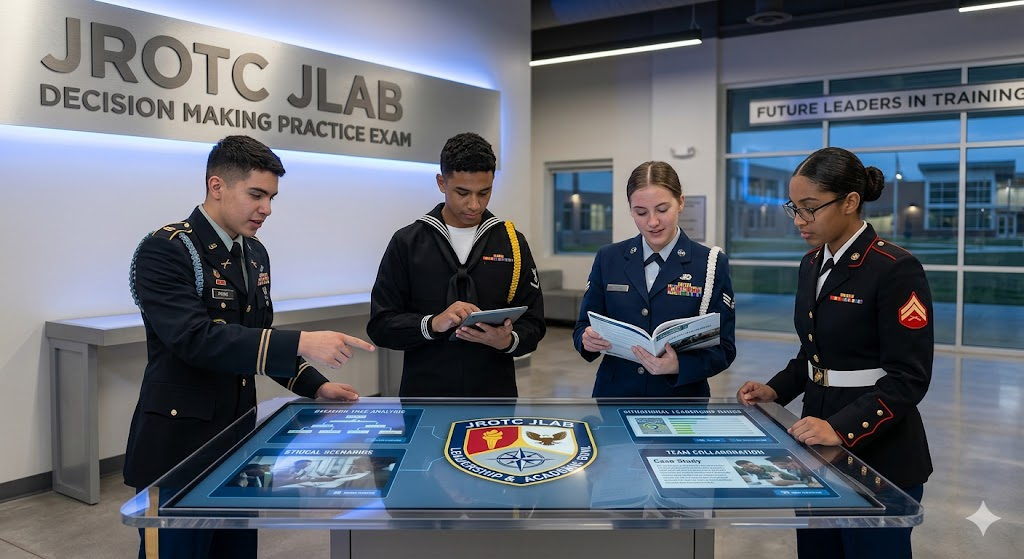
Additional Information
What the Course Entails and Exam Details
The final JLAB Leadership Bowl competition does not adhere to a simple syllabus but tests a comprehensive set of leadership competencies. The practice test materials mirror these core areas, focusing heavily on the practical application of the JROTC curriculum.
Key topics covered include:
JROTC Curriculum: Mastery of the specific leadership and citizenship materials taught within each branch's program (e.g., LET levels in Army JROTC).
Leadership Theory: Understanding foundational leadership concepts, styles, and traits.
Ethical Decision Making: Analyzing complex scenarios to make morally sound and effective decisions under pressure.
Scenario-Based Problem Solving: Reacting to dynamic, hypothetical situations that test a leader's ability to provide purpose, direction, and motivation.
Character Development: Application of core values, selfless service, and integrity.
Specific Leadership Frameworks: Familiarity with tools commonly used in JROTC, such as the "Winning Colors" personality framework.
Teamwork and Communication: Demonstrating the ability to lead and collaborate effectively within a small unit.
The final JLAB competition itself is a multi-level event. Level I and Level II are online, team-based qualifying rounds held regionally. The top-performing teams are then invited to the national championship, which is an in-person, multi-day competition.
What to Expect in the Final Exam
While the practice test is a simulated environment with varying formats, the final JLAB Leadership Bowl in-person competition is a high-stakes, interactive experience. It is not a standard multiple-choice test.
Cadets should expect the following format at the National Championship:
Hands-on Leadership Gauntlet: Teams rotate through timed stations, each presenting a unique leadership challenge.
Scenario-Based Challenges: Cadets are presented with complex, realistic scenarios requiring immediate analysis and action. These test situational awareness and the ability to make rapid, sound decisions.
Leader Reaction Course (LRC): A series of physical and mental obstacles that require teamwork, problem-solving, and decisive leadership to overcome.
Oral Presentations and Q&A: Teams may be required to brief their solutions to a panel of judges, explaining their decision-making process and rationale.
Interactive Tasks: Specific challenges designed to test a cadet's ability to apply JROTC knowledge in a collaborative, practical setting.
Scoring is objective and comprehensive, with judges evaluating teams on their application of leadership principles, teamwork, critical thinking, ethical reasoning, and the quality of their solutions. The final event is highly structured and does not allow for external resources.
How to Study and Exam Centers
Preparation for the JLAB Leadership Bowl requires a shift from passive studying to active, scenario-based practice.
How to Study:
Review Core JROTC Material: Solidify your understanding of leadership, ethics, and citizenship principles from your specific service branch’s curriculum.
Utilize the Official Practice Portal: Access the official JLAB practice and competition portal (cofcontests.com) for official practice tests and materials.
Form a Study Team: Practice as a unit. Create scenario-based role-playing exercises, challenging your team members to make decisions under pressure.
Solve Ethical Dilemmas: Find or create case studies involving complex moral challenges. Discuss as a group how to apply core values to resolve them.
Study Leadership Models: Deepen your understanding of frameworks like "Winning Colors" to improve self-awareness and team dynamics.
Practice Active Listening and Briefing: Develop the ability to listen critically and articulate decision-making processes clearly.
Practice on Unofficial Platforms: Use student-created practice quizzes on platforms like Wayground to review general JROTC knowledge and terminology.
Exam Centers:
Because the "Decision Making Practice Test" is a training component for an official competition, there is a clear distinction between where practice and official rounds occur.
Practice Tests: All unofficial and official practice tests for the JLAB Leadership Bowl are administered online. Students can access these through the official JLAB competition portal, or through unofficial study tools at school or home.
Official Competition (Level I & II): These regional qualifying rounds are online, timed tests taken as a team at the cadets' high school, under the supervision of their JROTC instructors.
Official Competition (National Championship - Level III): The final, in-person championship is held at a specific national location, typically in Washington, D.C., and requires the qualifying team to travel to the all-expenses-paid event.
Job Opportunities from the Course
Success in the JLAB Leadership Bowl does not grant a specific license or certification but provides a prestigious and highly recognized distinction that unlocks significant career and educational pathways.
The dedication to leadership and decision-making training prepares cadets for:
Military Officer Corps: Success in JLAB is highly valued for cadets seeking entrance to the U.S. Service Academies (e.g., West Point, Annapolis) or applying for high-tier ROTC scholarships at universities.
Military Enlistment: Demonstrating superior leadership skills provides a competitive edge for advanced training and accelerated promotion opportunities within the enlisted ranks of any service branch.
Federal Government: The structured decision-making and ethical training align well with careers in federal agencies like the Department of Defense, Homeland Security, or law enforcement (FBI, DEA).
Corporate Leadership Programs: Many large corporations actively recruit individuals with proven leadership experience for management training programs.
Emergency Services Leadership: The ability to make high-pressure decisions is critical for leadership roles in fire and rescue, emergency management, and law enforcement.
Strategic and Project Management: Success in JLAB translates directly into skills needed for project lead and strategic planning roles in diverse business sectors.
Public Policy and Administration: The ethical reasoning and problem-solving skills prepare individuals for leadership roles in non-profits or government administration.
Frequently Asked Questions
Reviews
5.0
Based on 0 reviews
Leave a Review
No reviews yet. Be the first to review!