
Joinder and Supplemental Jurisdiction Practice Test
$69.00
- Buy to unlock unlimited access to all Quiz questions and Answers in this Quiz.
- After purchase you can print a PDF of the whole quiz at any point. The PDF will contain the questions and the correct answers.
About this Exam
Mastering the complex rules of adding parties and claims to a lawsuit is a cornerstone of Civil Procedure. The Joinder and Supplemental Jurisdiction Practice Test is a specialized, comprehensive assessment tool designed for law students and Bar exam candidates. It targets the intricate dynamics between the Federal Rules of Civil Procedure (FRCP) and federal statutory requirements for subject matter jurisdiction. This practice test is ideal for anyone seeking to solidify their understanding of Rules 13, 14, 18, 19, 20, 24, and 28 U.S.C. § 1367. It provides an excellent diagnostic to measure readiness for law school finals or the Multistate Bar Examination (MBE). By using this tool, students can identify critical gaps in their knowledge before sitting for their high-stakes exams.
Ready to test your knowledge?
Buy Now to Access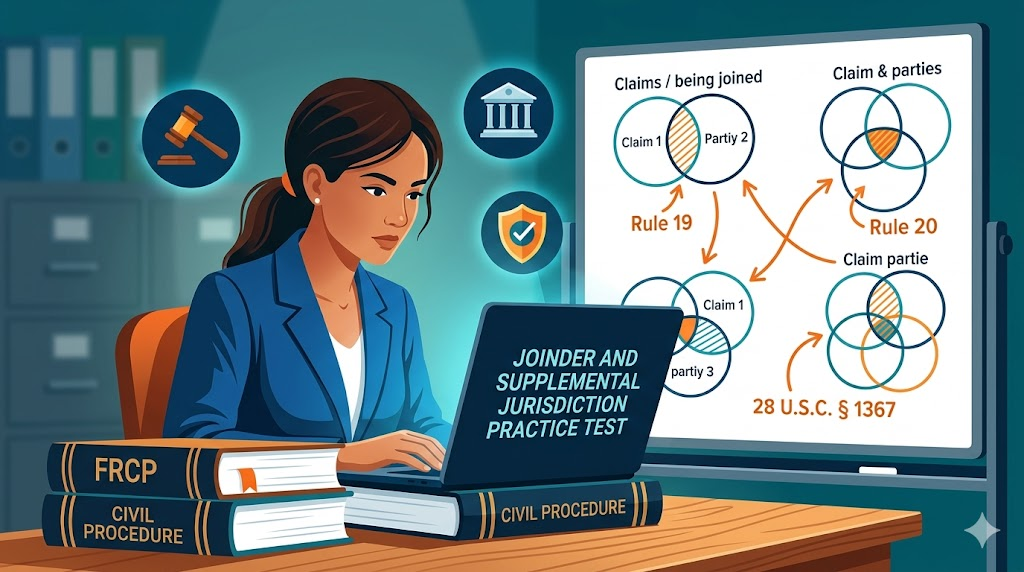
Additional Information
What the Course Entails and Exam Details
This practice test focuses heavily on detailed analytical skills and the precise application of legal rules to hypotheticals. It forces students to navigate multiple parties, conflicting claims, and jurisdictional limitations simultaneously. The core syllabus covered by this examination includes critical Civil Procedure mechanisms. You will face questions on joinder of claims (Rule 18), permissive and compulsory joinder of parties (Rules 19 and 20), counterclaims and cross-claims (Rule 13), third-party practice or impleader (Rule 14), and intervention (Rule 24). Additionally, a major portion of the test evaluates mastery of Supplemental Jurisdiction (28 U.S.C. § 1367). This requires examining the "common nucleus of operative fact" analysis and the specific statutory exceptions that apply in diversity cases.
What to Expect in the Final Exam
While actual law school and Bar exams vary, this specific practice test simulation focuses heavily on complex hypothetical analysis. You can expect a format consisting primarily of multiple-choice questions designed in the MBE style. A standard session usually features 25 to 50 questions that are heavy on "fact patterns" and logical deduction rather than simple rote memorization. The focus is purely on accuracy and analytical speed. While this is a study tool, you should treat it as a formal evaluation; aiming for a minimum score of 75-80% correct is a strong indicator of readiness for official legal exams. Instant digital feedback is often provided, explaining why certain options are correct and others are distractors.
How to Study and Exam Centers
Effective preparation for this topic requires active learning and strategic practice rather than passive reading. Do not just study the rules in isolation; you must apply them repeatedly. Start by creating visual charts that differentiate when joinder is "permissive" (may) versus "necessary" (must) and map out the exact three-step analysis required by 28 U.S.C. § 1367. Take this practice test under strict timed conditions to simulate the pressure of the Bar Exam and build essential analytical stamina. After completion, rigorously review every answer explanation, ensuring you understand the procedural interactions and jurisdictional bars at play in both your correct and incorrect answers.
Regarding exam centers, this is an online practice evaluation. It is readily accessible through various online legal education portals, law school library resources, and specialized bar preparation platforms. You can take this test anytime, anywhere with a stable internet connection, on your own computer. It is designed to be a flexible and immediate self-assessment tool.
Job Opportunities from the Course
Fluency in complex Civil Procedure—specifically joinder and supplemental jurisdiction—is not just an academic requirement; it is a fundamental skill used daily by practicing litigators. Excelling on this practice test demonstrates mastery of high-level procedural strategy that is critical in large-scale litigation. Achieving top grades in this subject areas directly correlates to high performance on the Bar Exam, which is the primary gateway to legal practice. Careers where a deep understanding of these rules is vital include:
Associate Attorney at a civil litigation law firm. Federal Law Clerk (State or Federal). Paralegal or Litigation Specialist in a complex commercial litigation practice. Class Action Administrator. e-Discovery Project Manager. Earning a strong score on assessments like this helps prove your readiness for the rigors of modern legal practice in a specialized field.
Frequently Asked Questions
Reviews
5.0
Based on 0 reviews
Leave a Review
No reviews yet. Be the first to review!