
Joint Air Operations Planning Course (JAOPC) Practice Exam
$69.00
- Buy to unlock unlimited access to all Quiz questions and Answers in this Quiz.
- After purchase you can print a PDF of the whole quiz at any point. The PDF will contain the questions and the correct answers.
About this Exam
The Joint Air Operations Planning Course (JAOPC) is a premier educational program designed to prepare military officers and select civilians for critical roles within a Joint Force Air Component Commander's (JFACC) staff. This intensive course equips participants with the conceptual framework and practical skills needed to orchestrate airpower at the operational level of war. It is primarily designed for mid-grade officers (typically O-3 through O-5) and their civilian counterparts who are assigned to or are projected to serve in positions responsible for planning, coordinating, and assessing joint air operations. The JAOPC graduation signifies a student's ability to contribute effectively to the development and execution of the Joint Air Operations Plan (JAOP) within a complex, multi-domain joint campaign.
Ready to test your knowledge?
Buy Now to Access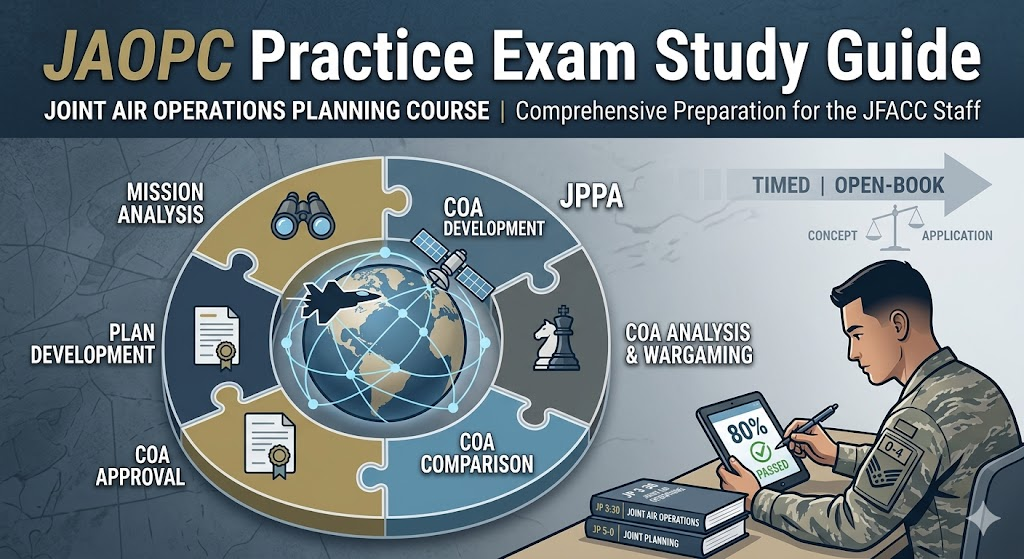
Additional Information
What the Course Entails and Exam Details
The comprehensive JAOPC curriculum is meticulously structured to provide an in-depth understanding of the processes and doctrine that govern joint air operations. The core syllabus includes, but is not limited to, the following key pillars:
1. Air Component Planning Fundamentals: Understanding the principles of war, operational art, and the contributions of airpower to achieving strategic and operational objectives.
2. The Joint Planning Process for Air (JPPA): A thorough immersion in the six-phase process for developing a JAOP. This includes Mission Analysis, Course of Action (COA) Development, COA Analysis and Wargaming, COA Comparison, COA Approval, and Plan Development.
3. Operational Design: Utilizing operational design methodologies to frame complex problems, define desired end states, and develop an operational approach.
4. Joint Doctrine: In-depth study of relevant Joint Publications, specifically JP 3-30, Joint Air Operations, and JP 5-0, Joint Planning.
5. JAOP Development: The practical application of JPPA and operational design to produce a comprehensive Joint Air Operations Plan, including the creation of Air Operations Directives (AOD), and understanding the formulation of Master Air Attack Plans (MAAP) and Air Tasking Orders (ATO).
The final examination is a culminating assessment that tests a student's mastery of these integrated concepts, demanding both theoretical knowledge and the ability to apply it to realistic scenarios.
What to Expect in the Final Exam
The final evaluation for the JAOPC is a rigorous test designed to ensure graduates possess the necessary competencies to function in high-pressure planning environments.
Format: The exam typically utilizes a timed, open-book format. This structure mirrors real-world planning scenarios where planners have access to doctrine and resources but must be efficient in their application. Question types are primarily multiple-choice and conceptual-based, focusing on the interpretation and application of doctrine rather than rote memorization.
Evaluation: Beyond the final exam, the course uses a multifaceted approach to evaluation. Students must achieve a score of 80% or better on the final exam to pass the course. In addition to the final exam, students must successfully complete and pass all required course deliverables, including briefings (e.g., Mission Analysis, COA Decision briefs), papers, and daily formative quizzes.
Rule: As an open-book exam, students are permitted to reference course materials and joint doctrine during the test, emphasizing the importance of efficient information retrieval and synthesis.
How to Study and Exam Centers
Preparation for the JAOPC and its practice exam requires a dedicated and multifaceted approach. Active participation and engagement throughout the course are paramount.
Actionable Study Strategies:
Master the Reading: Students must complete all assigned daily readings, particularly the core Joint Publications (JP 3-30 and JP 5-0), prior to lectures. Reviewing lesson objectives before reading provides necessary context.
Engage in Workshops: The workshops are where theory is put into practice. Active participation in syndicate exercises and discussions is vital for deepening comprehension.
Practice with Purpose: Take advantage of daily self-paced quizzes. These are excellent diagnostic tools to identify areas of weakness early.
Create the Deliverables: Approach the development of briefs and papers not just as pass/fail requirements but as essential practice for applying the planning process.
Use Practice Exams: While there is no official, publicly available practice exam, utilizing commercially developed "JAOPC Practice Exam" resources can help familiarize you with the types of questions and the time pressure of the final test. When using these, focus on why the correct answer is correct according to doctrine.
Exam Centers:
The JAOPC final exam is integrated into the course itself. Official courses are conducted at specific military educational institutions, such as the Air University (Maxwell AFB, AL), or through authorized mobile training teams and partner international defense schools. The final exam is administered through the course's designated learning management system (e.g., Microsoft Teams or a custom portal). Students must be officially enrolled in a JAOPC session to take the final exam.
Job Opportunities from the Course
A JAOPC certification is a significant differentiator that opens doors to prestigious and high-impact planning roles within the joint and combined operations community.
Joint Air Operations Planner
Theater Air Operations Specialist
Staff Officer (within an AOPG or JFACC HQ)
Combatant Command (CCMD) Planner
Joint Force Headquarters (JFHQ) Air Planner
Multi-National Operations Planner
Defense Contractor specializing in operational planning
Frequently Asked Questions
Reviews
5.0
Based on 0 reviews
Leave a Review
No reviews yet. Be the first to review!