
Joint Biological Point Detection System (JBPDS) Practice Test
$69.00
- Buy to unlock unlimited access to all Quiz questions and Answers in this Quiz.
- After purchase you can print a PDF of the whole quiz at any point. The PDF will contain the questions and the correct answers.
About this Exam
The Joint Biological Point Detection System (JBPDS) Practice Exam is an essential tool designed to help personnel prepare for operational qualification on the military's premier biological agent detection system. The JBPDS is a robust, automated instrument suite that provides detect-to-treat biological agent point detection, identification, and sampling capability across various operational environments, from vehicle-mounted shelters to shipboard and shore facilities. This practice exam is specifically created for military operators, Chemical, Biological, Radiological, and Nuclear (CBRN) specialists, and defense contractors who will be tasked with installing, operating, maintaining, and responding to a biological threat using this critical piece of equipment. Mastering the content within this practice exam ensures a high level of readiness and confidence for final operational evaluations.
Ready to test your knowledge?
Buy Now to Access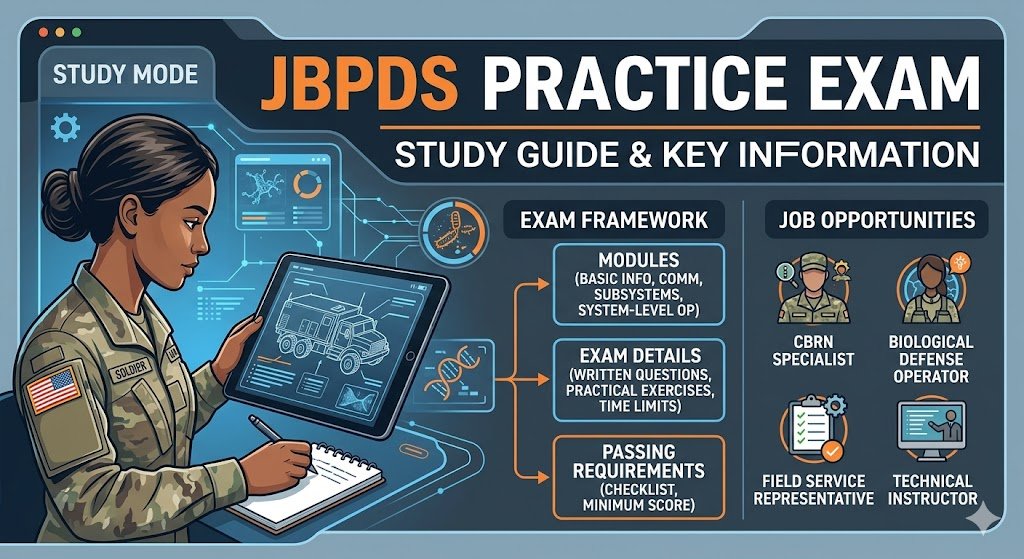
Additional Information
What the Course Entails and Exam Details
This practice exam serves as a comprehensive simulation of the official certification process, which is typically rooted in a modular course. The corresponding coursework trains personnel in all facets of the JBPDS M31A2. Core areas covered include:
System Basics and General Subjects: Introduction to the BIDS (Biological Integrated Detection System) and foundational principles of JBPDS operation.
Communications Equipment: Mastery of standard communication systems used to convey threat information and system status.
Subsystem Operations: Detailed understanding of the individual components that make up the biological suite, including the collector, fluid transfer system, and identifier.
System-Level Operation: Integrated training on how the JBPDS functions as a single, cohesive unit, from trigger and detection (via laser-induced fluorescence and RAAD upgrade) to confirmation and sampling.
Practical Field Drills: Application of knowledge in tactical setups, biological surveillance, and breakdown procedures in a cumulative training environment.
What to Expect in the Final Exam
While the exact structure can vary based on your branch or command, a standard JBPDS qualification assessment is often two-pronged, requiring demonstrated knowledge and hands-on proficiency. In this practice exam and the final evaluation, you should expect:
Exam Format: A combination of multiple-choice and scenario-based questions to test theoretical knowledge of system specifications, procedures, and troubleshooting. The ultimate standard for operational proficiency is typically a hands-on Practical Exercise (PE), where you must perform a set of crew drills and tasks under the supervision of an evaluator.
Passing Score Requirements: Candidates must often achieve a high standard, typically defined by successfully performing all critical tasks in a PE with a non-negotiable checklist and scoring a minimum of 80% on written components.
Time Limits: You will face strict time constraints during both parts of the assessment, reflecting the rapid response needed in real-world CBRN environments.
Specific Rules: Operational exams are strictly governed by specific technical manuals and procedures (e.g., MIL-STD-810), and all operations must be completed exactly as trained.
How to Study and Exam Centers
Effective preparation for the JBPDS assessment requires a blended approach. Utilize the following actionable strategies to maximize your success:
Deep Dive into Technical Manuals: Your primary resources are the official system technical manuals (TMs) and standard operating procedures (SOPs). Create detailed flashcards for acronyms, fault codes, and maintenance schedules.
Utilize the Practice Exam and Simulations: Repeatedly take this practice exam to identify weak points. If available, use software simulations that mimic the JBPDS interface and operational scenarios.
Conduct Hands-On Crew Drills: The importance of "muscle memory" cannot be overstated. With your team, practice tactical setup, breakdown, and emergency sample evacuation procedures until they become automatic.
Engage with Instructors and Mentors: Don't hesitate to ask questions. Experienced operators can provide invaluable tips and shortcuts that are not in the manuals.
Maintain a Study Schedule: The volume of technical information can be overwhelming. Set a consistent, disciplined study plan that breaks down the material into manageable modules.
Taking the Exam: Since JBPDS qualification is a specialized military certification, the formal assessment is not administered through standard civilian centers like Pearson VUE. The exam typically takes place at designated military training facilities, such as the CBRN School at Fort Leonard Wood for the Army, or other command-authorized testing environments on military bases or secured installations. In some cases, a subset of the written exam might be available through secure military portals, but the critical practical assessment will be a physical event.
Job Opportunities from the Course
A certification as a qualified JBPDS Operator or Maintainer unlocks specific, high-stakes career paths within both the military and supporting defense sectors. Common job titles and career paths include:
CBRN Specialist (Chemical, Biological, Radiological, and Nuclear Specialist): The primary military role, responsible for operating and training others on all CBRN defense systems.
Biological Defense System Operator: A focused role specializing in the day-to-day operation and monitoring of the JBPDS suite in a fixed or mobile installation.
CBRN Field Service Representative (Contractor): Civilian roles that involve providing on-site maintenance, troubleshooting, and training for military units across different locations.
Defense System Technical Instructor: Experienced operators who transition to a training role, educating new personnel in the operation of the JBPDS.
Homeland Security / Emergency Management Specialist: Individuals in this field utilize their knowledge of detection systems to manage responses to large-scale threats in both civilian and joint contexts.
Quality Assurance Specialist for Defense Systems: Working for manufacturers or defense agencies to ensure JBPDS units meet all operational and quality specifications before deployment.
Frequently Asked Questions
Reviews
5.0
Based on 0 reviews
Leave a Review
No reviews yet. Be the first to review!