
Joint Firepower Course Practice Test
$69.00
- Buy to unlock unlimited access to all Quiz questions and Answers in this Quiz.
- After purchase you can print a PDF of the whole quiz at any point. The PDF will contain the questions and the correct answers.
About this Exam
The Joint Firepower Course (JFC) represents the pinnacle of multi-service military training designed to coordinate and maximize the effects of diverse weapon systems. This course is a vital educational program for military personnel from all branches, as well as selected international partners, who operate in joint contexts where seamless integration is mission-critical. It equips graduates with the complex skills required to plan, synchronize, and execute integrated firepower from land, air, sea, space, and cyber domains. The course is essentially designed for personnel across various roles – from tactical air controllers and fire support officers to relevant staff and command positions – ensuring everyone on the modern, combined battlefield can work in unified, effective concert. It’s an immersive, rigorous, and highly respected course that enhances both operational efficiency and safety in the high-stakes environment of joint military operations.
Ready to test your knowledge?
Buy Now to Access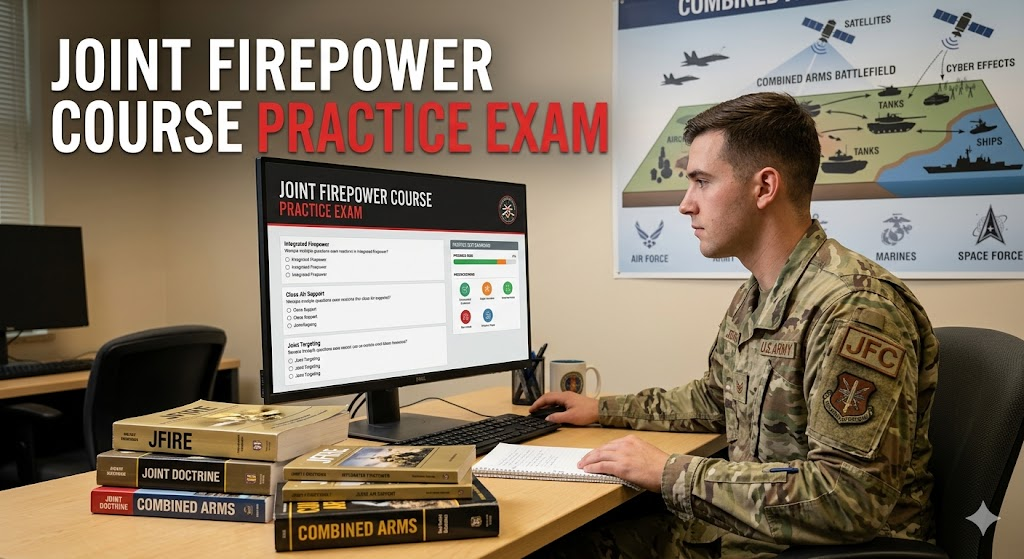
Additional Information
What the Course Entails and Exam Details
This comprehensive course delves into the intricate doctrines and procedures that form the foundation of effective joint firepower operations. The core topics covered extensively include Joint and Service-specific doctrine, multi-service tactics, techniques, and procedures (TTPs), and the indispensable JFIRE publication – a vital, quick-reference guide for requesting fire support. Students learn the detailed integration of close air support (CAS), indirect fires from artillery and mortars, and naval surface fire support (NSFS). The course goes beyond traditional kinetic effects, incorporating the synchronization of space and cyber capabilities into a unified fire support plan. Graduates are expected to become experts in the Joint Targeting Cycle, command and control architectures, weapon system capabilities, and proper communication protocols for ensuring precise and effective effects while minimizing the risk of fratricide. Midterm and final assessments, typically internal to the military training structure, assess knowledge through standardized multiple-choice questions, challenging planning scenarios, and practical evaluation in simulated environments.
What to Expect in the Final Exam
While specific, restricted final exam parameters can vary, candidates can typically expect a substantial portion of the assessment to consist of multiple-choice questions. These questions are carefully designed to test their detailed knowledge of joint and multi-service doctrine, various weapons systems, specific TTPs, and fundamental principles of integrated fire support. Furthermore, a critical aspect of the examination process involves demonstrating the practical application of this knowledge. Students are usually required to navigate simulated operational environments where they must correctly identify targets, formulate comprehensive fire support plans, and effectively communicate precise calls for fire using approved joint formats. This practical portion might include role-playing or interacting with sophisticated simulation systems. Passing requirements are typically based on a minimum score threshold for the multiple-choice section, along with successful demonstration of all required practical skills and procedural proficiencies as determined by the certifying military instructors. Specific time limits and restricted access apply, maintaining the confidentiality of the exam materials and ensuring the course’s integrity.
How to Study and Exam Centers
Preparation for the Joint Firepower Course is a significant undertaking, demanding rigorous study of all official doctrine and course materials provided during the instruction. Success is built upon a solid foundation of understanding. A foundational study of the JFIRE publication and multi-service doctrine is absolutely crucial for any student aiming to succeed. Candidates are encouraged to engage in group study, where they can work through complex tactical scenarios and debate the proper application of procedures in a combined arms context, which often deepens comprehension. Utilizing JFC practice tests and practice questions is a highly effective way to identify knowledge gaps, practice time management, and build confidence with the types of questions and concepts that will be present in the actual exams. Many students also find immense value in utilizing any available simulation tools or practical training aids to reinforce their procedural skills and tactical integration abilities. Staying current with all revisions to relevant military publications is also essential. It is important to understand that the Joint Firepower Course is generally an internal military training program. Therefore, the course and its associated examinations are typically administered only at authorized military training centers, dedicated specialized schools, relevant command headquarters, or through restricted internal military online portals. It is distinct from public, widely available commercial certifications, so information on specific testing locations and enrollment processes must be obtained through appropriate military channels, training commands, or unit education officers.
Job Opportunities from the Course
Upon successful completion of the Joint Firepower Course and certification, numerous crucial roles within the military structure become highly accessible or potentially require this specialized knowledge. These are often pivotal positions at the operational and tactical levels where integrated firepower is a key capability:
Joint Terminal Attack Controller (JTAC): The iconic role directing air strikes, often requiring JFC as a foundational step or part of their comprehensive training pipeline.
Fire Support Officer (FSO): At various command echelons (Battalion, Brigade, etc.) within the Army and Marine Corps, integrating indirect fires and coordinating other fire support assets.
Air Liaison Officer (ALO): Advising ground commanders on airpower capabilities and coordinating close air support.
Joint Fires Coordinator/Officer: Specialized staff roles in Joint Task Force or regional command headquarters, responsible for the overarching synchronization of all joint fires assets.
Relevant roles on Joint/Combined Staffs: specializing in fires, targeting, air-ground integration, and relevant plans and operations functions.
Special Operations forces positions: requiring a high degree of proficiency in integrated firepower coordination and execution in unconventional or specialized environments.
Instructor/Evaluator: in various joint and service-specific fires, CAS, and targeting courses, shaping future generations of joint firepower experts.
Frequently Asked Questions
Reviews
5.0
Based on 0 reviews
Leave a Review
No reviews yet. Be the first to review!