
Journeyman Beekeeping Practice Exam
$69.00
- Buy to unlock unlimited access to all Quiz questions and Answers in this Quiz.
- After purchase you can print a PDF of the whole quiz at any point. The PDF will contain the questions and the correct answers.
About this Exam
The Journeyman Beekeeping certification represents a significant step forward in a beekeeper's journey, marking the transition from an informed enthusiast to a recognized expert in the craft. It is the intermediate level within structured Master Beekeeper programs, typically positioned between the initial Apprentice (or Certified) tier and the advanced Master level.
This certification is designed for experienced beekeepers who have a minimum of one to two years of hands-on apiary management and have already demonstrated fundamental competence by holding the preceding level. It validates an in-depth understanding of honey bee biology, behavior, advanced management techniques, and an increased responsibility within the beekeeping community through mentoring and public service. Earning this title signifies that a beekeeper possesses the specialized knowledge and skills required to maintain optimal colony health, troubleshoot complex issues, and contribute meaningfully to the field.
Ready to test your knowledge?
Buy Now to Access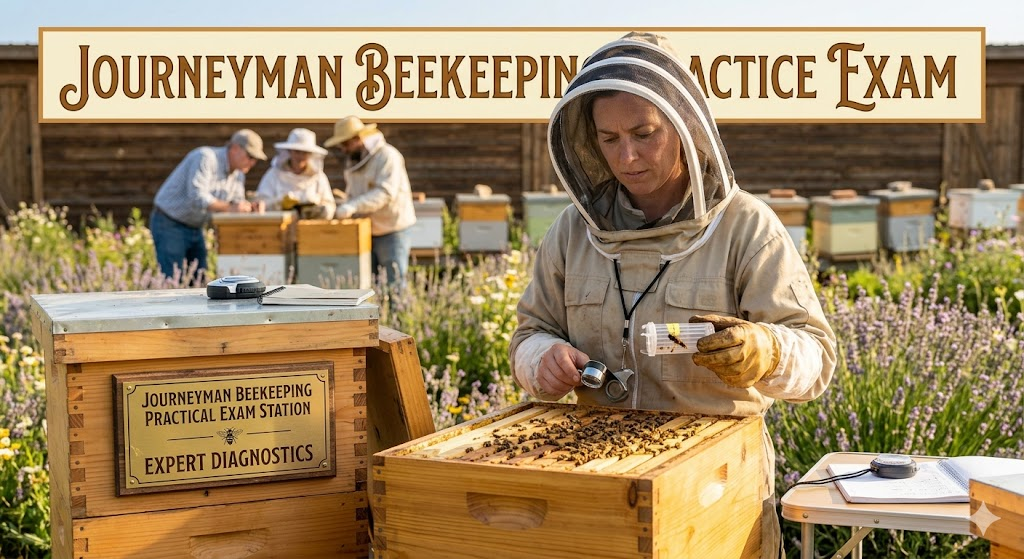
Additional Information
What the Course Entails and Exam Details
While each program is tailored to its specific region, a Journeyman Beekeeping course generally builds upon a solid foundation of beekeeping knowledge with a robust syllabus. The core topics focus on intermediate-level apiculture and bee science. Students dive deeply into advanced bee biology, including detailed studies of external and internal anatomy, the functionality of major glands, pheromone communication, and a precise understanding of the queen rearing process and calendar.
A significant portion of the curriculum is dedicated to integrated pest and disease management (IPM). Participants learn to identify all major honey bee diseases and pests—such as Varroa mites, Small Hive Beetles, American and European Foulbrood, and various viruses—not just by name, but by their nuanced symptoms and life cycles. The course also covers advanced colony manipulations, from swarming management and queen introduction to pollination ecology, honey floral sources, and products of the hive, including the legalities of honey labeling.
The exam details involve both theoretical and applied testing. To qualify, candidates must maintain continuous membership in their certifying organization and fulfill a prerequisite of held certification and experience. The final evaluation typically consists of two distinct parts: a comprehensive written exam and a rigorous practical or field exam, ensuring both book knowledge and physical skills are met with high standards.
What to Expect in the Final Exam
The final Journeyman Beekeeping exam is designed to be challenging, as it assesses a level of knowledge equivalent to a college course in apiculture.
The Written Exam is often a thorough, timed test lasting two to four hours. Its format is varied and can include multiple-choice, true/false, fill-in-the-blanks, matching, and short essay questions. One key feature at this level is the addition of a "situational" or "beekeeping situation" essay, which presents a complex problem (such as dealing with a specific pest or management dilemma) and requires the candidate to articulate a detailed, correct solution, drawing on both textbook knowledge and practical experience. Passing requirements for the written portion are typically between 75% and 85%.
The Practical or Lab/Field Exam is a crucial in-person evaluation, usually conducted by experienced Master Beekeepers. In a lab or workshop setting, it may involve stations where candidates must identify specimens, visual disorders, or equipment, such as distinguishing different pest larvae or diagnosing diseases by visual clues, often requiring a near-perfect score (e.g., 90%) for diagnostic sections. In the field, it assesses hands-on competency in skills like lighting a smoker properly, inspecting a colony while identifying all components of a brood nest, and finding or describing the queen and marked castes. Both parts combined demand clear demonstration of certainty and precision.
How to Study and Exam Centers
Successfully navigating the Journeyman level requires a structured study approach. Candidates should begin with the required and suggested reference materials. Essential texts often include Dewey Caron’s Honey Bee Biology and Beekeeping, Mark Winston’s The Biology of the Honey Bee, and Jurgen Tautz’s The Buzz about Bees. Studying past years' written and lab exams, which are sometimes provided by organizations like the Eastern Apicultural Society (EAS), is an invaluable practice method for understanding the level of detail and formatting.
Actionable study strategies include forming a study group, reviewing practical objectives in a personal apiary, and meticulously documenting apiary activities, as record-keeping is often a requirement. For the visual disorder diagnostics, use a magnifying loupe to examine active frames and high-quality photo resources. Participating in an organized Journeyman Prep Course, offered by some state associations, can also provide direct guidance and a review of the most critical topics.
Journeyman exams are not generally administered through major commercial testing centers like Pearson VUE. Instead, they are run directly by authorized organizations, state beekeeper associations (such as the Georgia MBP, NCSBA, or Alabama BA), regional societies like EAS, or specialized university programs (such as those at the University of Georgia, University of Florida, or Cornell University). Testing usually takes place in person at designated statewide or regional conferences, special testing events, or on the certifying university campus. Some components of preparatory coursework might be online, but the practical examinations are always held in physical locations to verify field skills.
Job Opportunities from the Course
Achieving the Journeyman Beekeeper certification is a clear signal of expertise that can unlock numerous career paths and income-generating opportunities within the apiculture industry. Individuals with this credential are often sought after for roles that require a reliable, scientific approach to managing honey bee health.
Here are specific job titles and career paths this certification unlocks:
Commercial Apiary Manager
Queen Rearing Specialist or Queen Breeder
Commercial Pollination Services Coordinator
Beekeeping Instructor and Educator (for state/local courses)
State Apiary Inspector
Apiary Research Assistant (at universities or government agencies)
Agricultural Extension Agent (Apiculture focus)
Artisanal Honey and Hive Products Producer
Specialized Beekeeping Retail Consultant
Frequently Asked Questions
Reviews
5.0
Based on 0 reviews
Leave a Review
No reviews yet. Be the first to review!