
Journeyman Electrician Practice Exam
$69.00
- Buy to unlock unlimited access to all Quiz questions and Answers in this Quiz.
- After purchase you can print a PDF of the whole quiz at any point. The PDF will contain the questions and the correct answers.
About this Exam
The Journeyman Electrician Exam is a crucial career milestone for electrical apprentices who are ready to transition into fully licensed, independent professionals.
This rigorous certification test is designed by state and local licensing boards to ensure that a candidate possesses the technical knowledge, safety awareness, and practical skills required to work without direct supervision.
It is specifically tailored for individuals who have completed their required thousands of hours of on-the-job training and formal classroom instruction.
Passing this exam proves your competency in navigating complex electrical systems, safeguarding public health, and adhering to strict national standards.
Whether you are aiming to work in residential, commercial, or industrial sectors, securing this license is your key to unlocking higher pay and greater professional autonomy.
Ready to test your knowledge?
Buy Now to Access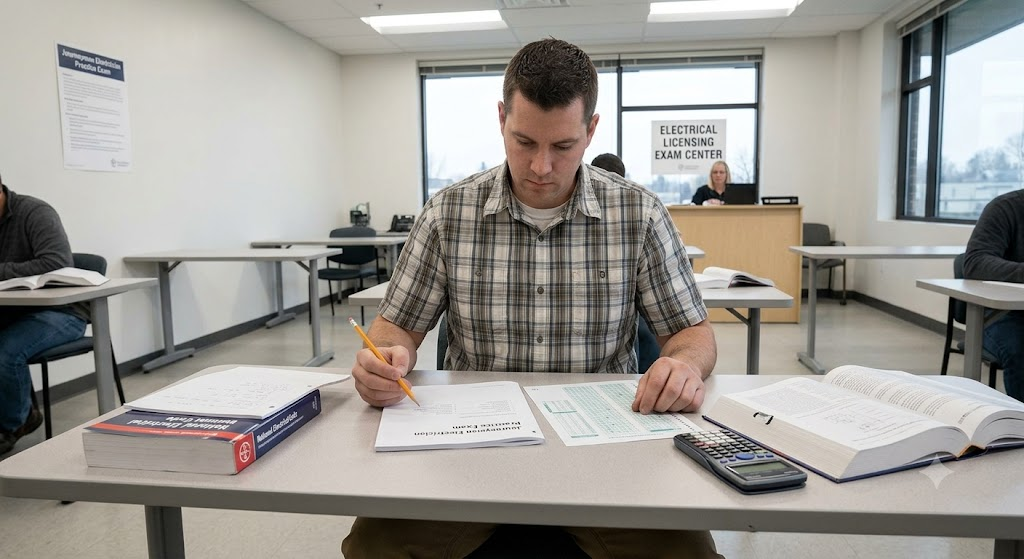
Additional Information
What the Course Entails and Exam Details
Preparing for the journeyman exam requires mastering a wide and complex syllabus centered around the National Electrical Code (NEC).
The core topics covered include general electrical knowledge, wiring and protection, wiring methods and materials, and equipment for general use.
You will also need to deeply understand special occupancies, special equipment, special conditions, and communication systems.
A significant portion of your study will entail complex electrical calculations, such as determining voltage drop, box fill, conduit fill, and proper sizing for conductors and overcurrent protection devices.
In addition to the NEC, the curriculum often covers basic electrical theory, ohms law, local state amendments, and vital occupational safety protocols.
What to Expect in the Final Exam
While specific exam formats vary slightly depending on your state or local jurisdiction, you can generally expect a rigorous multiple-choice test consisting of 80 to 100 questions.
You will usually be given a strict time limit ranging from 3 to 4 hours to complete the assessment.
Most jurisdictions require a minimum passing score of 70% to 75%.
The majority of these exams are "open book," allowing you to bring in an approved, bound copy of the National Electrical Code (NEC).
However, there are strict rules regarding this: your NEC book generally cannot contain loose-leaf notes, handwritten calculations, or unapproved sticky tabs, so you must carefully check your specific testing board's guidelines prior to exam day.
How to Study and Exam Centers
The most effective study strategy is to take multiple timed practice exams to build your speed in navigating the NEC codebook under pressure.
Familiarize yourself completely with the index and the table of contents of the NEC, as knowing exactly where to look up a code article is just as important as memorizing the formulas.
Focus heavily on practicing your calculation questions, as these often consume the most time during the actual test.
When you are ready to take the test, you must first apply for approval through your state or local electrical licensing board.
Once approved, the exam is typically administered at highly secure, third-party testing centers such as Pearson VUE, PSI, or Prometric.
These centers are located in various physical locations across your state, and they require strict government-issued photo identification and advance registration through their online portals.
Job Opportunities from the Course
Successfully passing this exam and obtaining your license opens the door to a wide variety of lucrative and highly respected career paths.
Journeyman Electrician: Work independently on complex wiring, troubleshooting, and installation projects across various job sites.
Commercial Electrician: Specialize in installing and maintaining intricate electrical systems in retail spaces, offices, and large commercial buildings.
Industrial Electrician: Focus on high-voltage systems, manufacturing equipment, and heavy machinery in factories and industrial plants.
Residential Electrician: Provide essential electrical installation, repair, and upgrade services directly to homeowners and housing developers.
Maintenance Electrician: Ensure the ongoing operation, safety, and repair of electrical systems within hospitals, schools, or corporate facilities.
Electrical Foreman: Step up into a leadership role to supervise crews of apprentices and other electricians while managing project timelines.
Independent Contractor: Use your licensed status as a stepping stone to obtain your Master Electrician license and eventually start your own electrical business.
Frequently Asked Questions
Reviews
5.0
Based on 0 reviews
Leave a Review
No reviews yet. Be the first to review!