
JRCALC Resuscitation Practice Test
$69.00
- Buy to unlock unlimited access to all Quiz questions and Answers in this Quiz.
- After purchase you can print a PDF of the whole quiz at any point. The PDF will contain the questions and the correct answers.
About this Exam
The JRCALC Resuscitation Practice Test is a vital educational tool designed for pre-hospital clinicians operating within the United Kingdom's healthcare system. Specifically tailored to the Joint Royal Colleges Ambulance Liaison Committee (JRCALC) Clinical Practice Guidelines, this simulation aims to help frontline personnel, including Paramedics, Ambulance Technicians, and Emergency Medical Technicians (EMTs), solidify their life-saving skills.
This practice test is an essential stepping stone, allowing users to assess their knowledge, build confidence, and identify critical areas for improvement before attempting their official, accredited resuscitation competency assessments required by their respective ambulance trusts or employers.
Ready to test your knowledge?
Buy Now to Access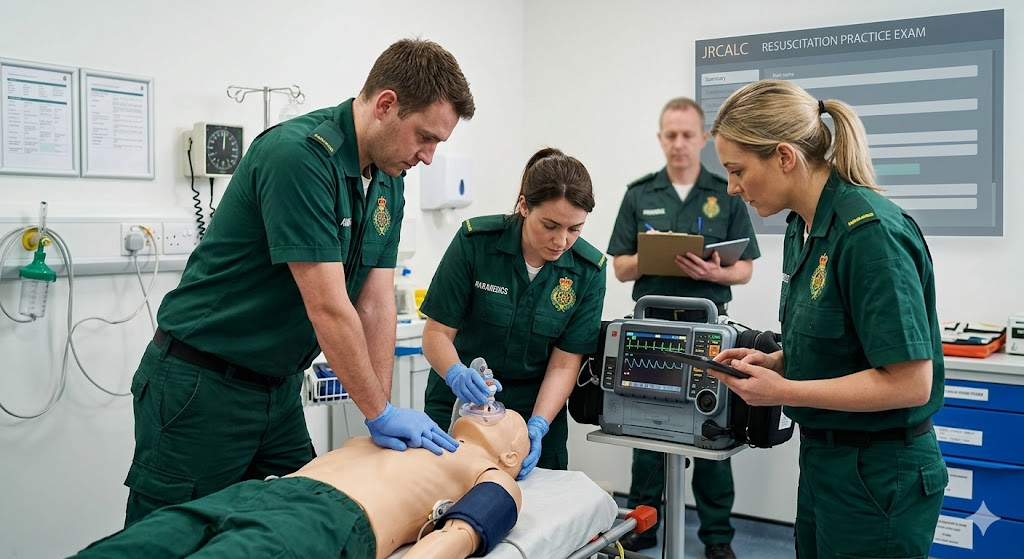
Additional Information
What the Course Entails and Exam Details
This examination is based on a course of study that rigorously covers the JRCALC guidelines for managing both adult and paediatric cardiac arrests and peri-arrest situations in the pre-hospital environment. Students must demonstrate mastery over the following core topics:
JRCALC Clinical Practice Guidelines (CPG): A comprehensive understanding and application of the current national standards of care.
Adult and Paediatric Basic Life Support (BLS): High-quality chest compressions, airway management, and ventilation.
Immediate Life Support (ILS) and Advanced Life Support (ALS): Defibrillation procedures, advanced airway management, and the correct administration of resuscitation drugs (e.g., adrenaline, amiodarone).
Newborn Life Support (NLS): Specialist algorithms for neonatal resuscitation.
Reversible Causes of Cardiac Arrest: Identifying and treating the '4 Hs' and '4 Ts' (Hypoxia, Hypovolaemia, Hyperkalaemia/Hypokalaemia/Hypoglycaemia, Hypothermia; Tension Pneumothorax, Tamponade (Cardiac), Toxins, Thrombosis (Coronary or Pulmonary)).
Ethical and Legal Frameworks: Including DNACPR (Do Not Attempt Cardiopulmonary Resuscitation) decisions, Recognition of Life Extinct (ROLE), and the decision-making process for when to terminate resuscitation efforts.
What to Expect in the Final Exam
While a 'practice test' is typically a mock simulation, the accredited final examination that pre-hospital clinicians must pass usually includes a combination of theoretical and practical assessments. Students should be prepared for the following structure:
Theoretical Component (Written Paper or Online MCQ): A rigorous multiple-choice question (MCQ) exam, typically 60–90 minutes long. This component assesses knowledge of the JRCALC algorithms, drug dosages, and legal guidelines. A high passing score, often 80% or above, is usually required.
Practical Assessment (OSCE): Objective Structured Clinical Examinations, where candidates must demonstrate their skills in real-time scenarios using medical manikins and official equipment. This will include managing a full cardiac arrest, advanced airway management, and showing competency as a team leader. Students must pass every practical element to achieve overall success.
How to Study and Exam Centers
Preparation is key to succeeding in a high-stakes medical examination. We recommend the following actionable study strategies:
Study the Primary Resource: The current edition of the JRCALC Clinical Practice Guidelines is your bible. Utilize both the printed version and the updated iCPG or JRCALC Plus app.
Practice with Real Equipment: If you are part of an ambulance trust, dedicate time to practising scenarios with the specific monitor/defibrillator and airway adjuncts used by your service.
Use ParaPass and Online Portals: Take advantage of digital learning management systems (LMS) and official assessment tools, such as ParaPass, which offer dedicated JRCALC quizzes and scenario-based learning.
Form Study Groups: Role-play scenarios with colleagues, taking turns as the team leader. Focus on communication, team resource management (TRM), and adherence to algorithms.
Take Multiple Practice Tests: Use online mock exams to get used to the wording of questions and to manage your time effectively.
Exam Centers: The accredited, final examination is a formal process. These assessments do not take place online but at authorised training centres. Common locations include ambulance trust training headquarters, university pre-hospital care departments, or accredited private medical training providers throughout the UK. You must be booked onto these courses by your employer or a recognized education provider.
Job Opportunities from the Course
A pass in the JRCALC-aligned resuscitation assessment is not just a competency check; it is a mandatory requirement for maintaining a licence to practice and unlocking career progression within the UK pre-hospital sector. Achieving this standard is critical for the following job titles:
Paramedic
Student Paramedic (A mandatory milestone)
Emergency Medical Technician (EMT)
Ambulance Technician
Associate Ambulance Practitioner (AAP)
Specialist Paramedic (e.g., Critical Care or Urgent Care)
Emergency Care Assistant (ECA)
Ambulance Care Assistant (ACA) / Emergency Care Practitioner (ECP)
Medical First Responder (in specific high-level roles)
Frequently Asked Questions
Reviews
5.0
Based on 0 reviews
Leave a Review
No reviews yet. Be the first to review!