
JROTC Navy Practice Test
$69.00
- Buy to unlock unlimited access to all Quiz questions and Answers in this Quiz.
- After purchase you can print a PDF of the whole quiz at any point. The PDF will contain the questions and the correct answers.
About this Exam
The Navy Junior Reserve Officer Training Corps (JROTC) program is a high school elective focused on citizenship development, leadership, and naval science. It is designed for students (cadets) who are interested in developing important life skills, increasing their sense of responsibility, and potentially exploring military-related opportunities. This course provides a stimulating blend of classroom instruction, practical drills, physical fitness, and community service activities. This comprehensive guide helps students prepare for the significant knowledge-based assessments that culminate the JROTC program, including what is often referred to as a "final exam" or significant course wrap-up. For those seeking resources to benchmark their progress, a well-structured [JROTC Navy Practice Test] is an indispensable tool, modeling the core knowledge areas and challenging students to demonstrate their understanding. This practice test serves as a foundational step for anyone aiming for success within their JROTC unit or looking towards future leadership roles.
Ready to test your knowledge?
Buy Now to Access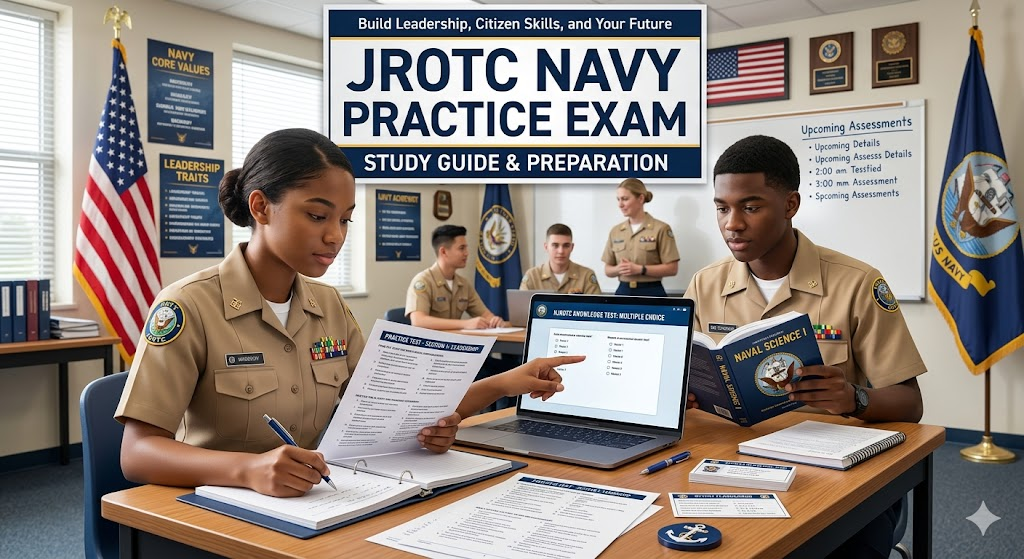
Additional Information
What the Course Entails and Exam Details
The JROTC Navy curriculum is multi-year, progressing from foundational principles to advanced application. The overall program covers:
Leadership and Ethics: Practical application of leadership, ethical decision-making, and teamwork.
Citizenship and Government: Foundations of democracy, the US constitution, government structures, and responsibilities.
Naval Science and History: Historical developments, significant naval operations, and naval strategy.
Maritime Geography, Oceanography, and Meteorology: Understanding the maritime environment, weather, and oceanography's role.
Seamanship and Navigation: Basic ship components, terminology, and fundamentals of maritime navigation.
Uniform regulations, Military Customs, and Courtesies: Proper wear, saluting, and basic etiquette.
Physical Fitness and Wellness: Principles of health, diet, and stress management.
Drill and Formations: Basic and potentially advanced drill knowledge and physical proficiency.
Marksmanship and Safety (Potentially): Safe handling and target shooting.
Exam Details (Knowledge Assessments): Significant written or digital knowledge assessments (often culminating in a major final exam) will typically test knowledge across all these academic areas. The specific exam format is decided by the JROTC unit and school, but students can usually expect:
Format: Multiple-choice questions, potentially augmented by short-answer questions, matching, or essays.
Delivery: Often administered digitally via school systems or paper tests, supervised by a JROTC instructor (SNSI/NSI) at the high school location. The [JROTC Navy Practice Test] is typically available online or in print as a preparatory resource.
What to Expect in the Final Exam
While the final or culminating knowledge exam will vary by JROTC unit, cadets should generally prepare for:
Exam Structure: A major knowledge-based test (often covering multiple years/all previous materials) consisting of a significant number of multiple-choice questions (e.g., 50 to 150), and possibly essay questions. The questions will be designed to test not only recall of facts but also understanding and application of concepts.
Passing Score: JROTC units and school districts set their own passing scores. A common range is between 70% and 80%, with some special advancement exams requiring even higher scores. Cadets should always check with their instructor for the exact required threshold.
Time Limits: You should expect a specific time limit (e.g., 60 to 120 minutes) for larger exams. Efficient reading and effective time management are key.
Rules & Integrity: These are official academic events demanding strict compliance:
No outside materials (textbooks, notes, etc.).
No communication during the exam.
No electronic devices (phones, smartwatches).
Identification may be required.
The [JROTC Navy Practice Test] is a preparatory tool and should be used responsibly as a study aid, not a substitute for comprehensive understanding.
How to Study and Exam Centers
Effective preparation is essential. Here is a strong strategy and key information on exam locations:
How to Study:
Curriculum Review: Your textbooks and JROTC manuals are your primary resources. Study them in detail, understanding definitions, core principles, historical timelines, and procedures.
Active Learning: Create outlines, use flashcards for vocabulary and facts, and form study groups with other cadets.
Physical and Practical: Drill with other cadets, practice uniform regulations, and maintain your physical fitness – these are assessed differently but contribute to your overall success and discipline, which help with focused study.
Practice with the [JROTC Navy Practice Test]: Utilize well-structured practice tests. Take them under timed, realistic conditions to simulate the exam experience. Analyze your results, identify your weaker areas, and devote extra time to reviewing those specific topics in your manuals. Repeat the practice test process.
Exam Centers:
Official Assessments: Official knowledge-based JROTC exams (unit finals, promotion tests, etc.) are NOT typically taken at standard commercial test centers (e.g., Pearson VUE). They are administered directly by your JROTC instructors within your high school. Your unit's leadership will provide specific dates, times, and instructions for all significant testing events.
Other Exams: Assessments for NROTC scholarships or service academy applications might involve designated locations or standard college testing for specific components like the SAT/ACT. However, the purely JROTC-focused knowledge exams described here are local to your unit and proctored by your instructors.
Where to take the Practice Test: The [JROTC Navy Practice Test] itself is usually an online study aid or a provided practice document. You can access and utilize it in any suitable study environment. It is a key tool in your home-based or school-based preparation plan, allowing you to prepare effectively from virtually anywhere.
Job Opportunities from the Course
A successful JROTC career and strong performance on its associated knowledge assessments contribute significantly to a student's portfolio and potential. While JROTC is not a direct job placement program, completion opens many pathways, particularly in the military and leadership sectors. The values and knowledge reinforced by succeeding on tests like the comprehensive knowledge exams can unlock:
Advanced Military Enlistment: Successful completion of two or three years of JROTC may qualify a student for a higher initial rank/paygrade (e.g., E-2 or E-3) when enlisting in any of the US Armed Forces, a significant advantage for both status and compensation.
NROTC Scholarship Opportunity: JROTC leadership and performance are excellent criteria for applying to a four-year Navy and Marine Corps ROTC college scholarship, which covers college tuition, fees, and provides a stipend, leading to a commission as a military officer. Success on knowledge exams helps demonstrate the required academic and dedicated character.
United States Naval Academy Candidate: The discipline, academic structure, and achievements recorded in JROTC are strong indicators of potential success at service academies like the US Naval Academy.
Military Officer Careers (via ROTC or Academy): Following successful officer training, individuals can become commissioned officers in a wide array of roles, including:
Naval Aviator (Pilot)
Surface Warfare Officer
Submarine Warfare Officer
Marine Corps Officer
Navy Special Warfare Officer (SEAL/EOD)
Nurse Corps Officer
Information Professional Officer
Transferable Skills: The leadership, teamwork, discipline, organization, and communication skills acquired through JROTC are invaluable in any career field. Success on exams demonstrates dedication, knowledge retention, and time management – qualities that admissions departments and civilian employers highly value. The specific "job title" is something you earn in your chosen next step, but your JROTC background provides a powerful launchpad.
In conclusion, your dedicated study and successful performance, bolstered by tools like the [JROTC Navy Practice Test], are your gateway to maximizing your JROTC experience and preparing for a fulfilling future. Good luck with your studies and your exams!
Frequently Asked Questions
Reviews
5.0
Based on 0 reviews
Leave a Review
No reviews yet. Be the first to review!