
JROTC Program for Accreditation (JPA) Practice Test
$69.00
- Buy to unlock unlimited access to all Quiz questions and Answers in this Quiz.
- After purchase you can print a PDF of the whole quiz at any point. The PDF will contain the questions and the correct answers.
About this Exam
The JROTC Program for Accreditation (JPA) is a rigorous evaluation designed to assess the overall performance, leadership, and operational excellence of a high school JROTC battalion.
It serves as the gold standard for measuring how well cadets have absorbed the leadership, civics, and physical fitness training provided by the curriculum.
This evaluation is specifically designed for high school students enrolled in the Junior Reserve Officers' Training Corps who are stepping up into leadership roles.
Rather than being a traditional sit-down written test for one individual, the JPA evaluates the collective effort, knowledge, and execution of the entire cadet staff.
Ready to test your knowledge?
Buy Now to Access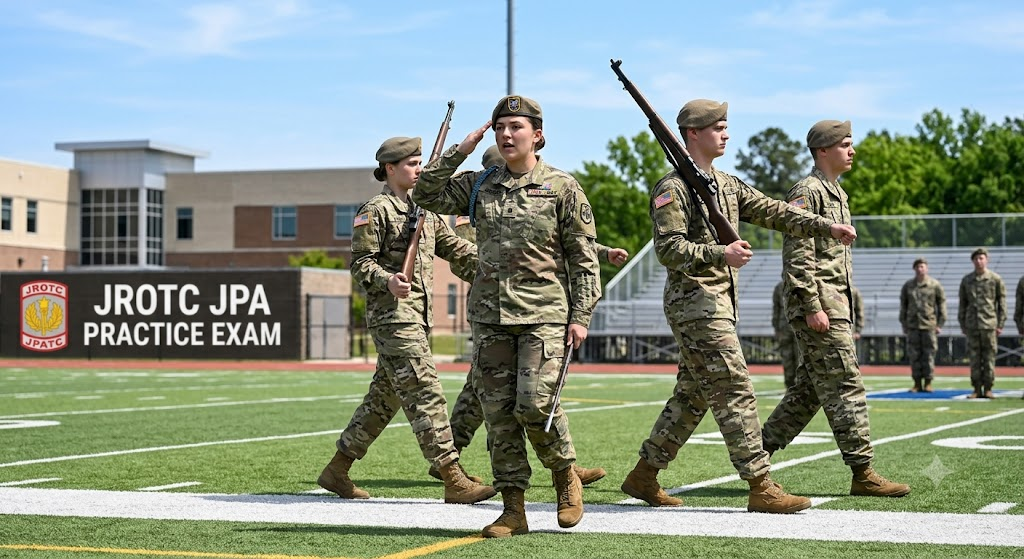
Additional Information
What the Course Entails and Exam Details
The JROTC curriculum leading up to the JPA covers a wide array of vital life skills and leadership principles.
Core topics include citizenship, leadership theory, communication skills, physical wellness, and drill and ceremony.
The syllabus also heavily emphasizes project management, financial literacy, and community service planning.
Cadets are expected to master the creation and maintenance of a Cadet Portfolio, which documents their academic achievements, service hours, and personal growth.
The skills covered go far beyond military knowledge; they focus on building responsible, organized, and effective citizens ready to lead in any environment.
What to Expect in the Final Exam
During the JPA, you should expect a highly structured, formal evaluation process conducted by external Brigade inspectors.
The format is largely practical and presentation-based, including formal briefings where cadet leadership presents their Continuous Improvement Project and Service Learning Project.
There is also a significant physical evaluation component, which includes an in-ranks uniform inspection, a color guard performance, and a platoon drill sequence.
Passing requirements are based on a point system using a strict 100-point rubric, with programs aiming for a score of 95% or higher to earn the prestigious Honor Unit with Distinction (HUD) gold star.
Time limits are strictly enforced during the formal briefings, requiring cadets to be concise, thoroughly prepared, and confident in their delivery.
A specific rule to remember is that inspectors will conduct randomized, on-the-spot interviews regarding your Cadet Portfolio, meaning every student must be ready to speak about their personal achievements without hesitation.
How to Study and Exam Centers
Studying for the JPA requires a hands-on, team-oriented approach rather than solitary reading.
Actionable study strategies include conducting regular mock boards, where cadets practice answering inspector questions under simulated pressure.
Practice methods should also involve routine uniform preparation sessions, where peers inspect each other's brass, ribbons, and grooming standards using the official grading rubric.
To prepare for the practical phases, you must participate in countless repetitions of drill and ceremony on the practice field until the movements become automatic.
Because this is a school-wide accreditation, the "exam center" is simply your own high school campus or JROTC facility.
Inspectors from higher headquarters will travel directly to your school on a designated inspection date, transforming your standard classrooms and gymnasiums into an official military testing environment.
Job Opportunities from the Course
While the JROTC JPA evaluation is not a standalone vocational certification, excelling in this program unlocks distinct advantages for various future career paths.
High school graduates who complete the program and perform well during the JPA often enter the military at an advanced enlisted rank (such as an E-2 or E-3), providing an immediate boost in base pay and leadership responsibility.
It also serves as a massive competitive advantage for students seeking full college scholarships through the Senior ROTC program, paving the way to become a Commissioned Officer.
For those aiming for elite leadership roles, a strong JPA showing can support your official nomination to prestigious institutions like West Point or the Naval Academy.
In the civilian sector, the project management and public speaking skills demonstrated during the JPA make candidates highly attractive for entry-level corporate management and team leader roles.
Furthermore, the documented community service and organizational skills provide a strong foundation for lifelong careers in public administration, law enforcement, and civil service.
Frequently Asked Questions
Reviews
5.0
Based on 0 reviews
Leave a Review
No reviews yet. Be the first to review!