
JROTC Promotion Board Practice Test
$69.00
- Buy to unlock unlimited access to all Quiz questions and Answers in this Quiz.
- After purchase you can print a PDF of the whole quiz at any point. The PDF will contain the questions and the correct answers.
About this Exam
The JROTC Promotion Board is a pivotal milestone for high school cadets seeking to advance their rank and take on greater leadership roles within their unit.
This assessment is designed specifically for students enrolled in the Junior Reserve Officers' Training Corps (JROTC) program across all military branches.
Whether you are striving for a higher enlisted rank or aiming to become a cadet officer, the promotion board evaluates your military bearing, confidence, and overall knowledge.
It serves as a comprehensive review of your dedication to the program and your readiness to lead your peers.
Ready to test your knowledge?
Buy Now to Access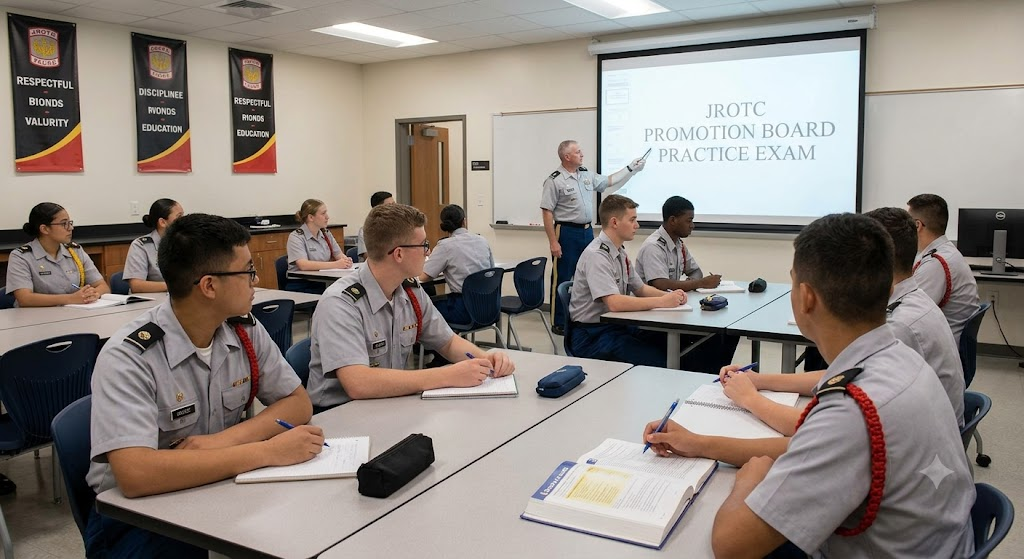
Additional Information
What the Course Entails and Exam Details
The JROTC curriculum is built on a foundation of leadership, citizenship, and personal responsibility.
To succeed in the promotion board, cadets must master a broad syllabus that covers several core military and civic disciplines.
Key topics include unit chain of command, uniform wear and appearance regulations, military customs and courtesies, and basic first aid.
Additionally, cadets are expected to have a firm grasp of their specific military branch's history, phonetic alphabet, and fundamental drill and ceremony commands.
The evaluation also tests essential soft skills, particularly public speaking, critical thinking under pressure, and the ability to maintain composure.
What to Expect in the Final Exam
Unlike traditional written tests, the JROTC Promotion Board is predominantly a formal oral examination and physical inspection.
When you enter the testing room, you will face a panel consisting of senior cadets and JROTC instructors.
You must report to the president of the board with crisp, precise facing movements and impeccable military bearing.
The panel will conduct a rigorous inspection of your uniform, looking for proper ribbon placement, shined shoes, and correct grooming standards.
Following the inspection, you will be asked a series of rapid-fire questions covering the core syllabus, and you are expected to answer confidently, loudly, and without hesitation.
While there is no standard national passing score, most units require a minimum proficiency rating (often 70% to 80% on the board's grading rubric) and zero critical uniform failures to secure a promotion.
How to Study and Exam Centers
Preparation is the absolute key to excelling at your promotion board.
Start by thoroughly studying your cadet reference manual or cadet guide, focusing heavily on memorizing the chain of command and general knowledge questions.
Use flashcards for historical dates and the phonetic alphabet.
Mock boards are one of the most effective practice methods; have a friend or family member inspect your uniform and fire questions at you while you stand at the position of attention.
Practice your marching and facing movements in front of a mirror to ensure your technique is sharp.
Because the JROTC program is school-based, you do not need to visit a third-party testing center like Pearson VUE.
The promotion board exams are held directly at your high school's JROTC facility, usually in an instructor’s office or a designated classroom, during specifically scheduled board dates throughout the academic year.
Job Opportunities from the Course
While JROTC is a high school program and not a civilian job certification, successfully advancing through the ranks opens highly valuable career and educational pathways.
Graduating with a high JROTC rank directly benefits those entering public service, higher education, and the workforce.
Advanced Enlisted Military Ranks: Cadets who successfully promote through JROTC and choose to enlist in the U.S. Armed Forces often enter at an advanced pay grade (such as E-2 or E-3), meaning higher starting pay and faster career progression.
ROTC Scholarship Candidates: Achieving high officer ranks in JROTC makes you a highly competitive candidate for university-level ROTC scholarships, paving the way for a career as a Commissioned Military Officer.
Service Academy Appointments: Success at JROTC promotion boards demonstrates the exact leadership qualities required for nominations to prestigious institutions like West Point or the Naval Academy.
Civilian Management and Leadership: The public speaking, discipline, and team-management skills acquired through board preparations translate seamlessly into early-career supervisor or management trainee roles in the corporate sector.
First Responder Careers: The discipline and chain-of-command experience are highly sought after in police academies, fire departments, and emergency medical services.
Frequently Asked Questions
Reviews
5.0
Based on 0 reviews
Leave a Review
No reviews yet. Be the first to review!