
JROTC Standard Operating Procedures (SOP) Practice Test
$69.00
- Buy to unlock unlimited access to all Quiz questions and Answers in this Quiz.
- After purchase you can print a PDF of the whole quiz at any point. The PDF will contain the questions and the correct answers.
About this Exam
The JROTC Standard Operating Procedures (SOP) Practice Test is an essential assessment tool designed specifically for Junior Reserve Officers' Training Corps (JROTC) cadets across all military service branches. This practice exam evaluates a cadet's comprehensive understanding of the foundational rules, regulations, and procedural protocols that govern daily operations, leadership conduct, and unit administration within their specific JROTC program. It serves as a critical checkpoint, ensuring cadets are prepared not only for internal unit evaluations but also for the standardizing protocols often required in competitive military, leadership, and public service environments.
Ready to test your knowledge?
Buy Now to Access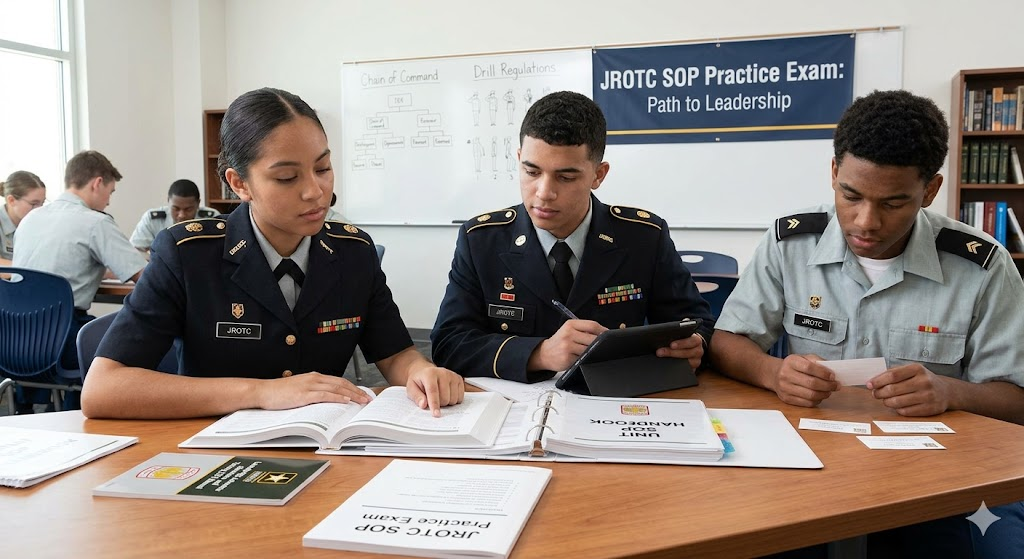
Additional Information
What the Course Entails and Exam Details
This examination curriculum encompasses a broad range of fundamental knowledge essential for effective JROTC participation and leadership development. The core topics covered include:
Chain of Command: Understanding the hierarchical structure and line of authority within the unit and service branch.
Uniform Standards and Wear: Mastery of proper grooming, insignia placement, and meticulous wear of the JROTC uniform.
Drill and Ceremonies: Precise knowledge of movements, commands, and protocols required for formations and official ceremonies.
Logistical Procedures: Accountability for equipment, supply requests, and inventory management.
Safety and Risk Management: Critical protocols for ensuring the safety of cadets during training and activities.
Ethical Conduct and Leadership Principles: Application of core values and ethical decision-making in diverse situations.
Administrative Processes: Understanding unit regulations, reporting procedures, and required documentation.
Mastering these SOPs is fundamental to efficient unit operations and individual professional growth within the program.
What to Expect in the Final Exam
The actual JROTC SOP final exam is usually structured as a rigorous knowledge-based assessment, often delivered in a classroom setting or integrated with practical evaluations. Candidates can generally expect a comprehensive test composed of multiple-choice questions, true/false scenarios, and sometimes short-answer responses that test critical thinking regarding the application of SOPs in simulated leadership situations. The precise format, passing score (often determined at the unit level, e.g., 80%), and time limit (typically 60-90 minutes) are set by the Senior JROTC Instructor (SI or SAI) and must be rigorously adhered to for successful completion.
How to Study and Exam Centers
Effective preparation for the JROTC SOP Practice Exam requires a multi-faceted study approach. Cadets should dedicate significant time to reviewing the latest service-specific JROTC Cadet Manuals (such as Army LET or Navy NJROTC manuals) and, critically, their specific unit's Standard Operating Procedures (SOP) handbook. Utilizing official JROTC practice questions, if available, or creating flashcards for key terms, rank structures, uniform regulations, and procedural steps can enhance memory retention. Practical repetition of drill movements and uniform inspection protocols is also essential. For this internal program assessment, examinations and practice sessions are exclusively held within authorized school facilities that host JROTC programs. Cadets must coordinate directly with their JROTC instructors to determine test dates, times, and designated testing locations.
Job Opportunities from the Course
While JROTC itself is a leadership development program rather than a direct job placement certification, achieving a high level of proficiency in JROTC SOPs provides cadets with a significant advantage and builds foundational skills highly relevant to numerous professional paths, especially in leadership and highly structured environments:
Enlisted Military Service: Potential for accelerated promotion based on JROTC time in service and demonstrated competency.
Military Officer: Enhanced preparation for subsequent ROTC programs, including associated scholarship opportunities, or Service Academy appointments.
Law Enforcement Officer: Application of discipline, command structure knowledge, and ethical training.
Firefighter/Emergency Medical Services: Utilizing disciplined execution, teamwork, and knowledge of safety protocols.
Security Manager: Leveraging leadership experience, protocol adherence, and risk management knowledge.
Logistics Analyst/Manager: Drawing on foundational logistical procedure training and accountability.
Administrative Services Manager: Utilizing knowledge of administrative procedures and structured operations.
Project Manager: Applying disciplined planning, organization, and execution skills developed through SOP adherence.
The discipline and attention to detail required to excel in JROTC SOPs are transferrable skills prized across the professional spectrum.
Frequently Asked Questions
Reviews
5.0
Based on 0 reviews
Leave a Review
No reviews yet. Be the first to review!