
JTED CPR Practice Test
$69.00
- Buy to unlock unlimited access to all Quiz questions and Answers in this Quiz.
- After purchase you can print a PDF of the whole quiz at any point. The PDF will contain the questions and the correct answers.
About this Exam
The JTED CPR exam is a crucial stepping stone for students enrolled in Joint Technical Education District (JTED) programs, particularly in the healthcare and public service sectors.
These innovative vocational programs are designed to provide high school students and some adults with hands-on technical skills and industry certifications.
Obtaining a CPR (Cardiopulmonary Resuscitation) and often an AED (Automated External Defibrillator) and First Aid certification is an essential prerequisite for many of these career paths.
It ensures that graduates possess the foundational life-saving skills necessary to respond effectively in emergency situations.
This study guide and practice test are specifically tailored to help students prepare for this important certification exam, whether it is for a specific program requirement or to enter the workforce as a certified first responder or healthcare assistant.
Ready to test your knowledge?
Buy Now to Access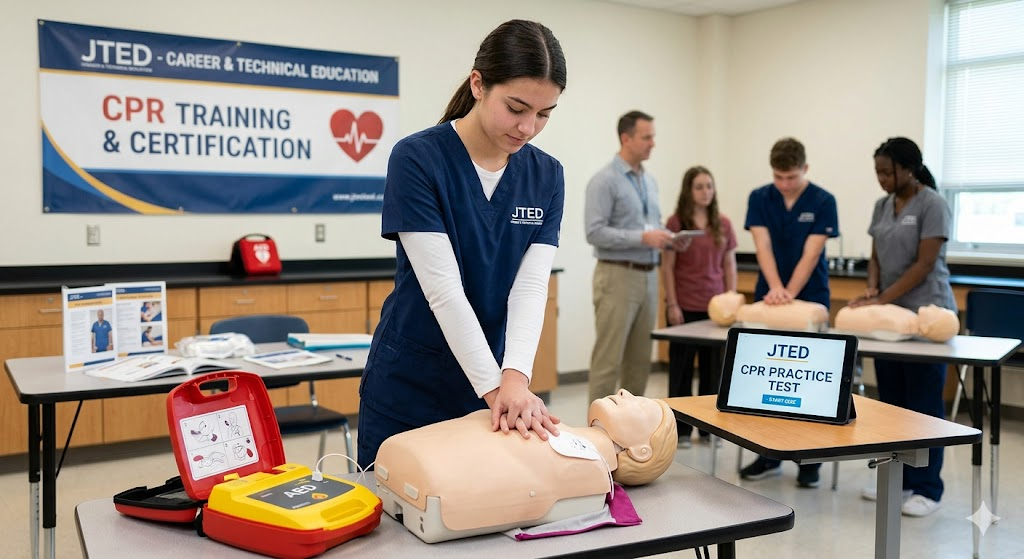
Additional Information
What the Course Entails and Exam Details
The CPR course foundational to this exam covers a comprehensive range of emergency response skills, typically adhering to the latest guidelines from organizations like the American Heart Association (AHA) or the American Red Cross.
Core topics included in the curriculum and subsequent testing generally encompass:
Recognizing Emergencies: Identifying the signs of cardiac arrest, respiratory distress, and other medical crises.
Safety Procedures: Understanding the steps to ensure rescuer and bystander safety before beginning care.
Adult CPR: Step-by-step techniques for high-quality chest compressions and rescue breaths on adult patients.
Child & Infant CPR: Specific procedures and adaptations for younger patients, including different compression depths and rescue breath techniques.
Choking Relief: Maneuvers for managing choking emergencies for adults, children, and infants.
Automated External Defibrillator (AED) Use: Operating an AED effectively on patients of all ages, including appropriate pad placement and following the device's prompts.
Team Dynamics: Understanding the roles and responsibilities in a multi-rescuer resuscitation attempt.
Ethics and Legal Considerations: Overview of consent, confidentiality, and the Good Samaritan law.
What to Expect in the Final Exam
Students should prepare for a rigorous two-part final exam process to achieve full certification, even if this study resource focuses primarily on the written practice test.
Written Exam (Practical knowledge application):
Format: Typically consists of a series of multiple-choice questions designed to assess a student's theoretical understanding of CPR protocols, correct sequences, and emergency response knowledge.
Passing Score: Requirements can vary, but generally expect a passing grade around 70% to 80% or a "pass" based on demonstrating a strong grasp of the material.
Time Limit: A specific time limit (often 30-60 minutes) is usually allotted for the written portion.
Practical/Skills Exam (Hands-on demonstration):
Format: Students will be required to physically demonstrate their competence in the skills they have learned. This is usually performed on training manikins and observed by a certified instructor.
Demonstrations include: Providing high-quality chest compressions, delivering effective rescue breaths, applying AED pads and operating the trainer device correctly, and relieving a simulated choking victim.
Assessment: The instructor will evaluate the student's technique, timing, depth, and adherence to the correct sequence. Successful completion of the final practical exam is typically necessary to receive the official certification.
A practice test is an excellent tool for reinforcing knowledge for the written exam component and familiarizing oneself with the types of scenarios that may be presented.
How to Study and Exam Centers
Effective preparation for the JTED CPR exam involves both theoretical study and practical application. Here are key strategies:
Practice Tests: Regularly utilize online practice exams and mock tests, like the ones associated with this guide, to review core concepts, gauge your understanding, and identify areas that need more focus.
Hands-on Practice: Actively participate in all training sessions provided by your JTED program. Use training manikins to practice proper hand placement, compression depth and rate, and coordination with rescue breaths and AED use. This is critical for the practical portion of your final exam.
Study Guides & Official Materials: Review all official textbooks, study guides, skill sheets, and videos provided by your instructor or the certification organization.
Peer Study: Study with classmates. Quiz each other on protocols and take turns acting as rescuers and observers during practical practice.
Watch Instructional Videos: Utilize official videos that demonstrate correct procedures for adult, child, and infant CPR, AED use, and choking relief.
Exam Centers & Registration:
The primary JTED CPR certification and final exam will typically be administered directly through your specific JTED program and school district.
Testing is often conducted at:
JTED Central Campuses: Designated training facilities where students from various high schools attend technical classes. (Search for "JTED near me" to find locations in your specific Joint Technical Education District, such as Pima County or similar).
Participating High Schools: Many JTED programs have satellite locations within the member high schools where classes and certifications are held.
Check with your JTED program coordinator, instructor, or school counselor for the exact location, scheduling, and registration process for your specific final CPR exam. They will provide the official information on where to go to take both your written and skills assessments.
Job Opportunities from the Course
A current CPR certification is not only a common requirement for JTED healthcare and public service programs but is also a highly valued credential for numerous career paths. Here are just a few specific job titles and fields where a CPR certification opens doors or is often a required qualification:
Registered Nurse (RN)
Emergency Medical Technician (EMT)
Firefighter
Paramedic
Nurse Practitioner (NP)
Physician Assistant (PA)
Physical Therapist (PT) & Physical Therapy Technician
Occupational Therapist (OT)
Athletic Trainer
Personal Trainer
Child Care Provider / Daycare Worker
Teacher & School Administrator
Lifeguard
Safety Officer & Workplace First Aid Responder
Home Health Aide & Caregiver
Dental Assistant & Dental Hygienist
By successfully completing the training and passing both components of the exam, you will not only satisfy program requirements but also gain a valuable, potentially life-saving credential that is an asset across a diverse range of rewarding professions. Master the material, practice your skills diligently, and you will be well-prepared to succeed!
Frequently Asked Questions
Reviews
5.0
Based on 0 reviews
Leave a Review
No reviews yet. Be the first to review!