
Judging Gymnastics: Level 10 Practice Test
$69.00
- Buy to unlock unlimited access to all Quiz questions and Answers in this Quiz.
- After purchase you can print a PDF of the whole quiz at any point. The PDF will contain the questions and the correct answers.
About this Exam
The Judging Gymnastics: Level 10 certification is the apex of the developmental judging pathway within the USA Gymnastics women’s artistic system. This advanced qualification is meticulously designed for individuals who have already mastered the intricacies of Level 9 judging and are ready to evaluate the highest level of optional, non-elite gymnastics. Level 10 routines are dynamic, complex, and full of risk, featuring high-level "D" and "E" value elements. A Level 10 judge must possess impeccable knowledge, quick decision-making skills, and the ability to apply the Code of Points with pinpoint accuracy under pressure. This certification is for those committed to the sport, ensuring that athletes competing at this vital stage receive fair, consistent, and expert evaluation as they aim for national recognition or collegiate careers.
Ready to test your knowledge?
Buy Now to Access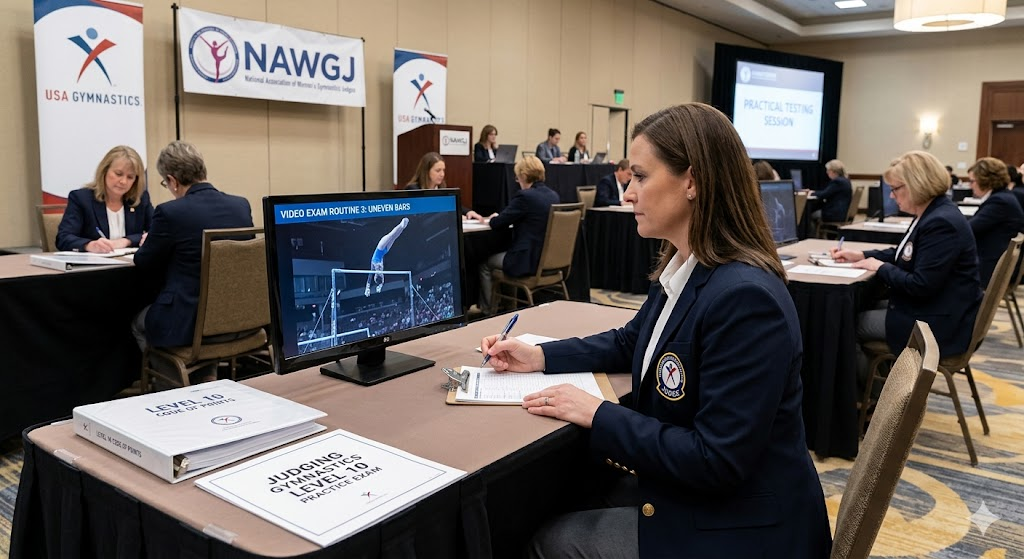
Additional Information
What the Course Entails and Exam Details
To attain a Level 10 rating, candidates must successfully navigate a pathway that demands both theoretical expertise and practical application. The process officially begins after a judge has held a Level 9 rating for a minimum of 12 months.
The core curriculum for Level 10 is rooted deeply in the USA Gymnastics Women's Development Program Code of Points. Candidates must undergo rigorous self-study or attend comprehensive judging clinics. The learning process covers the entirety of the optional rules, but with a specific focus on the unique demands of Level 10. Key areas of study include:
Start Value (SV) Calculation: Mastering the formula to determine the base score of a routine, which involves identifying all "Value Parts" (A-E skills), counting bonuses, and verifying specific special requirements for each apparatus.
Level 10 Apparatus Requirements: Understanding the exact compositional and technical rules for Vault, Uneven Bars, Balance Beam, and Floor Exercise, including permissible skills, dismount requirements, and combination bonuses.
Dynamic and Technical Deductions: Learning to apply dynamic deductions for errors in execution, artistry, and composition in a split second, distinguishing between a "small" and "large" error on elite-level skills.
Bonus & Connection Value: Expertly identifying connections that merit extra points (e.g., connecting a "D" skill directly into a "C" skill) and understanding the distinction between difficulty bonus and connection bonus.
Chief Judge Responsibilities: Preparing to serve as a meet referee or a chief judge on a panel, including handling inquires and ensuring panel consistency.
The prerequisite official course is often the J501 Developmental Program Categories 1-4 Judges’ Course/Study Materials, which provides comprehensive video and written practice, concluding with a "no-score-required" certificate of completion.
What to Expect in the Final Exam
The Level 10 certification exam is a two-part process that tests both your theoretical knowledge and your "on-the-fly" practical judging skills. You must pass both sections to receive your rating.
Part 1: The Online Written Exam
This is a comprehensive, timed, multiple-choice test taken online via the official USA Gymnastics testing portal. It covers general gymnastics knowledge and specific apparatus rules.
Format: Typically includes 50 multiple-choice questions.
Distribution: A common breakdown is: 7 questions on General Information, 7 on Vault, 12 on Uneven Bars, 12 on Balance Beam, and 12 on Floor Exercise.
Focus: It heavily tests complex scenarios, such as: "Is this combination eligible for Bonus?" or "What is the Start Value of this specific routine?" and "What is the maximum deduction for this execution error?"
Passing Score: You must achieve a minimum of 80% on the written exam. Only one re-take is generally permitted within a specified testing cycle.
Part 2: The In-Person Practical (Video) Exam
The practical exam assesses your ability to apply the rules in real-time as you watch routines. This exam must be taken in person at an authorized testing site.
Format: Candidates watch multiple video routines for each of the four events.
Number of Routines: It typically consists of 1 practice routine and 6 official exam routines per event.
Scoring: To allow for minor variability in evaluation, the routine on which you award the least number of points out of the 5 scored routines per event (excluding the practice) will be dropped from your final calculation.
Passing Score: You must achieve a minimum score of 75?ross the four events.
How to Study and Exam Centers
Preparation for the Level 10 exam requires a multi-faceted approach. There is no substitute for watching gymnastics and applying the rules consistently.
Top Study Strategies:
Master the Code of Points: Your Code of Points is your bible. Memorize the value parts (A-E), connections, and deductions for all events. Pay close attention to any recent rule clarifications (Errata).
Official Practice Materials: Utilize the USA Gymnastics J501 course to its fullest. This course includes practice written questions and video scoring scripts that detail the exact official deductions for specific routines.
Practice with Real Footage: Source video from Level 10 meet sessions (YouTube is a great resource). Score the routines in real-time. Do not stop the video. Write down your Start Value, every deduction, and your final score. Then, review it against the official results or with a mentor judge.
Form a Study Group: Collaborative learning is invaluable. Form a group with other Level 9 judges or Level 10 candidates. Analyze tough routines together and debate difficult deduction calls.
Use Practice Tests: A dedicated resource like the "Judging Gymnastics: Level 10 Practice Test" is essential. It provides exam-style questions in the correct format, helping you build confidence and identify areas of weakness before the real exam.
Attend Clinics: Participate in Regional or National NAWGJ workshops and USA Gymnastics judging clinics. These provide invaluable in-person training and a chance to ask questions of National-level judges.
Exam Center Locations:
Written Exam: Taken entirely online via the designated USA Gymnastics educational platform (such as Synap). It is timed and monitored.
Practical Exam: Conducted in person at officially sanctioned testing sites. These are frequently held in conjunction with major events, such as:
USA Gymnastics Regional Congresses
National Congress
Dedicated NAWGJ testing workshops
Job Opportunities from the Course
A Level 10 judging certification is highly respected and opens numerous career avenues within the competitive gymnastics community.
Your new rating unlocks the ability to serve in prestigious roles, including:
Level 10 Meet Judge: Qualify to judge at any sanctioned Level 10 sectional, state, regional, or even optional national invitational competitions.
Meet Referee / Chief Judge: Take on leadership roles for Level 10 and all lower developmental levels, managing the entire judging panel and handling coach inquiries.
NCAA College Gymnastics Judge: A Level 10 rating is a minimum requirement to be considered for college meet assignments, leading to exciting opportunities on the NCAA judging circuit.
Mentor Judge: Use your expertise to mentor and train new or lower-level judges, ensuring the quality of future officials.
NAWGJ Leadership: A Level 10 rating often leads to eligibility for leadership positions within the National Association of Women's Gymnastics Judges on state or regional boards.
Pathway to Higher Ratings: Successfully maintaining a Level 10 rating for a minimum of 24 months is a necessary step before you can even be invited to attend a National Judges’ Course to attempt a National or Brevet (International) rating.
Xcel Program Chief Judge: Judge and serve as Chief Judge for all divisions of the USA Gymnastics Xcel program (Bronze through Sapphire).
This certification not only allows you to contribute to the sport at its highest developmental level but also provides a challenging and rewarding career path with substantial growth potential.
Frequently Asked Questions
Reviews
5.0
Based on 0 reviews
Leave a Review
No reviews yet. Be the first to review!