
Judicial Branch Practice Test
$69.00
- Buy to unlock unlimited access to all Quiz questions and Answers in this Quiz.
- After purchase you can print a PDF of the whole quiz at any point. The PDF will contain the questions and the correct answers.
About this Exam
The Judicial Branch Practice Test is an essential preparatory tool designed for individuals who are serious about starting a career within the judicial system. This test is typically used to prepare for official entrance examinations for critical administrative and support roles, such as court clerks, court assistants, judiciary administrators, and legal secretaries. It provides a realistic simulation of the actual exams administered by judicial service commissions or unified court systems, allowing candidates to assess their knowledge and improve their test-taking skills before the high-stakes final evaluation. The guide is tailored to help you understand the foundational principles of the judiciary, court processes, and the administrative tasks required to keep the wheels of justice turning efficiently.
Ready to test your knowledge?
Buy Now to Access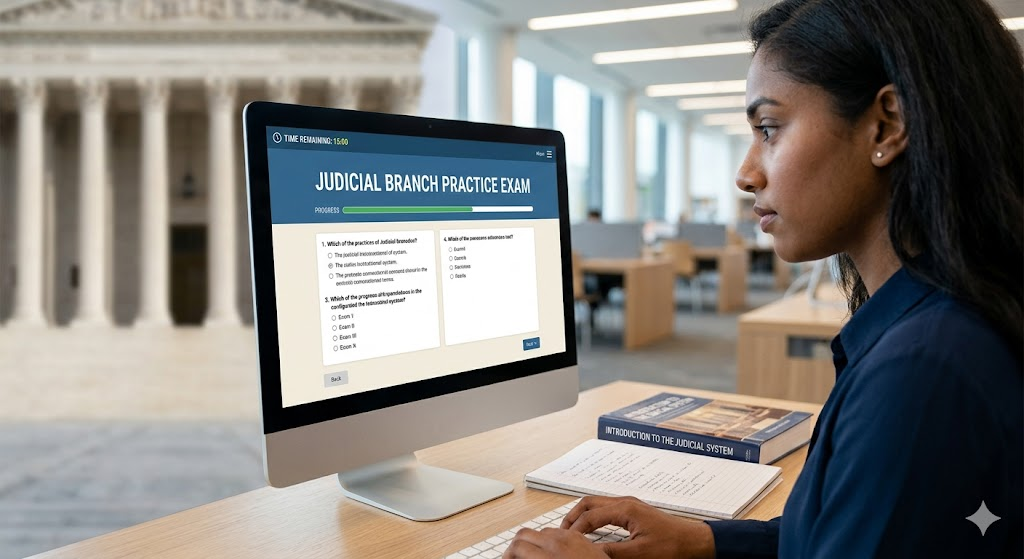
Additional Information
What the Course Entails and Exam Details
This course does not represent a physical or online class but rather a comprehensive study and assessment framework focused on the core skills required in a judicial environment. The content aligns with the knowledge base expected for entry- and intermediate-level court positions. The primary focus is on practical knowledge and administrative efficiency rather than complex constitutional jurisprudence.
Key topics covered within the practice material include:
Structure and Function of the Court System: Understanding the hierarchy of local, state, and federal courts and their respective roles.
Legal Terminology: Master the essential vocabulary used in filings, motions, orders, and courtroom proceedings.
Court Procedures and Documentation: Learn the lifecycle of a case, from initial filing to final disposition, and the corresponding official forms and documents.
Clerical and Administrative Skills: Focus on speed and accuracy in data entry, typing, filing, and managing case files.
Public and Professional Communication: Practice interactions with the legal community, litigants, and the general public in a professional and ethical manner.
Data Analysis and Records Management: Learn to extract information from and maintain complex legal databases and schedules.
Preparing Written Material: Enhance the ability to summarize information, organize facts logically, and write clear, grammatically correct official correspondence.
What to Expect in the Final Exam
While "practice" is the key, this guide prepares you for the actual final official job entry or certification exam. These final examinations are designed to be rigorous and to strictly screen for quality candidates for a competitive field.
Here is a breakdown of what a typical final exam for a court support role looks like:
Format: The most common format is a standardized, computer-based, objective test. You will encounter multiple-choice, true/false, and sometimes short scenario-based questions that test your decision-making.
Time Limit: The exam is strictly timed. You must work quickly and accurately, as the time allocated is often demanding for the number of questions provided.
Passing Score: The required score varies by jurisdiction, but a competitive score is often at least 70% to 80%. Meeting the minimum passing score may only get you on a list, while higher scores improve your ranking for job opportunities.
Practical Skills: Some exams may include a separate practical component, such as a typing test to measure words-per-minute (WPM) accuracy or a clerical checking scenario where you must compare documents and find errors.
Negative Marking: Be sure to understand if there is negative marking for wrong answers. In some cases, a small deduction is made for incorrect choices, making educated guessing a strategic risk.
How to Study and Exam Centers
Preparation is paramount to success. Effective study for this exam combines legal knowledge with the development of specific practical skills.
Actionable Study Strategies:
Utilize Practice Questions: This is the most effective method. Consistently work through practice tests to become familiar with the question types and the timed pressure.
Master Jargon: Create flashcards for legal terms and phrases, court titles, and administrative definitions. Don't just learn the definition; understand how it's used in a sentence.
Hone Practical Skills: Take online typing tests to improve speed and accuracy. Practice proofreading documents to enhance your clerical checking abilities. Work on exercises that involve organizing lists or data into a coherent sequence.
Review Sample Material: Seek out official sample exams provided by the official administering body (e.g., your state's Unified Court System or the specific Judicial Service Commission's recruitment page). These often give the most accurate insight into the test's difficulty and structure.
Time Yourself: Always take practice tests under timed conditions to build your stamina and pacing for the real event.
Where and How to Take the Final Exam:
Official exams for jobs within the judicial branch are not standardized in a central place. They are administered directly by the judicial branch of government in that specific location.
Applying: You must first apply for a specific vacant position through the official government job portal. Only candidates who meet the initial minimum requirements are then invited to take the entrance exam.
Locations: Physical exam centers are typically authorized government testing locations, judicial academy physical facilities, or professional testing service centers (like Pearson VUE, if outsourced). You will be notified of your specific testing center after your application is processed.
Authorized Schools: In some jurisdictions, specialized courses from authorized schools may offer a path to the exam or even provide the certification directly upon course completion, but for government roles, the official, state-run test is the norm.
Job Opportunities from the Course
A strong performance on a judicial entrance exam opens the door to a secure and respect-filled career in public service. These roles are critical for the daily operations of the courts. Here is a list of the specific job opportunities this exam sequence leads to:
Court Clerk / Deputy Court Clerk
Court Assistant
Judiciary Administrator / Court Administrator
Senior Court Office Assistant
Judicial Data Analyst / Data Entry Specialist
Legal Secretary / Judicial Secretary
Court Records Manager / File Clerk
Court Interpreter (specialized exam)
Court Reporter (specialized exam)
Case Management Specialist
By mastering the content in this study guide and dedicating yourself to practice, you can approach your final exam with confidence and secure your place in a rewarding legal career.
Frequently Asked Questions
Reviews
5.0
Based on 0 reviews
Leave a Review
No reviews yet. Be the first to review!