
Junior Livestock Skillathon Practice Test
$69.00
- Buy to unlock unlimited access to all Quiz questions and Answers in this Quiz.
- After purchase you can print a PDF of the whole quiz at any point. The PDF will contain the questions and the correct answers.
About this Exam
The Junior Livestock Skillathon is a premier youth development competition designed to challenge and showcase the comprehensive knowledge of young agricultural enthusiasts. Typically targeted toward members of 4-H and FFA (Future Farmers of America), this event evaluates a participant’s understanding of animal science, livestock management, and industry standards across various species, including beef cattle, swine, sheep, and goats. It is specifically designed for youth who want to move beyond the show ring and demonstrate their intellectual mastery of livestock production.
Ready to test your knowledge?
Buy Now to Access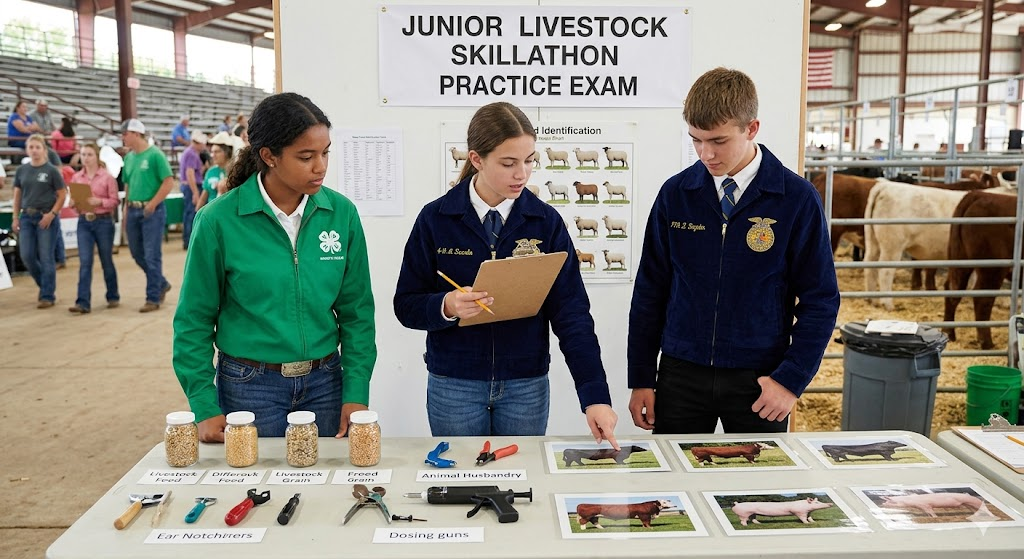
Additional Information
What the Course Entails and Exam Details
While not a traditional classroom course, preparing for the Junior Livestock Skillathon requires mastering a diverse curriculum covering the entire spectrum of animal agriculture.
Participants must dedicate themselves to studying several core areas.
First, comprehensive identification skills are required, covering dozens of breeds of beef cattle, swine, sheep, and goats, as well as identifying specific pieces of equipment used in livestock management and diverse feed samples.
Second, a deep understanding of animal evaluation and judging principles is essential for ranking animals based on confirmation and performance data.
Third, youth must study livestock quality assurance (LQA), which covers ethical treatment, animal health management, and proper medication administration.
Finally, the curriculum entails a thorough understanding of the retail meat industry, including identifying various cuts of meat and knowing where they originate on the carcass.
What to Expect in the Final Exam
The actual Skillathon competition is usually a multi-phased, highly interactive event that combines written knowledge with practical application.
It rarely follows a single standard standardized test format but rather consists of several distinct phases or "stations."
You should expect a written subject matter exam, often utilizing multiple-choice or true/false questions to test broad knowledge in animal science and industry trends.
Following the written portion, participants rotate through various "skill stations."
At these stations, you may be asked to physically identify breeds from photos, name specific pieces of veterinary or husbandry equipment placed on a table, or identify samples of grains and forages in jars.
Another major component is the meat identification and judging phase, where contestants must identify retail meat cuts and determine quality grades.
Finally, some competitions include a team problem-solving scenario, where a group must work together to solve a real-world livestock management issue, such as designing a herd health protocol.
Scoring is cumulative across all phases, and there is usually no single set "passing score"; rather, participants compete for individual and team rankings.
Time limits are strictly enforced at each rotation station, usually ranging from 5 to 15 minutes per station.
How to Study and Exam Centers
Effective preparation for the Junior Livestock Skillathon requires a blend of visual memorization, theoretical study, and hands-on experience.
You should begin by utilizing the practice exam provided through this portal to familiarize yourself with the type of questions asked.
Create flashcards for breed identification, veterinary tools, and meat cuts, as visual recognition is critical for high scores at the skill stations.
Utilize resources from university extension programs, official 4-H curriculum guides, and FFA materials.
We highly recommend attending local or regional workshops led by extension agents or agricultural teachers, as these often provide hands-on practice with equipment and feed identification.
Regarding exam centers, this specific practice test is available right here online through this educational portal.
The official, sanctioned Skillathon competitions do not take place in standard testing centers like Pearson VUE.
Instead, they are held at specific agricultural venues, such as county fairs, state fairs, major regional livestock expositions, or land-grant university campuses.
You should consult your local County Extension Agent or FFA Advisor to find the specific dates and locations for the qualifying competitions in your region.
Job Opportunities from the Course
Participating in the Junior Livestock Skillathon builds a rigorous foundation that is highly valued in the agricultural industry and is an excellent stepping stone toward specialized career paths.
While the contest itself is not a professional licensing exam, the knowledge gained unlocks opportunities in the following career areas:
Livestock Production Manager
Animal Nutritionist (requires further university study)
Veterinary Technician
AI (Artificial Insemination) Technician
USDA Meat Inspector or Grader
Agricultural Extension Agent
High School Agricultural Education Teacher
Livestock Pharmaceutical Sales Representative
Breed Association Representative
Farm or Ranch Manager
Frequently Asked Questions
Reviews
5.0
Based on 0 reviews
Leave a Review
No reviews yet. Be the first to review!