
Junior Officer Surface Material Readiness Course Practice Test
$69.00
- Buy to unlock unlimited access to all Quiz questions and Answers in this Quiz.
- After purchase you can print a PDF of the whole quiz at any point. The PDF will contain the questions and the correct answers.
About this Exam
The Junior Officer Surface Material Readiness Course (JOSMRC) is a critical component in the training pipeline for US Navy Surface Warfare Officers (SWOs). This course is specifically designed for Ensigns (O-1) and Lieutenants Junior Grade (O-2) who are preparing for their first or second division officer tours aboard surface ships. Its fundamental purpose is to equip junior leaders with the essential knowledge required to manage, maintain, and inspect their ship’s equipment and engineering systems effectively.
As a division officer, you are responsible not just for your personnel, but for the material condition and combat readiness of your assigned equipment. This practice exam is designed to simulate the final assessment, helping you identify knowledge gaps and master the material needed to confidently lead your division in maintaining a high state of readiness.
Ready to test your knowledge?
Buy Now to Access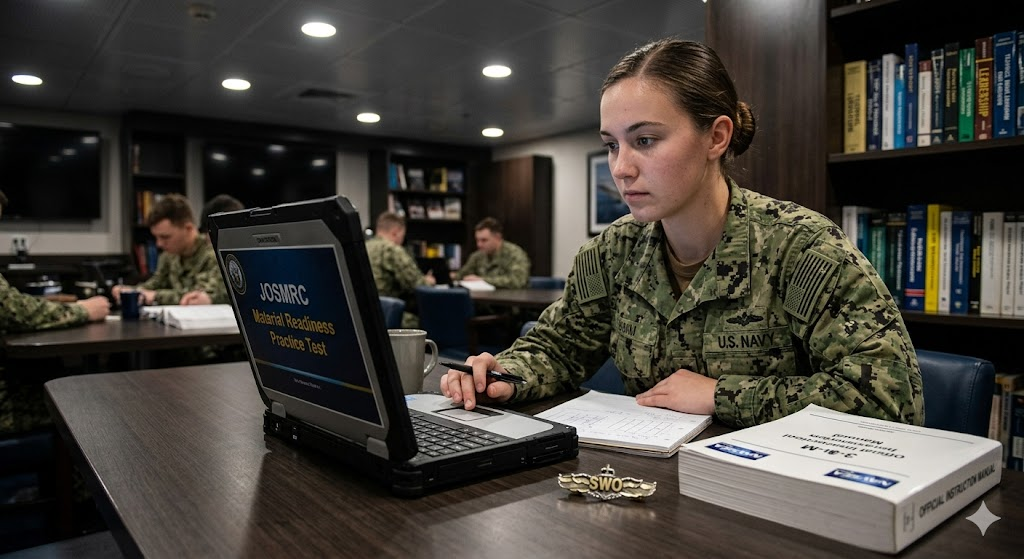
Additional Information
What the Course Entails and Exam Details
The JOSMRC course provides a comprehensive curriculum that bridges theoretical knowledge with practical fleet application. Students delve deeply into the material required to oversee the maintenance and material management systems of a US Navy surface ship. A successful junior officer must understand both the technical aspects of their equipment and the administrative procedures that govern its upkeep.
The core syllabus covers several critical domain areas, including:
Readiness Reporting and Management: Understanding the systems used to report a ship's status, including Casualty Reports (CASREPs) and SORTS/DRRS-N (Defense Readiness Reporting System-Navy). This knowledge ensures you can accurately communicate your system’s operational status.
Maintenance Material Management (3-M): This is a major pillar of the course. You will be tested on your understanding of the Planned Maintenance System (PMS), including maintenance requirement cards (MRCs), feedback reports (FBRs), and the auditing process required of a division officer.
Material Inspections: Detailed instruction on the types of inspections you will face, including INSURV (Inspection and Survey), zone inspections, and department-level inspections. Students must learn how to prepare their spaces and equipment and how to correctly identify and report deficiencies.
Supply and Acquisition: The logistical side of material readiness, covering how to order parts (using systems like OMMS-NG), manage consumables, and track divisional equipment.
Divisional Material Administration: Focuses on the logs, records, and training documentation a division officer is required to maintain. This includes the management of tool control, electrical safety, and damage control equipment within your spaces.
What to Expect in the Final Exam
The final exam for the Junior Officer Surface Material Readiness Course is designed to be a rigorous testing scenario that ensures you have internalized the course content. Unlike the practice tests, the official exam is proctored and counts significantly toward your graduation requirements.
Format: The exam is primarily a computer-based assessment. You should expect a large volume of multiple-choice and true/false questions. Many of these questions are scenario-based, requiring you to apply knowledge rather than simply recall definitions (e.g., "Given this equipment failure, what level of CASREP should you submit?").
Content Distribution: The questions are evenly distributed across the major curriculum areas (Readiness, 3-M, Inspections, and Supply), ensuring a comprehensive understanding.
Passing Score: The required passing score is generally strict, often demanding an 80% or higher, reflecting the real-world importance of this knowledge. Students who fail are usually required to remediate.
Time Limit: You will typically be given a defined time window to complete the exam, often 90 to 120 minutes, simulating the time pressures sometimes found in operational planning and reporting.
How to Study and Exam Centers
Preparation is key to success in both the JOSMRC and on this practice test. This is not a course you can simply "pass." You are preparing for the real responsibilities of leadership at sea. Use this practice exam as a foundational diagnostic tool.
First, focus your studying on the official course materials and references. Don't rely on outside notes; the Navy’s instructions (specifically the Joint Fleet Maintenance Manual - JFMM and the NAVSEAINST 4790.8D 3-M manual) are your authoritative sources. Take this practice test multiple times, focusing specifically on the questions you miss. This is not just about memorization; it's about understanding the "why" behind the correct answer. We encourage peer-to-peer studying, as discussing scenarios with other officers can reveal different perspectives and deepen understanding.
Where and How to Take the Exam:
The JOSMRC is typically administered within Navy training environments. The primary method of instruction and final examination is in a physical classroom setting at Navy schoolhouses. Major surface training hubs include the Surface Warfare Schools Command (SWSC) in Newport, Rhode Island, with additional training sites in key fleet concentrations like San Diego, California, and Norfolk, Virginia. You will be scheduled for this course as part of your training pipeline.
Job Opportunities from the Course
While the Junior Officer Surface Material Readiness Course is not a certification for civilian employment, it is a non-negotiable prerequisite for advancing within the US Navy as a Surface Warfare Officer. Successfully passing the course and the final exam unlocks your pathway to a first or second division officer tour. Specific billets and leadership paths this knowledge is vital for include:
Surface Warfare Officer (SWO) Division Officer (DIVO)
Engineering Division Officer (AUX, MPA, CHENG)
Weapons/Combat Systems Division Officer
Navigation/Deck Division Officer
Department Head (in the subsequent career stage)
Commanding Officer (eventually, based on consistent superior performance)
Frequently Asked Questions
Reviews
5.0
Based on 0 reviews
Leave a Review
No reviews yet. Be the first to review!