
Junior Sailor of the Year / Quarter (JSOY/JSOQ) Board Practice Exam
$69.00
- Buy to unlock unlimited access to all Quiz questions and Answers in this Quiz.
- After purchase you can print a PDF of the whole quiz at any point. The PDF will contain the questions and the correct answers.
About this Exam
The Junior Sailor of the Year (JSOY) and Junior Sailor of the Quarter (JSOQ) are prestigious recognition programs within the United States Navy designed to honor outstanding petty officers (typically E-4 to E-6) who demonstrate superior performance, leadership, and military bearing. This is not a standard standardized test; rather, it is a competitive selection process culminating in an oral board interview.
A JSOY Practice Exam or mock board is an essential preparation tool for motivated sailors aiming for this high-level recognition, serving as a dress rehearsal for the challenging questioning they will face from senior leadership.
Ready to test your knowledge?
Buy Now to Access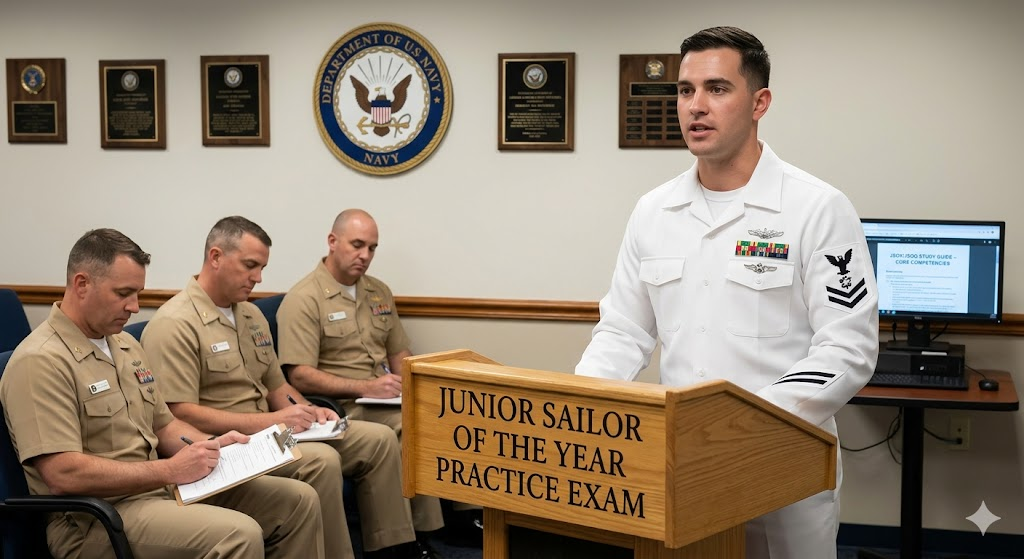
Additional Information
What the Course Entails and Exam Details
Preparing for a JSOY or JSOQ board does not involve a specific formal "course," but rather a dedication to comprehensive military and professional knowledge. The core topics, which a practice exam will cover, include:
Naval History and Heritage: Significant dates, battles, and figures.
Current Events: Major geopolitical issues and domestic news affecting the military.
Chain of Command: Knowing leadership from the local command up to the President.
Uniform Regulations: Meticulous knowledge of the NAVPERS 15665I.
Military Customs and Courtesies: Proper protocols and honors.
Sailorization and Leadership Programs: Knowledge of commands, programs, and mentorship.
Technical Ratings: Mastery of one's specific job specialty (Rating).
Current Navy Policies: Including issues like cybersecurity, harassment prevention, and safety.
What to Expect in the Final Exam
The "final exam" for JSOY/JSOQ is the Oral Selection Board. This is a formal, in-person interview where the candidate stands or sits before a panel of Senior and Master Chief Petty Officers (and sometimes officers).
Format: Candidates begin by reporting to the Board President and often reciting the Sailor's Creed. The panel then takes turns asking rapid-fire questions covering the topics listed above.
Time Limit: Boards typically last between 20 to 45 minutes, although they can feel much longer.
Passing Score Requirements: There is no numerical passing score. Instead, candidates are graded subjectively on their uniform appearance, military bearing, confidence, and the accuracy and articulateness of their answers. The sailor with the highest cumulative "score" against their peers wins.
Specific Rules: Perfect uniform compliance (usually Full Dress or Service Dress) is mandatory. Complete composure under pressure is expected.
How to Study and Exam Centers
Effective study for a JSOY practice exam combines rote memorization with presentation practice.
Actionable Strategies: Use flashcards (physical or digital apps like Quizlet) for chain of command, history dates, and regulations. Read Navy Times and major news outlets daily for current events. Review the modern Sailor's Creed, the Navy Core Values, and the Sailor 2025 initiatives. Crucially, conduct "Mock Boards" with your own mentors and Chief Petty Officers. This is the most effective way to practice speaking clearly under pressure.
Exam Centers: There is no external testing center like Pearson VUE for JSOY boards.
The practice and the final exam are conducted entirely in-house at your current command. The final board typically takes place in a command conference room or the Chief's Mess.
Job Opportunities from the Course
Winning Junior Sailor of the Year or Quarter is a massive achievement that drastically accelerates a sailor’s career and opens up competitive opportunities. Direct benefits include:
Promotion Advancement Points: Awarded on the Navy-Wide Advancement Exam (NWAE).
Stronger Evaluations: The award guarantees a bullet-point on performance evaluations (EVALs), making the sailor highly competitive for promotion to the next rank.
Meritorious Advancement: In some commands, JSOY winners may be eligible for meritorious advancement to the next paygrade.
Special Assignments: Increased visibility often leads to selection for prestigious "A-school" instructor duty, recruiting duty, or special programs.
Command Leadership Trust: Winners are often given higher levels of responsibility and leadership roles within their divisions.
Frequently Asked Questions
Reviews
5.0
Based on 0 reviews
Leave a Review
No reviews yet. Be the first to review!