
Juvenile Probation Officer Practice Test
$69.00
- Buy to unlock unlimited access to all Quiz questions and Answers in this Quiz.
- After purchase you can print a PDF of the whole quiz at any point. The PDF will contain the questions and the correct answers.
About this Exam
Embarking on a career as a juvenile probation officer is both a challenging and deeply rewarding pursuit for those committed to justice and youth mentorship. This specialized civil service or state-administered exam is specifically designed to assess candidates seeking to enter the field of juvenile justice. It serves as a critical filter to ensure individuals possess the unique blend of knowledge, reasoning, and ethical judgment required to work effectively with at-risk minors and their families. This practice test is an essential preparation resource for aspiring officers, psychology graduates, or anyone looking to transition into a career focusing on rehabilitation and public safety within the youth court system.
Ready to test your knowledge?
Buy Now to Access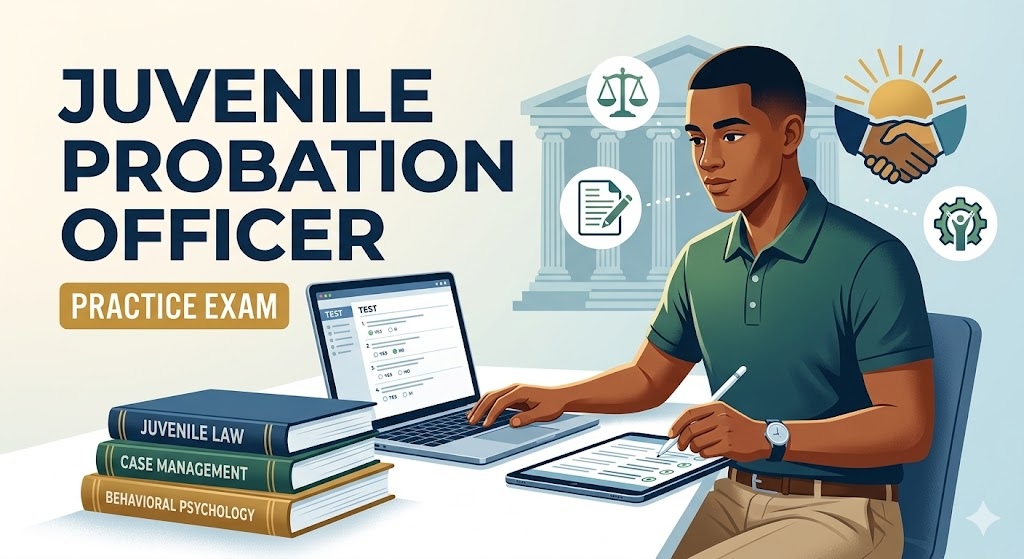
Additional Information
What the Course Entails and Exam Details
This comprehensive practice test course covers the foundational pillars and advanced skills necessary for successful juvenile casework. The syllabus focuses heavily on concepts derived from actual law enforcement and correctional officer examinations.
You will delve deep into the mechanics of the criminal justice system, specifically as it applies to minors in your jurisdiction.
Core topics covered in the study material include detailed analyses of juvenile law, restorative justice models, case management strategies, and behavior intervention techniques.
Furthermore, preparation includes enhancing critical skills such as written communication for incident reports, verbal interaction scenarios, and acute reading comprehension.
Ethical considerations, cultural sensitivity, and understanding adolescent psychology are also vital components detail in the course details.
What to Expect in the Final Exam
The final official examination is typically administered as a rigorous, timed, computerized assessment.
While the exact number of questions varies by state or county, candidates can generally expect a multiple-choice format containing between 75 and 150 questions.
The time limit is usually strict, allowing approximately 1.5 to 3 hours for completion, demanding strong time management skills from test-takers.
Passing score requirements generally hover around the 70% to 80% mark, depending on the current competitiveness of the hiring agency and the standard set by the civil service commission.
The environment is strictly proctored, and specific rules regarding background checks and physical ability tests may follow the written cognitive portion.
How to Study and Exam Centers
Preparation is paramount, and the best actionable strategy is consistent, retrieval-based study.
Begin by utilizing full-length practice tests under timed conditions to simulate the actual exam atmosphere and build mental stamina.
Review the official job description of the hiring agency to understand exactly what traits and knowledge bases they value most in an applicant.
Focus intense study on any provided state or local legal codes relating to minors, and practice reading complex scenarios to identify the core facts quickly.
Regarding exam centers, this is not an open, universal certification, but rather an employment exam.
Once you apply for a specific vacancy, the hiring agency or the state’s civil service department will send you a notification to register for the test.
Examinations are usually held at local government buildings, state personnel testing facilities, designated community colleges, or authorized computer-based testing centers such as Pearson VUE in some instances.
Job Opportunities from the Course
Successfully preparing for and passing this rigorous examination directly unlocks several distinct and fulfilling career paths within the public sector.
Here are the specific job titles and career paths this certification preparation makes accessible to candidates:
Juvenile Probation Officer (JPO): The primary role, focusing on supervising youth who have been adjudicated by the court, ensuring compliance with court orders, and facilitating rehabilitation.
Juvenile Caseworker: Managing treatment plans, counseling referrals, and assessment for youth under state or county care.
Youth Parole Officer: Similar to a JPO, but focusing specifically on supervising minors who have been released from state-run juvenile correctional facilities.
Intake Officer: Working directly with the courts to review arrests, interview juveniles and families, and determine whether a youth should be formally charged or diverted to community programs.
Juvenile Detention Officer: Working within secure juvenile facilities, maintaining safety, security, and orderly operations among the resident youth population.
Frequently Asked Questions
Reviews
5.0
Based on 0 reviews
Leave a Review
No reviews yet. Be the first to review!