
Kansas Gun Laws & Firearms Safety Practice Exam
$69.00
- Buy to unlock unlimited access to all Quiz questions and Answers in this Quiz.
- After purchase you can print a PDF of the whole quiz at any point. The PDF will contain the questions and the correct answers.
About this Exam
This study guide is your essential resource for preparing to master the fundamentals tested in the Kansas Gun Laws & Firearms Safety Practice Exam. This practice tool, which mirrors the knowledge required for official certifications and responsible firearms ownership within the state of Kansas, is designed for a broad audience. It is an invaluable asset for potential concealed carry permit applicants, hunters, and any Kansas resident or individual who wishes to safely and legally navigate gun ownership in the state. Whether you're a first-time firearm owner or an experienced shooter seeking to refresh your understanding of local regulations, this guide, and the practice exam it supports, will build your confidence and competence.
Ready to test your knowledge?
Buy Now to Access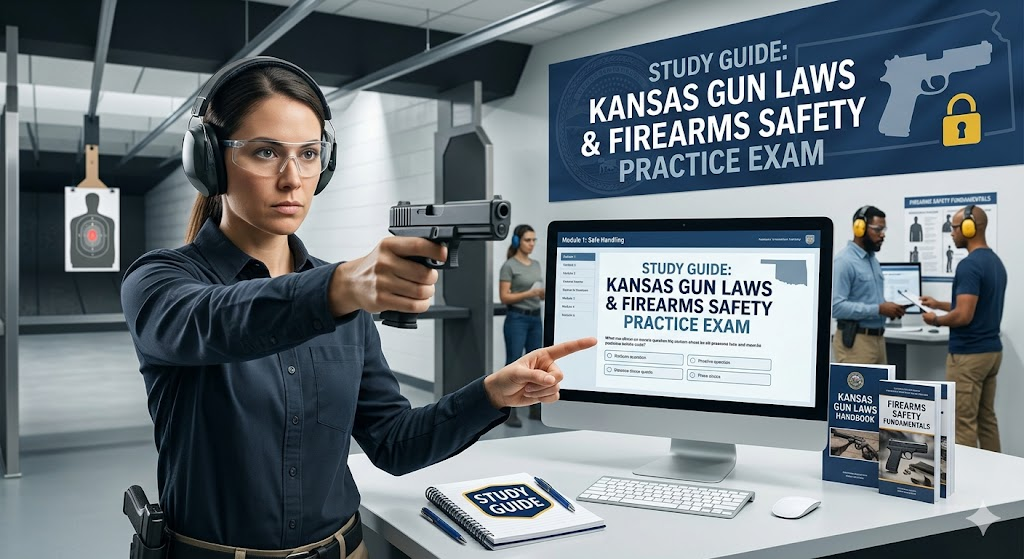
Additional Information
What the Course Entails and Exam Details
This comprehensive knowledge base encompasses the fundamental principles and legal requirements for safe and responsible firearm use in Kansas. Key topics typically covered include:
Firearms Safety Fundamentals: The non-negotiable rules of safe gun handling, including treating every firearm as if it's loaded, keeping your finger off the trigger until ready to shoot, and knowing your target and what lies beyond it. Proper storage and transportation methods are also covered.
Absolute Safe Handling: Understanding how different types of firearms operate, including how to load, unload, and clear malfunctions safely.
Kansas Statutes and Regulations: A deep dive into state-specific laws, including the Personal and Family Protection Act (PAPA). This covers regulations on where firearms are allowed (open vs. concealed), restricted locations, state and local restrictions, and how these laws apply to reciprocity with other states.
Legal Standards for Use of Force: A critical understanding of Kansas laws regarding the justified use of force and self-defense, differentiating between justifiable use and criminal behavior.
Range Safety Protocols: Proper procedures and etiquette for operating within a shooting range environment.
This practice exam serves as a direct reflection of these core areas, providing a practical method to assess and refine your understanding of this crucial knowledge.
What to Expect in the Final Exam
While the exact structure of official examinations can vary by certifying body, the [Kansas Gun Laws & Firearms Safety Practice Exam] is designed to simulate the format and rigor you can typically expect.
Format: Official exams are usually written assessments, often with multiple-choice and true/false questions. The practice exam accurately mirrors this, challenging your recall of safe handling practices, specific legal statutes, and appropriate decisions in hypothetical scenarios.
Passing Score: While specific required scores can vary, a minimum of 80% is common for many firearms safety certifications. Some critical safety questions might even require a 100% correct answer with immediate correction and review.
Time Limit: For official certifications, you might be given a specific time limit to complete the written portion, though the primary focus remains on accurate and safety-conscious responses over raw speed. The practice exam allows you to take the necessary time to carefully consider each scenario and rule.
Specific Rules: All firearms safety exams are strictly monitored in professional settings. You must typically present valid identification and may be prohibited from using notes or external aids. For any certification with a practical component (not included in this knowledge-based practice exam but common for actual permits), hands-on safe handling and firing assessments will also be required under direct supervision of a certified instructor.
How to Study and Exam Centers
Effective preparation for this comprehensive knowledge base requires a dedicated approach that combines self-study and practical experience.
Actionable Study Strategies:
Utilize the Practice Exam: Consistently taking the Kansas Gun Laws & Firearms Safety Practice Exam will familiarize you with the question style, test your knowledge, and highlight areas needing improvement.
Review Official State Resources: Deeply study the official guides from the Kansas Attorney General's Office and the Kansas Department of Wildlife and Parks (for hunter safety). These resources provide the definitive information on state laws and regulations.
Read and Understand the Law: Actively read the relevant Kansas statutes, particularly PAPA, and focus on understanding definitions and key legal frameworks rather than just memorization.
Hands-on Training: For the practical skills required for actual certification, seek in-person firearms safety and training courses taught by certified instructors in Kansas. Practice safe handling (with inert firearms or strictly controlled environments) under supervision.
Study Groups and Discussions: Discussing scenarios and laws with peers or instructors can deepen your understanding and expose you to different, helpful perspectives.
Exam Centers for Practice vs. Official Certification:
Practice Exam: This practice resource is often available through professional, educational, or recognized firearms safety websites. You can typically access it online from any location.
Official Certification Exams: To obtain official certifications (e.g., for a concealed carry permit or specific career path requirement), you must take an authorized exam. This almost always occurs through an approved in-person firearms training course led by a certified instructor. These courses are held at designated training facilities, licensed firearm ranges, police facilities, or sometimes community centers throughout Kansas. Check the Kansas Attorney General’s website for lists of certified instructors and training opportunities in your area. While some components of training, like initial adult hunter safety for residents, might have an online option, practical assessments and official knowledge exams for permits are generally conducted in-person.
Job Opportunities from the Course
Successfully mastering the knowledge evaluated in this practice exam can open doors or significantly enhance your prospects in several relevant career paths across Kansas. Potential opportunities include:
Armed Security Officer: Roles in private security firms protecting property, personnel, and assets in various environments, where carrying a firearm responsibly and within legal bounds is required.
Firearm Safety Instructor (Assistant or aspiring role): Teaching others is a valuable career; having strong knowledge of safe handling and law is a prerequisite.
Range Safety Officer (RSO): Supervising firing range operations to ensure all shooters adhere to safety protocols, making a comprehensive understanding of both basic safety and state laws essential.
Retail Firearms Sales Associate: Assisting customers and ensuring compliance with all legal requirements and documentation.
Forensic Science (LE-adjacent roles): Positions within law enforcement support or investigations that require extensive knowledge of firearm types and operations.
Law Enforcement and Security Analyst: Advanced roles where understanding of local gun laws and safety standards is critical for risk assessment and protocol development.
Frequently Asked Questions
Reviews
5.0
Based on 0 reviews
Leave a Review
No reviews yet. Be the first to review!