
Kansas Structural Pest Control Practice Exam
$69.00
- Buy to unlock unlimited access to all Quiz questions and Answers in this Quiz.
- After purchase you can print a PDF of the whole quiz at any point. The PDF will contain the questions and the correct answers.
About this Exam
The Kansas Structural Pest Control certification is a crucial credential for professionals seeking to manage, control, and eradicate pests in residential, commercial, and industrial buildings.
This exam and its corresponding certification are designed specifically for aspiring pest control technicians, commercial pesticide applicators, and exterminators who want to operate legally and safely within the state of Kansas.
Achieving this certification demonstrates a profound understanding of state regulations, environmental safety, and the effective handling of restricted-use pesticides.
Whether you are starting a new career path or looking to elevate your current landscaping or maintenance business, passing this exam is your official gateway to becoming a licensed structural pest control expert.
Ready to test your knowledge?
Buy Now to Access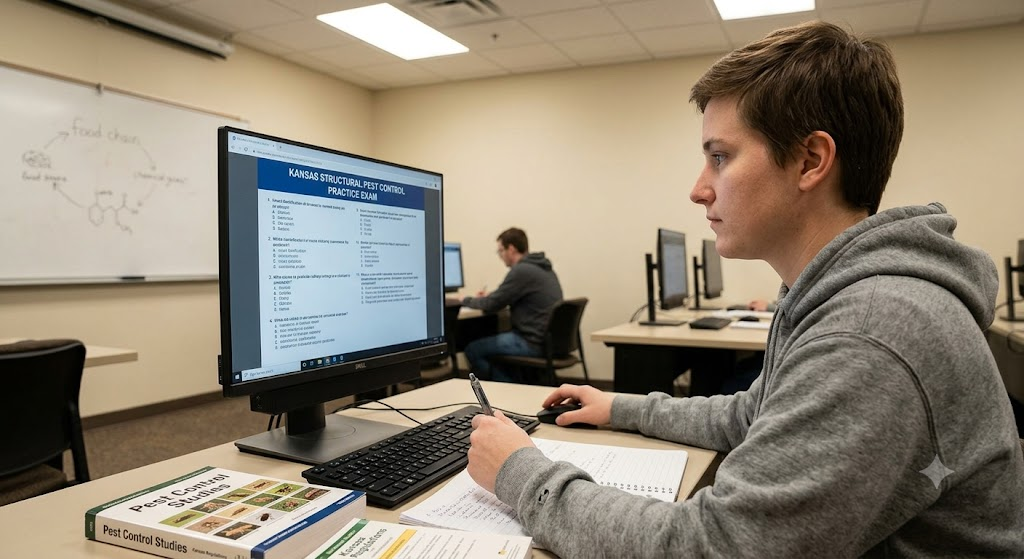
Additional Information
What the Course Entails and Exam Details
Preparing for the Kansas Structural Pest Control exam requires a thorough understanding of both state laws and practical extermination sciences.
The core syllabus heavily focuses on pest identification, meaning you must be able to recognize various rodents, termites, cockroaches, ants, and other structural pests common to the Midwest region.
You will also dive deep into pesticide safety and label comprehension, learning how to properly mix, apply, and store hazardous chemicals without endangering yourself or the public.
Furthermore, the curriculum covers environmental protection protocols, teaching you how to prevent groundwater contamination and protect non-target species.
Integrated Pest Management (IPM) strategies are another critical component, emphasizing prevention and non-chemical pest control methods alongside traditional chemical applications.
What to Expect in the Final Exam
The final Kansas Structural Pest Control exam is a rigorous, closed-book test designed to evaluate your comprehensive knowledge of safe pesticide application.
You can expect a multiple-choice format that tests both your memorization of state laws and your situational judgment regarding pest management scenarios.
To achieve certification, candidates are generally required to pass the exam with a minimum score of 75%, though it is always best to aim higher during your practice sessions.
The time limit for the exam is typically set at around two to three hours, which provides ample time if you have adequately prepared, but requires steady pacing.
Strict testing rules apply, meaning no personal reference materials, mobile phones, or outside notes are permitted inside the testing facility.
How to Study and Exam Centers
A strategic approach to studying is your best defense against test anxiety and unexpected questions on exam day.
Begin by acquiring the official study manuals provided by K-State Research and Extension, as these texts directly mirror the content you will be tested on.
Incorporate specialized practice exams into your routine to familiarize yourself with the phrasing of the questions and to identify any weak areas in your knowledge.
Flashcards are highly effective for memorizing specific pesticide labels, chemical classifications, and state regulations.
When you are ready to take the official test, you will need to register through the Kansas Department of Agriculture (KDA).
Exams are typically administered at specific physical testing centers designated by the KDA, or through authorized third-party testing partners like Pearson VUE, which offer secure, computerized testing environments across the state.
Job Opportunities from the Course
Successfully passing this exam and securing your Kansas Structural Pest Control license opens the door to a highly stable and in-demand career field.
Here are the specific job titles and career paths this certification unlocks:
Commercial Pesticide Applicator
Structural Pest Control Technician
Termite Control Specialist
Residential Exterminator
Quality Assurance Pest Inspector
Integrated Pest Management (IPM) Coordinator
Fumigation Specialist
Pest Control Business Owner or Manager
Frequently Asked Questions
Reviews
5.0
Based on 0 reviews
Leave a Review
No reviews yet. Be the first to review!