
Kaplan Certified Financial Planner (CFP) Practice Test
$69.00
- Buy to unlock unlimited access to all Quiz questions and Answers in this Quiz.
- After purchase you can print a PDF of the whole quiz at any point. The PDF will contain the questions and the correct answers.
About this Exam
The Certified Financial Planner designation is the benchmark of excellence for professionals in the financial planning industry.
Designed for financial advisors, wealth managers, and aspiring planners, this rigorous credential proves a candidate's ability to provide comprehensive, ethical, and highly skilled financial advice.
Achieving this certification requires passing the CFP exam, a challenging assessment that evaluates technical knowledge and the ability to apply it to real-world scenarios.
Taking the Kaplan CFP practice test is a critical step in this journey, offering candidates a realistic preview of the testing environment to ensure they are fully prepared for exam day.
Ready to test your knowledge?
Buy Now to Access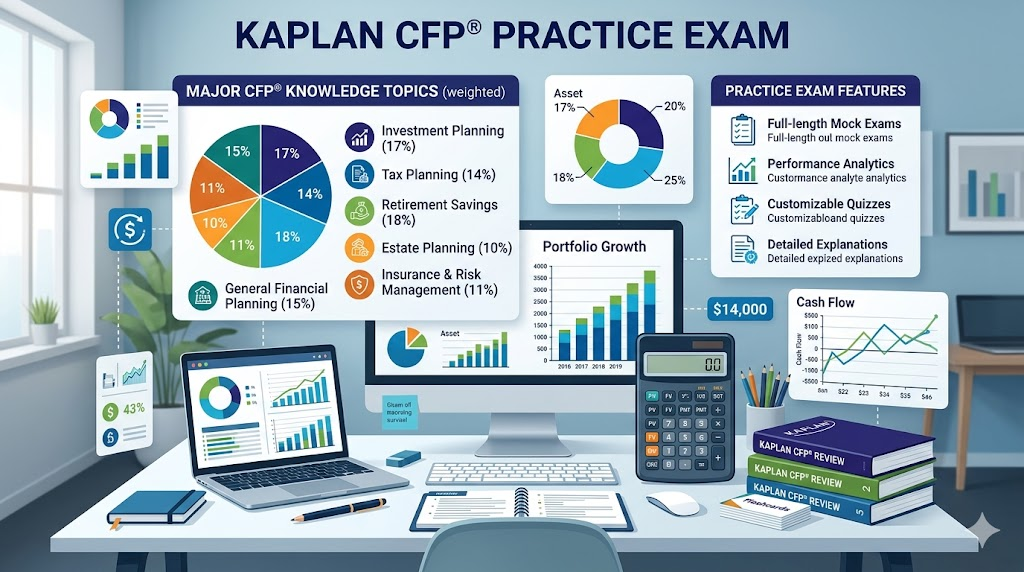
Additional Information
What the Course Entails and Exam Details
The Kaplan exam prep course and the official CFP exam cover a staggering breadth of knowledge.
The syllabus is divided into eight principal knowledge domains that reflect the diverse needs of modern clients.
These core topics include Retirement Savings and Income Planning at 18 percent, Investment Planning at 17 percent, and General Principles of Financial Planning at 15 percent.
Additionally, the curriculum covers Tax Planning at 14 percent, Risk Management and Insurance Planning at 11 percent, Estate Planning at 10 percent, Professional Conduct and Regulation at 8 percent, and the Psychology of Financial Planning at 7 percent.
Optimized for the 2026 testing cycle, the content includes recent legislative updates affecting tax limits and estate planning.
The Kaplan program integrates these topics through a structured study plan, comprehensive textbooks, and extensive question banks to build your confidence.
What to Expect in the Final Exam
The official CFP exam consists of 170 multiple-choice questions designed to test your critical thinking and application skills rather than simple memorization.
The test is administered in a computer-based format over a total of six hours.
This time is split into two three-hour sessions, separated by a scheduled 40-minute break.
Questions are presented in three distinct formats.
You will face stand-alone questions, short scenario questions, and extensive case study questions that require you to analyze multi-page client profiles.
The exam is graded on a pass or fail basis, with the total score determined across all sections.
Taking the Kaplan practice test replicates this exact format, providing you with a timed environment, retired exam questions, and a detailed performance report outlining your proficiency in each domain.
How to Study and Exam Centers
To succeed on the CFP exam, your study strategy must prioritize application over rote memorization.
Experts recommend committing at least 250 hours to study preparation.
Focus heavily on scenario-based practice questions to train your brain to integrate multiple domains, such as combining tax implications with retirement strategies.
Utilizing the Kaplan QBank and mock exams is highly effective for identifying weak areas before the real test.
Ensure you also review the CFP Board's Code of Ethics thoroughly, as it dictates professional conduct.
The actual CFP exam is offered three times a year during dedicated testing windows in March, July, and November.
You can take the exam in person at authorized testing centers located nationwide.
Alternatively, remote testing options are available, provided you meet strict workspace and technology requirements, including a pre-exam video scan of your environment.
Job Opportunities from the Course
Earning the CFP mark unlocks a variety of lucrative and rewarding career paths in the financial services sector.
It signals to employers and clients that you possess elite competency and adhere to a strict fiduciary standard.
Below are specific job titles and career paths this certification unlocks:
Certified Financial Planner
Wealth Management Advisor
Private Banker
Retirement Planning Consultant
Estate Planning Specialist
Investment Portfolio Manager
Trust Officer
Financial Compliance Director
By passing the CFP exam, you position yourself as a trusted expert capable of guiding clients through their most significant life decisions.
Frequently Asked Questions
Reviews
5.0
Based on 0 reviews
Leave a Review
No reviews yet. Be the first to review!