
Kaplan Certified Financial Planner (CFP) Practice Test.
$69.00
- Buy to unlock unlimited access to all Quiz questions and Answers in this Quiz.
- After purchase you can print a PDF of the whole quiz at any point. The PDF will contain the questions and the correct answers.
About this Exam
The Certified Financial Planner (CFP) designation is widely recognized as the gold standard for professionals in the financial planning and wealth management industries. Administered by the CFP Board, this elite certification demonstrates a practitioner’s core competency, structural knowledge, and absolute commitment to ethical, fiduciary standards when handling client assets.
The Kaplan Certified Financial Planner (CFP) Practice Test is a premier diagnostic and preparatory tool engineered by Kaplan Financial Education. It is specifically built for financial advisors, wealth managers, investment analysts, and insurance professionals looking to evaluate their readiness before sitting for the official, high-stakes board exam. By precisely mirroring the structure and rigor of the official exam, Kaplan's practice test bridges the gap between theoretical classroom learning and practical, real-world case analysis.
Ready to test your knowledge?
Buy Now to Access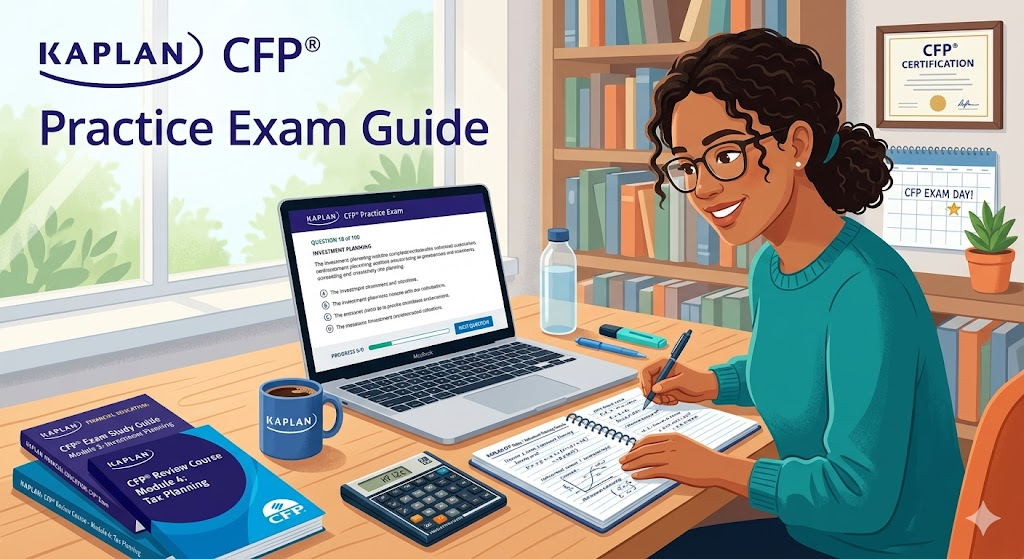
Additional Information
What the Course Entails and Exam Details
Preparing for the CFP exam through a curriculum like Kaplan's requires mastering a diverse, multidisciplinary syllabus. The material focuses heavily on application, forcing you to cross-reference multiple financial concepts within single client scenarios.
The curriculum and practice exams cover the eight Principal Knowledge Domains mandated by the CFP Board:
Retirement Savings and Income Planning (18%): Focuses on types of retirement plans, distribution strategies, Social Security, and business succession.
Investment Planning (17%): Covers portfolio diversification, asset allocation, bond and stock valuations, and modern market cycles.
General Principles of Financial Planning (15%): Explores cash flow management, education funding, and foundational time-value-of-money mechanics.
Tax Planning (14%): Evaluates individual and business income tax calculations, property transactions, and tax mitigation techniques.
Risk Management and Insurance Planning (11%): Assesses policy selection, health care cost management, life insurance, and risk exposure evaluations.
Estate Planning (10%): Dives into taxation compliance, trusts, gift taxes, and postmortem estate strategies.
Professional Conduct and Regulation (8%): Covers the CFP Board’s Code of Ethics, fiduciary standard applications, and consumer protection laws.
Psychology of Financial Planning (7%): Explores client communication principles, behavioral finance, and navigating client biases.
What to Expect in the Final Exam
The official CFP Board Exam—and by extension, the Kaplan full-length simulator—is a comprehensive, computer-based testing experience. It is designed to be a marathon of mental endurance and critical thinking.
Question Format: The test consists of 170 multiple-choice questions. These are broken down into standalone conceptual questions, short scenario questions, and extensive, data-rich case studies that require analyzing a hypothetical client’s entire financial profile.
Time Limit: Candidates are given a total of 6 hours to complete the test. This time is divided into two 3-hour sessions.
Breaks: A scheduled 40-minute break is provided between the two 3-hour blocks, allowing you to step away from the terminal. Optional, unscheduled micro-breaks are also permitted between individual test subsections, though the exam timer will keep running.
Passing Score Requirements: The official exam uses a criterion-referenced scoring approach, meaning it is a pass/fail system based on a minimum competency threshold established by the CFP Board. Historically, data reflects that a raw score hovering around 65% to 70% generally aligns with a passing standard, depending on the psychometric difficulty of that specific test iteration.
How to Study and Exam Centers
Succeeding on this exam requires moving past passive memorization and transitioning into active application.
Actionable Study Strategies
The "Perform" Strategy: Utilize Kaplan’s adaptive QBank to pinpoint structural weaknesses. When you get a practice question wrong, do not just read the rationale; create a separate running log of your incorrect responses to study directly before test day.
Emulate Test Parameters: Sit down and take Kaplan’s full-length mock exams under strict timed constraints. Do not pause the exam, use outside notes, or check your phone; your brain needs to build the stamina required for a 6-hour testing session.
Master Your Calculator: Ensure you have fluid, second-nature familiarity with financial calculators, specifically the HP 10bII+ or TI BA II Plus, which are authorized for use. Kaplan's specific calculator tutorial videos are critical for mastering complex internal rate of return (IRR) and compounding sequences.
Testing Logistics and Centers
Kaplan's study platform is entirely digital, enabling you to take mock tests directly through their online education dashboard.
When you are ready to take the official CFP certification exam, it is administered through Prometric Test Centers across the country. Candidates register via the CFP Board website and schedule a testing appointment at a local, secured Prometric physical computer lab.
Job Opportunities from the Course
Earning your CFP mark drastically elevates your professional credibility, directly translating to increased client trust and significantly higher earning potential.
Key career paths unlocked by this qualification include:
Certified Financial Planner (CFP): Operating independently or within an established firm to build holistic, all-encompassing financial strategies for high-net-worth clients.
Wealth Management Advisor: Managing large investment portfolios, tax mitigation strategies, and asset preservation for corporate executives and affluent families.
Private Client Associate / Relationship Manager: Serving as the direct point of contact for premium banking clients, orchestrating customized lending, investment, and trust solutions.
Estate and Trust Specialist: Collaborating alongside legal teams to structure complex intergenerational wealth transfers, philanthropic giving, and asset protection mechanisms.
Retirement Planning Director: Advising institutional corporate clients on structuring employee 401(k) programs, pension compliance, and individualized executive benefit designs.
Frequently Asked Questions
Reviews
5.0
Based on 0 reviews
Leave a Review
No reviews yet. Be the first to review!