
Karel Challenges Practice Test
$69.00
- Buy to unlock unlimited access to all Quiz questions and Answers in this Quiz.
- After purchase you can print a PDF of the whole quiz at any point. The PDF will contain the questions and the correct answers.
About this Exam
The Karel Challenges Practice Test is a crucial assessment for students beginning their journey into computer science and algorithmic thinking. It validates your understanding of foundational programming concepts through the lens of Karel the Robot, a widely-used educational tool. This exam is designed for absolute beginners, typically introductory computer science students in high school or early college, who need to demonstrate mastery of basic logic, control structures, and problem-solving skills before advancing to complex programming languages.
Ready to test your knowledge?
Buy Now to Access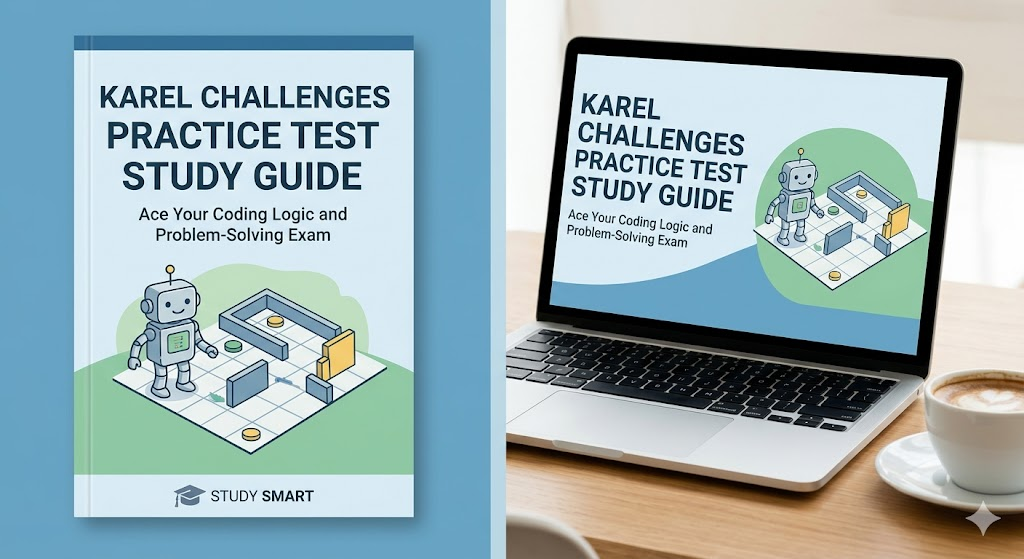
Additional Information
What the Course Entails and Exam Details
This examination focuses on the core principles taught in an introductory Karel programming course. It is not about memorizing complex syntax but about demonstrating sound logic. The core topics and skills covered include:
Basic Commands: Proficiency in executing Karel's fundamental movements, such as move(), turnLeft(), putBeeper(), and pickBeeper().
Defining New Functions: The ability to simplify programs by defining and calling new functions (e.g., teaching Karel how to turnRight() or moveFive()).
Control Structures: Expert use of if/else statements for conditional decision-making.
Loops: Demonstrating competence with both for loops (for fixed iterations) and while loops (for conditional iterations, like moving until blocked).
Problem-Solving: Combining these tools to guide Karel through varied grid environments, avoiding walls and manipulating beepers to solve specific, stated challenges.
What to Expect in the Final Exam
The final practice test simulates a real programming environment. Here is a breakdown of what you should anticipate:
Exam Format: The test is usually administered in a practical, digital format. You will not just answer multiple-choice questions; you will be required to write actual code within a designated interface to solve live challenges. The test may also include a few multiple-choice questions to assess theoretical understanding of the commands and logic.
Time Limits: The exam is typically timed, ranging from 60 to 90 minutes. You must manage your time efficiently across multiple distinct challenges.
Passing Score: Requirements can vary by institution, but a passing score is generally 70% or higher, reflecting proficiency in basic computational logic.
Rules: The exam is usually "closed book" for syntax reference, meaning you should memorize the basic commands. You are required to submit working code that solves the specific parameters of each given challenge.
How to Study and Exam Centers
Effective preparation is key to success on the Karel Challenges Practice Test. We recommend the following actionable strategies:
Practice, Practice, Practice: The most effective study method is solving numerous Karel puzzles. Re-do assignments, try extra challenges, and focus on using loops and conditionals effectively.
Write Clean Code: Don't just solve the problem; solve it efficiently. Focus on readability and breaking down complex problems into smaller, manageable functions.
Trace Your Code: Practice "desk checking" your logic. Manually follow Karel's path through the grid for each line of your code to spot errors before you run it.
Understand 'Why': Don't just copy solutions. Make sure you understand exactly why a while loop was used instead of a for loop in a specific scenario.
Exam Centers: The Karel Challenges Practice Test is usually taken online. If you are enrolled in a specific course (such as through CodeHS, Khan Academy, or a school program), the test will be administered directly through that platform. Authorized schools or universities may also host the exam in computer labs for their students. Check your specific course syllabus for the exact location or URL of your testing portal.
Job Opportunities from the Course
While this is an introductory certification, it is a foundational prerequisite that unlocks the pathway to a wide range of lucrative and exciting careers in technology. Successfully completing this course and exam proves you have the fundamental aptitude required for roles such as:
Software Developer Trainee
Junior Web Developer
Quality Assurance (QA) Tester
Data Analyst (Entry Level)
Coding Bootcamp Candidate
Computer Science Tutor
Achieving certification on the Karel Challenges Practice Test is your first formal step toward a successful career in the vast field of computer science. Good luck!
Frequently Asked Questions
Reviews
5.0
Based on 0 reviews
Leave a Review
No reviews yet. Be the first to review!