
Karel Programming Practice Test
$69.00
- Buy to unlock unlimited access to all Quiz questions and Answers in this Quiz.
- After purchase you can print a PDF of the whole quiz at any point. The PDF will contain the questions and the correct answers.
About this Exam
The Karel Programming test is a foundational assessment designed for beginner computer science students.
It evaluates a learner's grasp of basic programming logic using a visual, grid-based environment where a robot named Karel navigates and completes tasks.
This exam is ideal for high school students, college freshmen, and coding boot camp beginners who are taking their first steps into software development.
By testing core concepts without the clutter of complex syntax, it builds the problem-solving mindset required for advanced languages like Java, Python, and C++.
Successfully mastering this material gives students the confidence to pursue more rigorous computer science curricula.
Ready to test your knowledge?
Buy Now to Access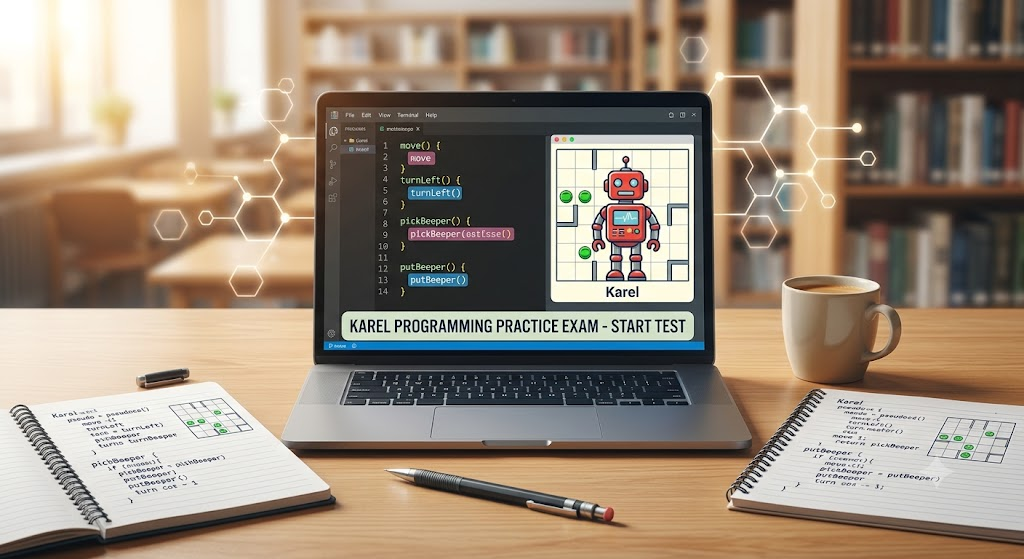
Additional Information
What the Course Entails and Exam Details
The course syllabus centers on teaching students how to think like a programmer through top-down design and algorithmic problem-solving.
Students learn fundamental commands such as moving the robot, turning, and interacting with items called "beepers" within a confined digital grid.
As the course progresses, it introduces crucial control flow structures including if-else statements, while loops, and for loops.
Another major component of the syllabus is the creation of custom functions or methods.
This teaches students how to break down massive, complex problems into smaller, manageable pieces of reusable code.
The exam focuses heavily on code tracing, syntax comprehension, and the ability to debug logical errors in preexisting code blocks.
What to Expect in the Final Exam
Students should prepare for a comprehensive test that typically lasts between 60 to 90 minutes.
The exam format generally features a balanced mix of multiple-choice questions and practical free-response coding challenges.
In the multiple-choice section, you will be asked to trace the path of the robot based on a given snippet of code.
For the practical portion, you will need to write out your own algorithms to solve specific navigational puzzles on a blank grid.
Most educational institutions require a minimum passing score of 70%, though this can vary depending on your specific school or program.
Calculators are generally not permitted, but students are sometimes allowed a basic syntax reference sheet to assist with command spelling.
How to Study and Exam Centers
The most effective way to prepare is through active, hands-on practice in your designated coding environment.
Spend time tracing code on physical paper, drawing out the grid, and tracking the robot's movement step-by-step.
Review past assignments to understand where you previously made logical errors or created infinite loops.
Since Karel is primarily an introductory educational tool, exams are typically administered directly through your school's computer lab or an online educational portal like CodeHS.
If you are taking this as part of a university extension or distance learning program, the exam may be hosted on a digitally proctored platform.
Ensure you have a stable internet connection and a quiet environment if testing remotely, and always test your login credentials the day before the exam.
Job Opportunities from the Course
While Karel programming itself is an educational stepping stone rather than a commercial language, the underlying skills it teaches unlock a highly lucrative career path.
Mastering these concepts prepares you for advanced coding certifications that lead to the following roles.
Junior Software Developer
Quality Assurance Tester
Technical Support Specialist
Web Development Apprentice
Computer Science Teacher
IT Systems Analyst
Frequently Asked Questions
Reviews
5.0
Based on 0 reviews
Leave a Review
No reviews yet. Be the first to review!