
KCCMA Administrative Assisting Practice Test
$69.00
- Buy to unlock unlimited access to all Quiz questions and Answers in this Quiz.
- After purchase you can print a PDF of the whole quiz at any point. The PDF will contain the questions and the correct answers.
About this Exam
The KCCMA Administrative Assisting Certification validates the core skills and knowledge required to excel as an administrative professional, particularly within the framework of city and county management and related fields. This credential is designed for individuals aspiring to, or already working in, support roles that require strong organizational, communication, and clerical abilities to ensure the smooth operation of local government offices and departments. The KCCMA Administrative Assisting Practice Test is an essential tool for candidates to gauge their readiness and prepare effectively for the final exam.
Ready to test your knowledge?
Buy Now to Access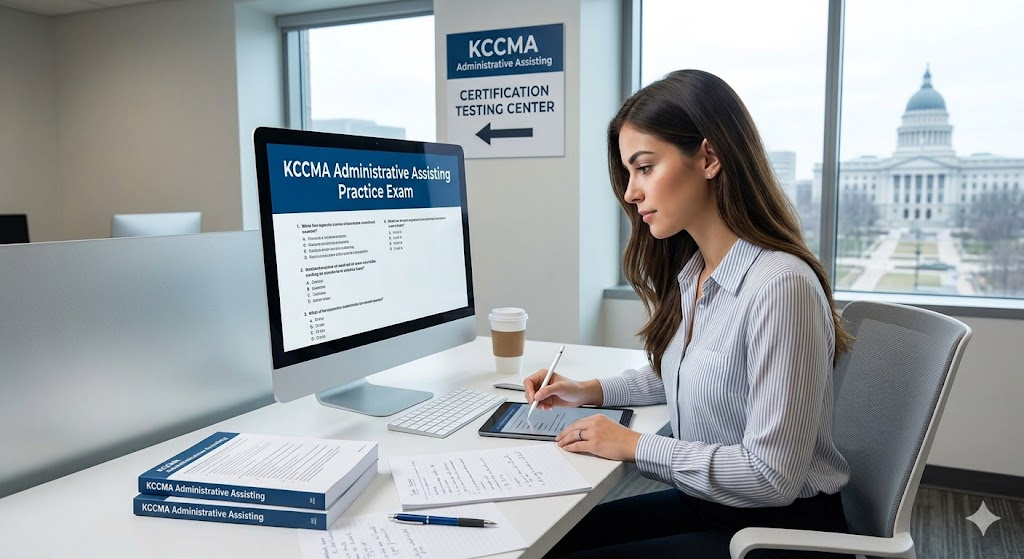
Additional Information
What the Course Entails and Exam Details
The path to KCCMA Administrative Assisting certification involves a thorough understanding of the multifarious tasks that support a productive office environment. The course and practice test focus on several critical domains:
General Office Administration: Managing daily workflow, handling telephone and email communication with professionalism, maintaining office supplies, and coordinating logistics for meetings and events.
Records Management: Creating, organizing, maintaining, and protecting physical and electronic files, with an emphasis on data accuracy, confidentiality, and relevant retention policies.
Business Communication: Crafting clear, correct, and professional written documents, such as memos, letters, reports, and emails, and demonstrating effective verbal communication skills.
Financial and Technical Skills: Basic knowledge of budgeting, accounts payable/receivable, and proficiency in common office software (word processing, spreadsheets, databases, presentations).
Local Government Overview: While not a clinical medical exam, this particular administrative assistant course includes a foundational understanding of the structure, functions, and key terminologies of local (city and county) government entities to better support their management.
The practice exam consists of multiple-choice questions meticulously designed to mirror the content, difficulty, and format of the final KCCMA Administrative Assisting exam. It is a comprehensive assessment that covers all the aforementioned domains, allowing you to identify strengths and pinpoint areas requiring further study.
What to Expect in the Final Exam
The final KCCMA Administrative Assisting Exam is a comprehensive, timed assessment, typically administered via a computer-based platform. Here is a breakdown of what you can expect:
Format: The exam predominantly features multiple-choice questions, which may include some that present situational scenarios, requiring you to apply your knowledge to solve real-world office management problems.
Time Limit: You will typically have a specific time limit, such as 2 hours (120 minutes), to complete all sections of the exam.
Number of Questions: The number of questions can vary but is often around 100 to 120 scored questions, plus additional unscored pretest questions used for future exam development.
Passing Score: To become KCCMA certified, you must achieve a specific passing score. This is often a scaled score, for instance, 70% or 390 on a scale ranging from 200 to 500.
Specific Rules: The exam is closed-book, and strict proctoring rules apply. Candidates are generally prohibited from using outside materials, personal electronic devices, or leaving the testing area during the session without authorization.
How to Study and Exam Centers
Preparation is paramount for success on the KCCMA Administrative Assisting Exam. The combination of practice testing and structured study will build the knowledge and confidence necessary to excel. Here are actionable strategies:
Take the Practice Test Early: Begin your preparation by taking the full KCCMA Administrative Assisting Practice Test. This is a critical diagnostic tool. After completion, thoroughly review the answer explanations, not only for the questions you got wrong but also for the ones you guessed on. This will expose your specific knowledge gaps.
Review Official Study Materials: Obtain and study the official guide or course materials, if available. Use the detailed content outline provided by the certifying body as your roadmap, focusing your efforts on the areas identified as weak points during your practice test.
Focus on Applied Scenarios: For areas like communication and office management, work on case studies and applied scenarios. Consider how you would handle complex scheduling, difficult constituent interactions, or the management of sensitive public records.
Simulate Exam Conditions: For subsequent attempts of the practice test, simulate actual exam conditions. Set aside a block of uninterrupted time, sit in a quiet space, and time yourself strictly to build endurance and time-management skills.
Exam Centers and How to Take the Test:
The final KCCMA Administrative Assisting Exam is administered at authorized locations and via secure online platforms.
Online Portals: Many candidates choose to take the exam remotely through a secure online proctoring service or a dedicated portal provided by the certifying organization, allowing flexibility to test from home.
Authorized Physical Centers: The exam can also be taken at designated physical testing centers, which may include specific technical or community colleges, authorized business schools, or, in some cases, dedicated government training facilities.
Local Government or Authorized Schools: In particular regions, certain large local government bodies or educational institutions with pre-approved programs may be authorized to host the examination for their employees or students. When you register for the exam, you will be able to select your preferred method and see a list of available centers.
Job Opportunities from the Course
Earning the KCCMA Administrative Assisting certification validates your specialized skills and opens doors to a diverse range of positions. Job titles unlocked by this credential include:
Administrative Assistant
Office Manager
City Departmental Secretary
County Clerk Assistant
Receptionist
Executive Assistant
Records Coordinator
Finance and Payroll Clerk
Public Works Administrative Support
Human Resources Assistant
For each of these roles, the KCCMA certification serves as a powerful signal to employers, particularly within the public and non-profit sectors, that you possess the verified skills and understanding needed to support leadership and contribute effectively to an organizational team. We wish you the very best in your preparation and subsequent success on your administrative career path!
Frequently Asked Questions
Reviews
5.0
Based on 0 reviews
Leave a Review
No reviews yet. Be the first to review!