
Keller und Knappich Augsburg (KUKA) Certification Practice Test
$69.00
- Buy to unlock unlimited access to all Quiz questions and Answers in this Quiz.
- After purchase you can print a PDF of the whole quiz at any point. The PDF will contain the questions and the correct answers.
About this Exam
The Keller und Knappich Augsburg (KUKA) Certification is a globally recognized credential that validates your expertise in industrial robotics and automation.
As one of the world's leading manufacturers of intelligent robotics, KUKA sets the industry standard for precision manufacturing, assembly, and plant engineering.
This certification is designed specifically for robotics engineers, automation technicians, system integrators, and maintenance professionals.
Earning this credential proves to employers that you possess the hands-on skills and theoretical knowledge required to safely operate, program, and troubleshoot KUKA robot systems in high-stakes industrial environments.
Whether you are looking to break into the automation industry or elevate your current engineering career, this certification serves as a powerful testament to your technical proficiency.
Ready to test your knowledge?
Buy Now to Access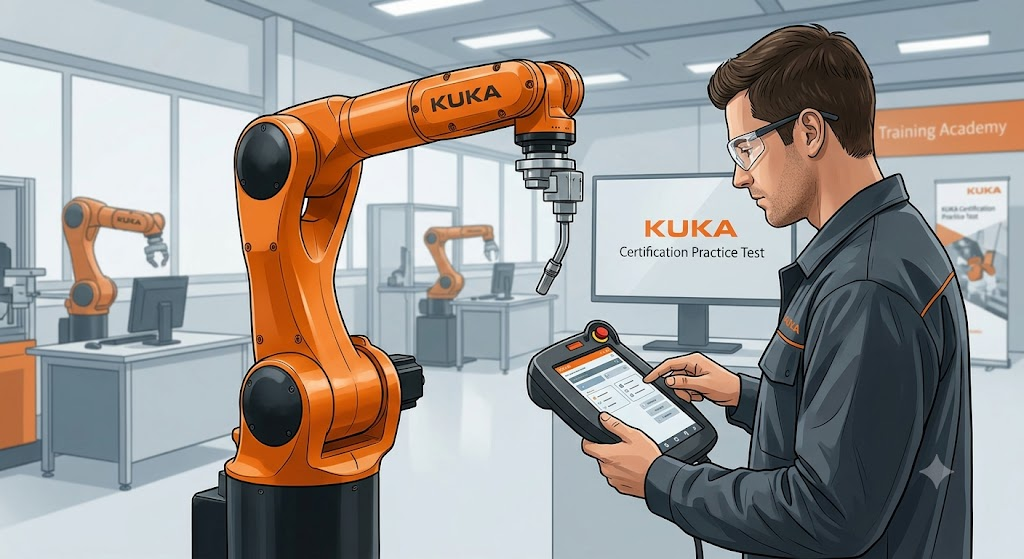
Additional Information
What the Course Entails and Exam Details
The certification pathway typically begins with comprehensive training courses such as KUKA Robot Programming 1 and 2, which build your foundational and advanced skills.
You will dive deep into the fundamental principles of robotic safety, learning how to operate within secure industrial parameters.
The syllabus heavily emphasizes practical operation using the KUKA smartPAD teach pendant, teaching you how to jog the robot effectively in various coordinate systems including Joint, World, Base, and Tool coordinates.
Students will also master tool calibration, payload configuration, and the intricacies of the KUKA Robot Language (KRL).
Furthermore, the course covers vital maintenance procedures, mastering techniques, and error handling to ensure minimal downtime on the factory floor.
The exam itself is meticulously structured to test both your conceptual grasp of these systems and your physical ability to command a robotic arm in real time.
What to Expect in the Final Exam
The final certification exam is a rigorous evaluation split into two main components to ensure comprehensive competency.
First, you will encounter a theoretical section consisting of multiple-choice and short-answer questions.
This section tests your knowledge of KRL syntax, safety protocols, coordinate mathematics, and system diagnostics.
Second, and most importantly, you will face a hands-on practical assessment where you must physically interact with a KUKA robot using the smartPAD.
During the practical exam, an evaluator will ask you to perform specific tasks such as calibrating a new tool center point (TCP), creating a movement program avoiding defined obstacles, and recovering the robot from a simulated fault.
Time limits are strictly enforced to simulate real-world production pressures, typically allowing you around two hours for the practical tasks.
You must achieve a passing score of at least 70% to 80%, depending on the specific certification level, with zero tolerance for severe safety violations.
How to Study and Exam Centers
Preparation is the key to success, and mastering a KUKA system requires a blend of theoretical study and practical muscle memory.
Your best study strategy is to spend as much guided time as possible practicing on physical KUKA robots or utilizing KUKA.Sim, the official simulation software.
KUKA.Sim allows you to build virtual cells and practice programming KRL offline, giving you a risk-free environment to test complex logic.
Additionally, thoroughly review your official KUKA College training manuals, focusing heavily on safety guidelines and coordinate system definitions.
When you are ready to take the test, exams are typically administered in person due to the hands-on requirement of the practical assessment.
You can schedule your exam at official KUKA College locations distributed globally or through authorized educational partner institutions and certified technical schools.
Some theoretical prerequisite exams may be available online via designated testing portals, but the final certification will always require your physical presence at a certified robotics lab.
Job Opportunities from the Course
Earning your KUKA Certification opens the door to a highly lucrative and rapidly expanding job market in the automation sector.
Below are some of the primary career paths and specific job titles this certification unlocks:
Robotics Programmer: You will be responsible for writing, testing, and optimizing KRL code for new manufacturing cells to maximize production efficiency.
Automation Technician: You will handle the day-to-day operation, troubleshooting, and minor programming adjustments of robotic systems on the factory floor.
Robotics Maintenance Engineer: Your focus will be on predictive and preventative maintenance, diagnosing hardware faults, and ensuring the mechanical integrity of the KUKA arms.
System Integrator: You will design complete automated work cells, linking KUKA robots with PLCs, vision systems, and safety networks.
Control Systems Engineer: You will develop the overarching control logic that dictates how KUKA robots interact with other automated machinery in a synchronized production line.
Robot Operator: An entry-level role where you will monitor automated processes, load and unload fixtures, and perform basic fault recovery using the smartPAD.
Frequently Asked Questions
Reviews
5.0
Based on 0 reviews
Leave a Review
No reviews yet. Be the first to review!