
Kent State General Psychology Practice Test
$69.00
- Buy to unlock unlimited access to all Quiz questions and Answers in this Quiz.
- After purchase you can print a PDF of the whole quiz at any point. The PDF will contain the questions and the correct answers.
About this Exam
Welcome to your comprehensive guide for the Kent State General Psychology course and its practice assessment, inspired by the rigorous academic standards of Kent State University. The foundational General Psychology course (often designated as PSYC 11762) is designed as a dynamic introduction to the scientific approach to understanding human behavior and mental processes. Whether you are aiming for a career in psychology or simply want to gain profound insights into yourself and others, this course is your essential starting point. It's tailored for students across diverse academic disciplines, providing the critical thinking skills and core knowledge necessary to succeed in a complex world. The practice test itself is a valuable diagnostic tool, offering a realistic preview of the final exam, helping you identify areas of strength and weakness early in your study journey. Let this practice test be a powerful resource to boost your confidence and prepare you for academic success at KSU.
Ready to test your knowledge?
Buy Now to Access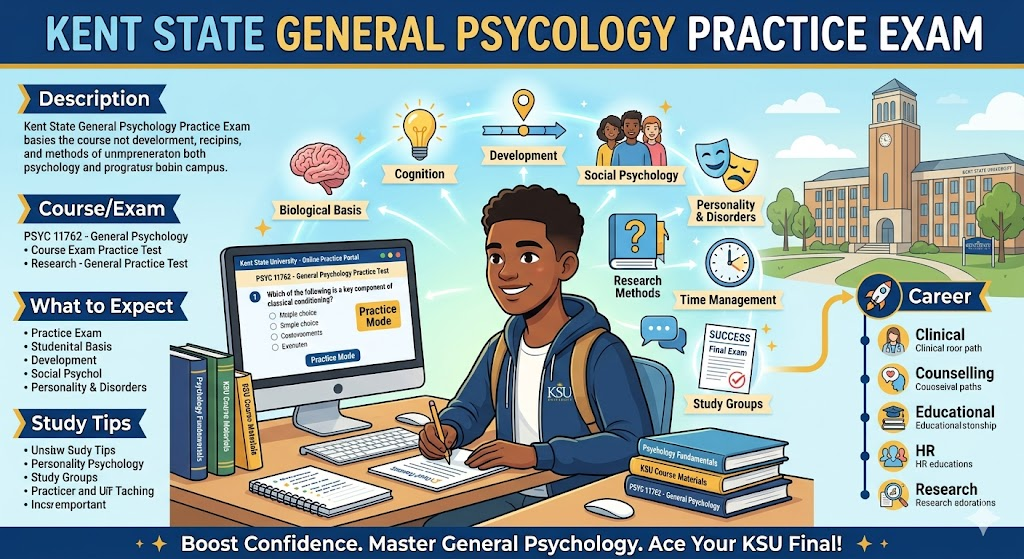
Additional Information
What the Course Entails and Exam Details
Kent State's General Psychology course provides a sweeping tour of the landscape of psychological science, exploring the multifaceted nature of the human mind. The syllabus typically covers a wide array of fascinating topics, giving you a holistic understanding of this dynamic field. Completion of the course is a key requirement for psychology degrees and many other programs, serving as a vital prerequisite for advanced study. While specific course policies can vary by semester and instructor, this article focuses on the broad content you can expect to encounter and prepare for, including what the actual final exam entails.
Key topics covered in the course generally include:
The History & Science of Psychology: Discover how the discipline evolved and the rigorous research methods psychologists use.
Biological Bases of Behavior: Explore the intricate connections between the brain, nervous system, and our actions.
Sensation and Perception: Learn how we receive, interpret, and understand information from the world around us.
Learning and Memory: Unravel the processes that shape how we acquire new skills, habits, and knowledge, and how we retain and recall that information.
Consciousness and Sensation: Delve into topics like sleep, dreaming, attention, and our awareness of internal and external stimuli.
Cognition, Language, and Intelligence: Understand the complex mental activities involved in thinking, communication, and problem-solving.
Human Development Across the Lifespan: Trace the physical, cognitive, and social changes that occur from infancy to adulthood.
Motivation and Emotion: Examine the forces that drive our behavior and the rich tapestry of human feelings.
Personality: Discover different theories and approaches for understanding human individuality.
Social Psychology: Explore how our thoughts, feelings, and actions are influenced by other people.
Psychological Disorders & Therapy: Understand the diagnosis, causes, and treatments of mental health conditions.
Health Psychology & Stress: Learn about the interplay between physical and mental health.
The final course exam, for which the practice test is key preparation, will comprehensively assess your understanding of these and other core principles, ensuring you are well-grounded for subsequent academic and professional pursuits.
What to Expect in the Final Exam
While specific exam formats are at the discretion of the instructor, you can typically anticipate a rigorous and comprehensive assessment during the designated finals week. This exam serves as a direct, summative measurement of your performance in the course.
Exam Format: The actual final exam at Kent State commonly features a combination of assessment types. You can expect a significant number of multiple-choice questions designed to test your breadth of knowledge across the syllabus. Instructors may also include short-answer questions, matching exercises, or even an essay component to assess deeper critical thinking and application skills.
Passing Score: Students should strive to check their specific course syllabus for exact details, as individual course requirements and grading scales can vary. However, a common benchmark in university courses is a grade of 'C' (typically 60-70% or higher, depending on the specific scale) to earn credit and progress to subsequent courses.
Time Limits: Final exams are typically scheduled for 2 to 3 hours, allowing ample time for careful consideration and thorough responses. This allocated time ensures fairness and allows you to demonstrate the full extent of your learning.
Rules & Integrity: Adherence to academic integrity is paramount. You will be expected to present valid student identification, use only permitted materials (usually none beyond pens/pencils and potentially a simple calculator, as detailed by the instructor), and maintain absolute confidentiality. Academic dishonesty is taken seriously at Kent State, and maintaining high ethical standards is a key part of your educational journey. For the specific location of your final, be sure to consult your course-specific communications and the university's academic success and testing centers.
How to Study and Exam Centers
Effective study and knowing where to go are crucial components of exam success. Use this article to optimize your preparation strategy!
Actionable Study Strategies:
Embrace the Practice Test: Use the Kent State General Psychology Practice Test for realistic simulation, diagnostic feedback, and to familiarize yourself with the question styles you are likely to encounter. Actively review your answers, especially the incorrect ones.
Review Course Material Regularly: Consistency is key. Create a schedule to review your class notes, textbooks, and any supplementary material. Use effective techniques like flashcards for terminology and key concepts.
Form or Join Study Groups: Collaborate with fellow students to discuss complex topics, quiz each other, and gain different perspectives. Teaching a concept to someone else is a powerful way to reinforce your own understanding.
Active Engagement & Application: Don't just passively read. Actively recall information, explain concepts in your own words, and think of real-world examples to make the knowledge stick.
Utilize University Resources: Visit the Kent State Library for quiet study spaces or group rooms. Explore tutoring services, supplemental instruction sessions, and individual consultations with your professor or TA. Seek out additional study guides and online portals for practice resources.
Exam Centers:
Practice Test Location: Access to the practice test is typically provided online, often through Kent State's learning management system (such as Canvas) or by your instructor. This gives you the flexibility to practice in a setting convenient for you. Be sure to check your course communications for access details.
Actual Final Exam Location: The real final exam is usually administered in person at a specific campus location, such as a large lecture hall or designated exam room, during the scheduled final exam week. The location will be clearly communicated by your instructor and potentially listed in your course syllabus. For online or special accommodation exams, details regarding proctoring or online portals will be provided. In certain situations, student accessibility services and testing centers, like those at the Kent Campus or other regional locations, may be involved, so stay informed via official channels. Ensure you confirm the exact time and location well in advance to avoid any stress on exam day.
Job Opportunities from the Course
A strong performance in General Psychology and subsequent psychology coursework is an investment in a future full of diverse and impactful career paths. While completing this single course does not unlock a professional certification itself, it is the fundamental stepping stone to a wide range of professional fields. Use this guide to explore potential future roles! The foundational knowledge you gain is crucial for:
Clinical Psychologist (Further graduate education & licensure required): Assessing and treating mental and emotional disorders.
Counseling Psychologist (Further graduate education & licensure required): Helping people recognize strengths and cope with everyday problems.
Educational Psychologist (Further graduate education required): Working within educational settings to help students, teachers, and parents.
Forensic Psychologist (Further graduate education required): Applying psychological principles within the legal system.
Health Psychologist (Further graduate education required): Examining the interplay between psychological factors and health/illness.
Industrial-Organizational Psychologist (Further graduate education required): Using psychological principles in workplace settings.
Social & Market Researcher (Related fields): Collecting and analyzing data to understand consumer behavior and social trends.
Social Worker/Mental Health Counselor (Requires further education & often licensure): Providing support and resources to individuals and families.
Human Resources Specialist (Uses foundational principles): Managing personnel and organizational development.
Teaching/Academia (Typically requires further education): Educating the next generation at various levels.
Career paths in diverse sectors: Including healthcare, government, and creative industries, where a deep understanding of human behavior is valued.
Completing this course credit successfully not only demonstrates your academic capability but also equips you with versatile skills and insights that are highly valuable in countless professional contexts. Your journey starts here, and this comprehensive guide, combined with your diligent preparation and the Kent State General Psychology Practice Test, is your key to unlocking a future of opportunity. Good luck on your exam!
Frequently Asked Questions
Reviews
5.0
Based on 0 reviews
Leave a Review
No reviews yet. Be the first to review!