
Kentucky Association for Academic Competition (KAAC) Practice Test
$69.00
- Buy to unlock unlimited access to all Quiz questions and Answers in this Quiz.
- After purchase you can print a PDF of the whole quiz at any point. The PDF will contain the questions and the correct answers.
About this Exam
The Kentucky Association for Academic Competition (KAAC) is a prestigious organization dedicated to promoting academic excellence in Kentucky's schools. It is renowned for hosting the annual Governor's Cup, the Commonwealth's premier academic competition. This program is designed for students from elementary to high school (grades 4-12), offering a platform to showcase their knowledge and skills across a wide spectrum of subjects. The KAAC Practice Test is a crucial tool, acting as a simulation for these high-stakes competitions. It is engineered to help students, coaches, and academic teams familiarize themselves with the content, format, and rigor of official events. This practice opportunity is intended for high-achieving students who want to test their depth and breadth of academic knowledge, cultivate critical thinking, and build effective teamwork strategies in a competitive yet encouraging environment. Participating in KAAC events helps students grow not only academically but also in key life skills such as leadership, quick decision-making, and creativity.
Ready to test your knowledge?
Buy Now to Access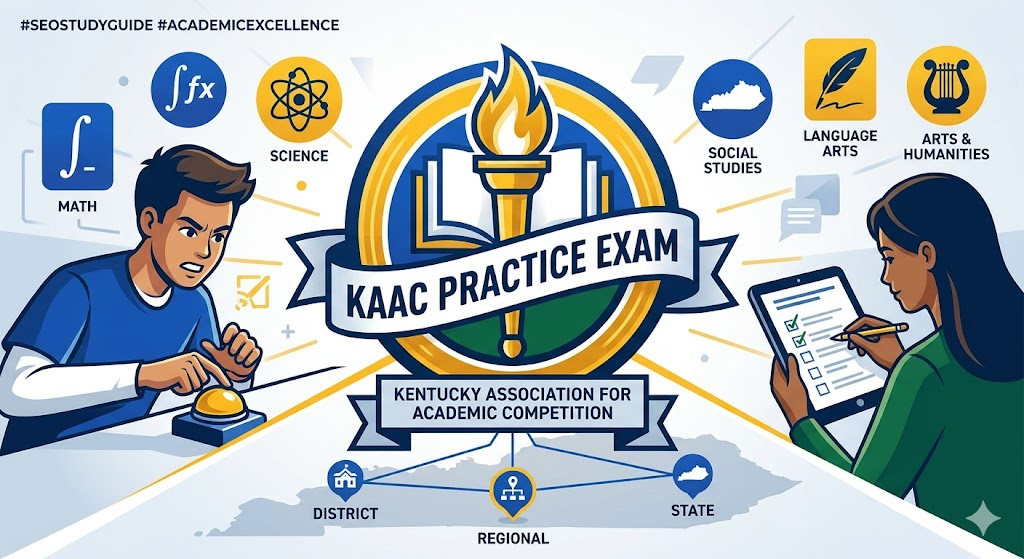
Additional Information
What the Course Entails and Exam Details
Preparing for a KAAC event through a practice test requires understanding the core academic pillars the organization assesses. While not a conventional 'course' with a linear syllabus, KAAC competitions evaluate mastery in several specific events and content areas. The focus is on a comprehensive understanding of core disciplines, demanding not only memorization of facts but also the ability to apply that knowledge quickly and accurately. The practice materials mirror the official competition, ensuring students are tested on the same standards.
The core areas of focus in a KAAC context, and therefore in the practice test, typically include:
Quick Recall: A fast-paced, quiz bowl-style event where teams of four use buzzers to answer questions in the five main content areas listed below. This entails developing speed, accuracy, and strong team communication.
Written Assessments: Individual tests where students must demonstrate deep subject-specific knowledge. The five content areas covered are:
Mathematics: Algebra, Geometry, Calculus, Statistics, and problem-solving.
Science: Biology, Chemistry, Physics, Earth Science, and Space Science.
Social Studies: History (U.S., World, Kentucky), Geography, Economics, Government, and Current Events.
Language Arts: Literature (heavy emphasis on classic and contemporary works), Grammar, Literary Terms, and Writing Mechanics.
Arts & Humanities: Art History, Music Theory and History, Dance, Drama/Theater, Mythology, Religion, and Pop Culture.
Future Problem Solving (FPS): A team event focusing on critical and creative thinking. Students are given a complex future scenario and must use a six-step process to identify problems and develop a comprehensive plan of action with creative solutions.
Written Composition: An event assessing writing skills, requiring students to craft an argumentative (Middle/High) or opinion (Elementary) essay in response to a specific prompt within a strict time limit.
A comprehensive KAAC practice test will offer simulated experiences across all these domains, providing a complete diagnostic of a student's or team's strengths and weaknesses.
What to Expect in the Final Exam
While the term "Final Exam" in this context refers to an official KAAC Governor's Cup competition (District, Regional, or State level), the format is precisely what the practice test aims to simulate. The official competitions are highly organized and follow a specific, rigid structure. Students should expect a formal setting with strict rules, proctors, and a competitive atmosphere. The format for each key event is as follows:
Written Assessments: These are individual, multiple-choice exams.
Number of Questions: 30 for Elementary and JV Challenge, 40 for Middle Grades, and 50 for High School.
Tiebreaker Questions: Assessments usually include additional questions for tie-breaking purposes.
Time Limit: A strict time limit is enforced, commonly 35 minutes for Elementary. High school students may have slightly longer but similarly strict limits per test.
Passing Score: There is no "passing" score; the focus is on achieving the highest possible raw score to place against other students.
Rules: Students must bring a charged, functional device for content assessments, as they may be administered digitally at the host site. Calculated are typically only allowed in specified math events.
Quick Recall:
Format: Toss-up and bonus questions in the five main content areas.
Rounds: Each match consists of two halves.
Time: A strict time limit per question (e.g., 5-10 seconds to answer after buzzing in, and 10 seconds to answer a bonus) determines the pace.
Future Problem Solving & Composition: Both are timed events where students or teams are given a prompt or scenario and must complete their responses (booklets or essays) online or on paper, depending on the current format. A 90-minute limit is standard for high school levels in composition, while elementary has 60 minutes.
The "Final Exam" is a combination of these elements, where individual scores contribute to an overall team standing, aiming for advancement to higher competition levels and final placement.
How to Study and Exam Centers
Preparation is the absolute key to success in KAAC. Students and coaches must adopt a dedicated, multi-faceted study strategy. The practice test is a cornerstone of this, but must be supplemented by deep, foundational learning.
Here are actionable study strategies:
Deep-Dive Studying: Don't just skim. Create detailed study binders or digital notes for each content area. Focus on key figures, major events, fundamental theories, and influential artistic works. The depth of knowledge expected goes beyond a standard classroom level.
Use Official KAAC Materials: The single most effective way to study is by using official KAAC-produced resources. This includes their specific study guides and, critically, past years' actual Written Assessment and Quick Recall questions, which are available for purchase from the KAAC store. These show the exact type, phrasing, and rigor of questions.
Master the Format: Use the KAAC practice test to get comfortable with the timing and pressure. For Written Assessments, practice finishing within the 35-minute window. For Quick Recall, simulate matches using a buzzer system to build response speed. Coaches can set up practice sessions using the online KAAC practice system for FPS and Composition.
Specialization and Teamwork: While breadth is important, teams succeed when members specialize in different areas for Quick Recall. For team events like FPS, practice consistent brainstorming and problem-solving drills.
Stay Informed: Keep a pulse on current events, as they form a significant portion of Social Studies and can be relevant in FPS.
Exam Centers and Registration:
How and Where to Take the Exam: Official competitions do not use commercial centers like Pearson VUE. They are hosted physically by member schools throughout Kentucky at the District, Regional, and State levels. A designated "host site" is determined for each level. The Galt House in Louisville is the traditional home of the KAAC State Finals. Practice tests and scrimmages are organized by individual schools, leagues, or coaches, often using the official KAAC online tools.
How to Register: Students must be part of an academic team at a KAAC-member school to participate. The coach is responsible for officially entering students into competitions by specified deadlines before the District Planning Meeting. Direct individual public registration is not typically available.
Academic and Career Benefits unlocked by the Course
While a KAAC competition isn't a vocational certification that directly unlocks a specific job title, it is a highly recognized and prestigious achievement that opens significant academic and professional doors. The skills honed in this program are exactly what universities and future employers look for, marking a student as an exceptional achiever.
Participating in KAAC and excelling can "unlock" the following opportunities:
Academic and Career Benefits | Description |
College Scholarships | KAAC State Finalists, particularly winners in individual assessments or components like FPS, frequently receive substantial scholarship offers from Kentucky universities and other institutions that recognize academic prowess. |
Distinguished College Applications | High placement in Governor's Cup is a major "distinguishing factor" on college applications, demonstrating academic depth, commitment, and ability to perform under pressure. It is highly valued by admissions officers, especially at top-tier universities. |
Leadership and Teamwork Skills | Serving as a Quick Recall captain or leading an FPS team builds critical, transferable skills essential in any future career. It provides demonstrable proof of teamwork and leadership experience on a resume. |
Critical and Creative Thinking | The rigor of Future Problem Solving and rapid-fire decision-making in Quick Recall develop advanced mental agility, problem-solving, and critical thinking abilities that are vital for success in STEM, law, medicine, and business careers. |
Strong Academic Foundation | Mastery of the KAAC content areas provides a head-start for advanced high school coursework (AP/IB) and undergraduate studies in everything from the humanities to engineering. |
Recognition and Prestige | Earning a placement at the District, Regional, or State level brings formal recognition to the student and their school, creating a lasting record of academic achievement in the Commonwealth of Kentucky. |
Participating in the KAAC practice test is the essential first step on a pathway that doesn't just measure knowledge, but builds a future of academic and professional success. Students should embrace this comprehensive study guide and the practice opportunities it provides to unlock their full potential.
Frequently Asked Questions
Reviews
5.0
Based on 0 reviews
Leave a Review
No reviews yet. Be the first to review!