
Kentucky Civics Practice Test
$69.00
- Buy to unlock unlimited access to all Quiz questions and Answers in this Quiz.
- After purchase you can print a PDF of the whole quiz at any point. The PDF will contain the questions and the correct answers.
About this Exam
The Kentucky Civics Practice Test serves as a essential study aid for understanding the fundamental principles of American democracy, the structure of both the U.S. and Kentucky state governments, and the rights and responsibilities of citizenship. It is designed primarily for high school students in Kentucky as part of their graduation requirements, and also contains many topics relevant to the naturalization process for aspiring United States citizens. This comprehensive resource aims to build a deep, functional understanding of our shared civic knowledge, ensuring that test-takers are well-equipped not just to pass an exam, but to be informed, active participants in our society. The tone is encouraging, professional, and dedicated to helping each individual achieve their educational goals.
Ready to test your knowledge?
Buy Now to Access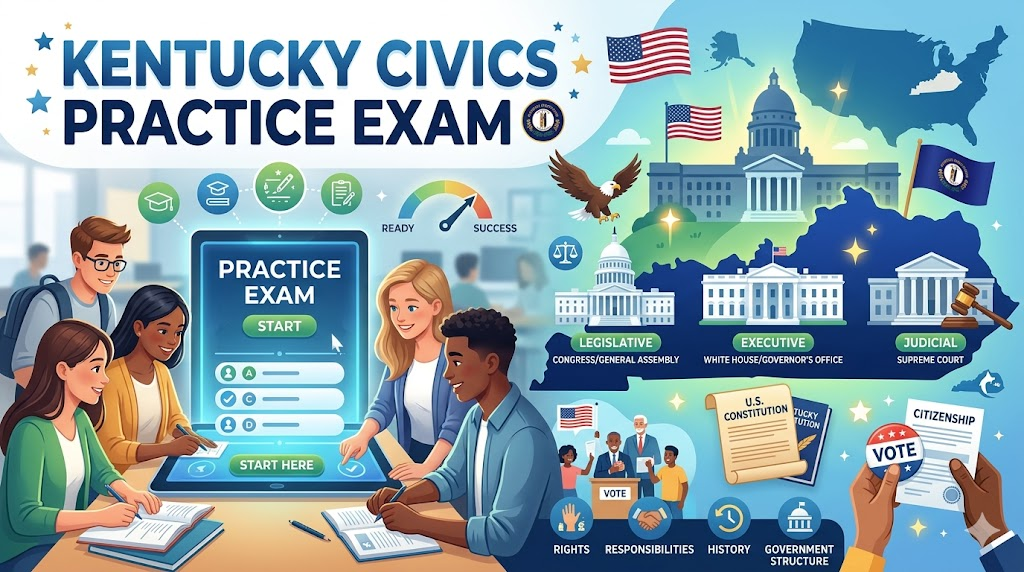
Additional Information
What the Course Entails and Exam Details
While the specific curriculum preceding the exam may vary by school or study program, the core topics covered in the Kentucky Civics test remain consistent. Key areas of study include:
Principles of American Democracy: This covers the supreme law of the land, the functions of the Constitution, the Bill of Rights, and fundamental concepts of democracy and representation.
System of Government: You will explore the structure and powers of the three branches of the U.S. federal government (Legislative, Executive, Judicial), the system of checks and balances, and the roles of key figures like the President and members of Congress. This section also likely delves into the principles of federalism.
Kentucky State Government: A unique and important element for Kentuckians, you must understand the organization of your own state's government, including the structure and function of the Kentucky General Assembly (legislature), the role of the Governor, and the judicial system. This section would also touch on key elements of Kentucky's own history and constitution.
Rights, Responsibilities, and History: The test covers crucial information on the rights guaranteed by the Constitution (such as those in the First Amendment), historical documents and events (like the Declaration of Independence), important historical figures, and the basic responsibilities and requirements of citizenship.
The USCIS Civics Questions: For high school students, the questions are typically drawn from the list of 100 civics questions used in the U.S. naturalization test, making that specific material a primary area of focus. Aspiring citizens, of course, study this specific list directly.
The exact number of questions can vary slightly by implementation for high school students but typically involves a multiple-choice format covering these extensive topic areas. The key is comprehensive preparation across all potential questions.
What to Expect in the Final Exam
For high school students in Kentucky fulfilling the civics requirement for graduation:
Format: The actual final exam is typically a multiple-choice test. It consists of around 100 questions covering the topics outlined above. You will select the best answer from several options for each question.
Passing Score: Students are generally required to pass the exam as a graduation requisite. While the specific passing score can be set at the local level and you should consult your school's guidance, it represents a benchmark that demonstrates adequate civic literacy. A common passing score requirement can be in the range of 60% or higher.
Time Limit: Expect a sufficient time limit to carefully read and answer each question. The exact duration may be specified by your school but typically allows enough time for thoughtful responses, potentially 60 to 90 minutes.
Exam Setting: The actual graduation civics test is typically administered in a supervised setting within your high school.
For those taking the USCIS Naturalization Civics Test:
Format: This version consists of 10 oral questions drawn from the list of 100 possible civics questions. An applicant must answer 6 out of the 10 questions correctly to pass.
Passing Score: Meeting the 6-out-of-10 correct answers requirement is a key step in naturalization.
Time Limit/Rules: The time is managed by the USCIS officer during your naturalization interview, and the rules are standard for federal agency procedures.
Exam Setting: This is held at a local USCIS office during your naturalization interview.
Regardless of which context applies to you, proper preparation with resources like this practice exam and the official study materials is your most important step to knowing exactly what to expect.
How to Study and Exam Centers
Effective preparation is key to success on the Kentucky Civics test. Here are some actionable study strategies:
Practice Frequently: The very best way to prepare is by taking and retaking high-quality practice tests. This not only familiarizes you with the question format but also helps you identify areas where your knowledge may be lacking. Treat each practice test like the real thing to build stamina and confidence.
Review Official Resources: High school students should use their classroom materials, textbooks, and any specific resources provided by their school or the Kentucky Department of Education. For the USCIS content, utilize the official study guides, flashcards, and materials available on the USCIS website.
Discuss and Engage: Civics is best understood through discussion. Talk about the concepts, historical events, and government functions with teachers, peers, or mentors. Engaging in conversations helps solidify information and build a more complete understanding.
Break Down the Material: Divide the material into manageable sections (e.g., studying the three branches of government one day, rights and responsibilities another, Kentucky state details, etc.). Focus on truly understanding the why and how of each concept.
Simulate Test Conditions: When comfortable with the material, take at least one full-length practice test under timed, quiet conditions to understand your pacing and manage potential test anxiety.
Exam Centers and Administration:
Practice Tests: You can find practice tests through various online platforms, educational websites, and potential resources provided by your school or educational organizations. These are taken whenever and wherever you choose online.
The Final High School Civics Test: For high school students, the actual graduation exam is almost always administered within your high school. You will be notified by your school administration or guidance office about specific dates, times, and procedures. It is taken on campus in a standardized setting.
The Final USCIS Naturalization Civics Test: This official oral exam is given during your naturalization interview at a local USCIS field office. Specific details and your appointment time will be communicated to you by USCIS after you apply for citizenship.
You will not typically take the final test at commercial centers like Pearson VUE or other external locations. The key is to know where you will be tested and prepare accordingly.
Job Opportunities from the Course
A strong understanding of civics, demonstrated by passing the Kentucky Civics test, opens up a wealth of educational and career paths. While the test itself is often a prerequisite rather than a direct professional certification, the knowledge and achievement it unlocks are invaluable. Here are some key career paths and opportunities:
Meets High School Graduation Requirement: Successfully completing this requirement is fundamental for obtaining your high school diploma. A diploma is the foundation for nearly all secondary and post-secondary educational and career choices.
Public Service Roles: While additional specialized knowledge is required, a foundational understanding of government structure and function is essential for roles at the local, state, or federal level, including:
Law Enforcement and Correctional Officers
Administrative roles within various government agencies
Public Administration staff
Foundation for Careers in Education: A strong background in civics, history, and government is relevant for:
Social Studies and Civics Teachers (requires teacher certification)
Educational Administrators and Staff
Prepares for the USCIS Naturalization Test: For aspiring citizens, passing this portion of the process is a direct step towards becoming a U.S. citizen, which can unlock a vast array of jobs and opportunities restricted to citizens.
Enhances Business and Law Prerequisites: For those considering careers in:
Law (fundamental understanding of constitutional frameworks)
Business (understanding of legal structures and political environments)
Journalism (knowledge of government and legal processes is crucial for informed reporting)
Promotes Informed Civic Engagement and Leadership: The skills and knowledge you gain are relevant to roles that require understanding of community and government, such as:
Non-profit Organization staff and leadership
Community outreach and advocacy positions
Active participation and potential leadership in local civic or political organizations
Ultimately, this test is a vital step and the knowledge it represents is a fundamental building block for a vast range of careers that require understanding of, or interaction with, our government, history, and civic institutions.
This comprehensive study guide and practice test, combined with dedicated study of the foundational materials, will prepare you effectively. Embrace the learning process, engage with the information, and approach your study time with dedication. You have all the potential to meet this challenge with confidence and success! Good luck on your path to civic literacy and accomplishment!
Frequently Asked Questions
Reviews
5.0
Based on 0 reviews
Leave a Review
No reviews yet. Be the first to review!