
Kentucky Occupational Skill Standards Assessment (KOSSA) Culinary and Food Services EOP Practice Test
$69.00
- Buy to unlock unlimited access to all Quiz questions and Answers in this Quiz.
- After purchase you can print a PDF of the whole quiz at any point. The PDF will contain the questions and the correct answers.
About this Exam
The Kentucky Occupational Skill Standards Assessment (KOSSA) Culinary and Food Services EOP is a comprehensive evaluation designed for high school students enrolled in culinary arts and food service career and technical education (CTE) pathways throughout Kentucky.
This assessment is part of the state’s program-ending evaluation system, validating that students have mastered the essential knowledge and practical skills required to transition effectively from high school into entry-level culinary careers, postsecondary education, or advanced training.
A strong performance on this exam provides a recognized credential that demonstrates a student's readiness and commitment to the industry, making it a valuable asset for young people passionate about food service and professional cooking.
Ready to test your knowledge?
Buy Now to Access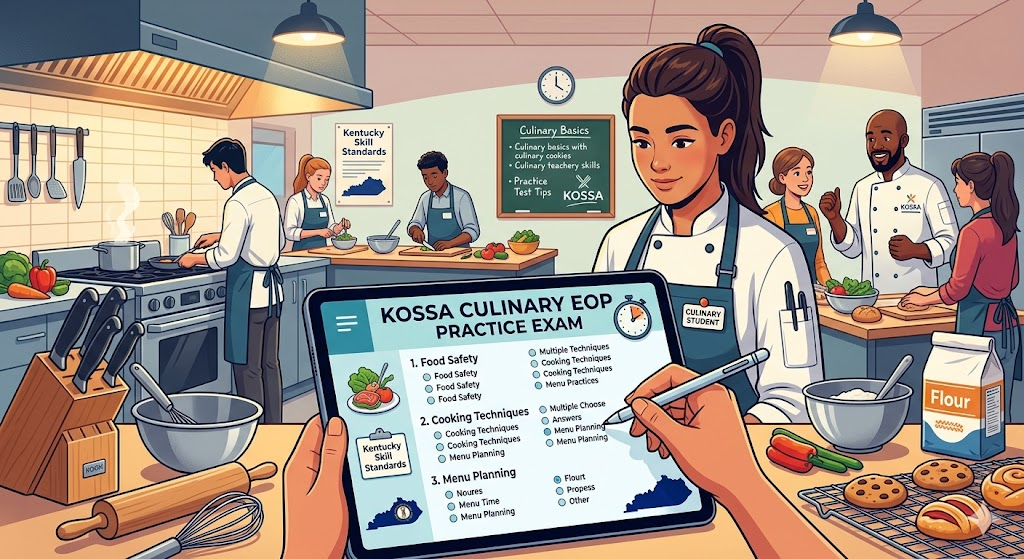
Additional Information
What the Course Entails and Exam Details
The preparatory coursework for the KOSSA Culinary and Food Services EOP covers a broad and essential spectrum of the culinary industry. While specific classroom experiences can vary, the final assessment is structured around standardized Kentucky skill standards, typically encompassing:
Food Safety and Sanitation: Crucial knowledge regarding temperature control, foodborne illness prevention, correct handwashing, and cross-contamination protocols. This area is fundamental and heavily weighted.
Professionalism and Customer Service: Understanding the industry, developing teamwork skills, positive customer interaction, and professional conduct.
Introduction to Food Service: Basic kitchen mathematics, menu types and design, nutrition fundamentals, and standard operating procedures within a professional kitchen.
Fundamental Cooking Principles and Techniques: Mastery of essential cooking methods (dry, moist, and combination heat), classic sauces, ingredient preparation, and the function of basic ingredients.
Equipment Identification and Use: Safe and proper operation of typical commercial kitchen equipment and tools, from knives to mixers and ranges.
The exam itself is typically administered via a secure online platform and primarily consists of multiple-choice questions. It aims to test both a student's academic understanding of culinary concepts and their ability to apply practical knowledge in theoretical scenarios. Practice tests, like the one mentioned, are vital for familiarizing students with the unique terminology, style, and structure of the actual questions.
What to Expect in the Final Exam
While a specific "practice test" is intended to mirror the final assessment, the KOSSA Culinary and Food Services EOP has clear expectations for students. The final exam typically features a substantial number of multiple-choice questions, which students must answer within a predefined time limit.
Specific details regarding the exact number of questions and time allowance can be confirmed by your course instructor, as these are state-determined but can be subject to yearly updates.
To achieve passing status on this assessment, students must meet or exceed a specific percentage score, established by Kentucky's Department of Education based on industry standards and performance levels. Passing this exam, or achieving high proficiency, can earn students a certificate of occupational skill standards completion, which is a recognized accomplishment within the Kentucky education system and the local food service industry.
Rules during the exam are strict, requiring completion within the secure, proctored environment of an authorized school testing center. Personal electronics are typically prohibited, and proper identification may be required. The best source for the most current information regarding specific rules, question counts, and scoring benchmarks is your culinary arts instructor or school testing coordinator.
How to Study and Exam Centers
Preparation is the key to success on any assessment. For the KOSSA Culinary and Food Services EOP, a successful study strategy should integrate both theory and practice.
Actionable study methods include:
Review Class Materials: Thoroughly go through your textbooks, class notes, and assignments. Your course instructor has likely based their curriculum directly on the Kentucky standards the exam tests.
Use Study Guides: Leverage any study materials provided by your teacher or school. These are often tailored to the most critical topics.
Take the Practice Test: This is arguably your most important step. Use the specific KOSSA Culinary and Food Services EOP Practice Test mentioned in the title. Taking a practice test, especially one mirroring the online format and question style, helps you identify knowledge gaps, familiarize yourself with the question types, and practice managing your time.
Focus on Key Concepts: Pay special attention to high-weight areas like food safety and sanitation. Consider using resources from standard industry bodies, such as ServSafe materials, for additional practice in this area.
Practice Practical Skills: Even though the primary EOP is often multiple-choice, having a strong command of hands-on skills (knife cuts, cooking methods, measurement conversion) will bolster your theoretical understanding.
Group Study: Collaborate with classmates. Discussing concepts and quizzing each other can expose you to different perspectives and reinforce your own knowledge.
KOSSA exams are administered locally at your own high school or technical school testing center within a defined statewide testing window (usually in the spring of your senior year). They are not typically given at external, general testing hubs like Pearson VUE. Students do not generally register for this exam individually; registration is coordinated directly through your high school’s career and technical education department or school counselors.
Consult your culinary arts instructor or school guidance office for specific information regarding registration deadlines, the exact testing dates within the statewide window, and how to access the secure online testing environment.
Job Opportunities from the Course
A strong performance on the KOSSA Culinary and Food Services EOP and completion of the associated coursework provides a tangible signal to employers that you possess fundamental culinary and professional skills. This certification acts as a valuable stepping stone, opening doors to various exciting paths within the vast food service and hospitality industry.
Career paths and roles that are unlocked or benefited by this certification include:
Entry-Level Culinary Positions
Line Cook: Working specific stations (grill, fry, sauté) in a high-volume kitchen.
Prep Cook: Preparing ingredients and mise en place for the main production.
Garde Manger Chef: Handling cold preparations, salads, appetizers, and buffet displays.
Breakfast Cook: Specializing in morning menus and short-order cooking.
Service and Front-of-House Roles
Waitstaff / Server: Providing professional service and interaction with customers.
Host/Hostess: Managing reservations, seating, and welcoming guests.
Barista: Crafting coffee beverages, and in some settings, preparing basic light food.
Management & Specialized Career Paths (often with further experience or training)
Kitchen Manager: Overseeing kitchen operations, staffing, and food production.
Restaurant Manager: Assuming overall responsibility for both back-of-House and front-of-house.
Catering Manager: Planning and execution of off-site events and large scale service.
Catering Assistant: Supporting events from preparation to service.
Pastry Chef Assistant: Working under a pastry chef to prepare desserts and baked goods.
Additional Career Options
Institutional Food Service Worker: Contributing to food service in schools, hospitals, or corporate cafeterias.
Entrepreneur / Food Truck Owner: Starting and running your own unique food business (after further training/experience).
Culinary Educator (Future): After further education and experience, teaching the next generation of chefs.
Food Blogger / Content Creator: Using your knowledge to share recipes and culinary experiences online.
This list represents just a sample of the numerous possibilities. The solid foundation validated by the KOSSA Culinary and Food Services EOP certification, combined with real-world experience, further education, and determination, can lead to diverse and fulfilling careers throughout the entire dynamic hospitality sector.
Frequently Asked Questions
Reviews
5.0
Based on 0 reviews
Leave a Review
No reviews yet. Be the first to review!