
Kentucky Registered Environmental Health Specialist (REHS) Practice Test
$69.00
- Buy to unlock unlimited access to all Quiz questions and Answers in this Quiz.
- After purchase you can print a PDF of the whole quiz at any point. The PDF will contain the questions and the correct answers.
About this Exam
The Registered Environmental Health Specialist (REHS) credential, often referred to as the Registered Sanitarian (RS) in some jurisdictions, is a prestigious certification that signifies a high level of competence and dedication in the field of environmental health. In Kentucky, becoming an REHS is a crucial step for professionals committed to protecting public health by managing and mitigating environmental factors that can impact community well-being. This study guide is specifically tailored for individuals aiming to achieve Kentucky registration by taking the challenging REHS exam, typically administered through the National Environmental Health Association (NEHA). Whether you are a recent graduate in environmental science, a current public health employee looking to advance your career, or a professional transitioning into this vital field within Kentucky, this guide will provide you with essential insights, strategies, and a roadmap to success. The REHS role is fundamental to maintaining safe food and water supplies, managing waste effectively, controlling disease vectors, and ensuring healthy living and working environments throughout the state.
Ready to test your knowledge?
Buy Now to Access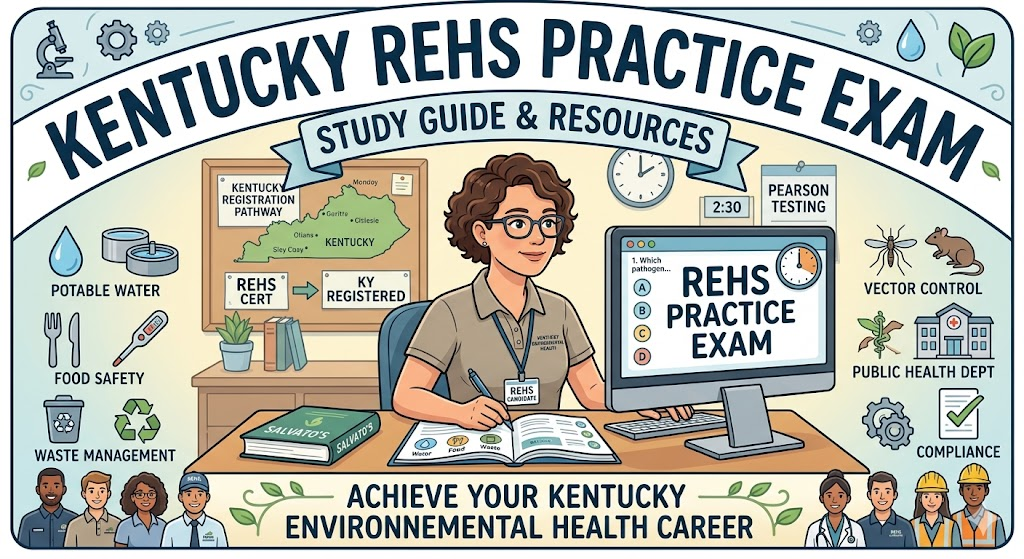
Additional Information
What the Course Entails and Exam Details
Preparation for the REHS exam, and consequently for your career in Kentucky, entails mastering a broad and complex array of environmental health domains. While there isn't a single mandated "Kentucky REHS course," you must demonstrate proficiency across several core areas. The exam rigorously tests your knowledge and practical understanding of topics crucial to everyday environmental health practice.
Key areas you must be intimately familiar with include:
Food Safety: Principles of food microbiology, identification and prevention of foodborne illnesses, safe food handling and storage practices, comprehensive inspection procedures for various food establishments, understanding and application of HACCP (Hazard Analysis Critical Control Point) plans, and thorough knowledge of the FDA Food Code relevant to current Kentucky standards.
Potable Water & Wastewater Management: Understanding public and private water supply sources, sophisticated water treatment processes, distribution system integrity, rigorous sampling and testing methodologies, relevant federal and state safe drinking water regulations, as well as principles of both municipal and onsite wastewater treatment, disposal methods, and the environmental impact of improper management.
Solid and Hazardous Waste: Comprehensive knowledge of proper collection, storage, transport, disposal, and recycling of solid waste; understanding the identification, safe handling, and regulation of hazardous materials.
Vector Control & Pests: Identifying common disease vectors (mosquitoes, rodents, ticks) prevalent in Kentucky and nationally, understanding the diseases they transmit (e.g., West Nile Virus, Lyme Disease, Rabies), and implementing effective, environmentally-sound integrated pest management strategies.
Institutions and Licensed Facilities: Applying environmental health principles to manage sanitation, safety, and hygiene in diverse settings such as schools, hospitals, childcare centers, swimming pools, campgrounds, and correctional facilities, ensuring compliance with relevant Kentucky health codes.
Air Quality & Radiation: Basic understanding of indoor and outdoor air pollution sources, their health effects, monitoring techniques, and control measures; foundational knowledge of radiation types, sources, and safety principles.
Epidemiology and Risk Assessment: Ability to apply basic epidemiological principles to investigate disease outbreaks and understand disease patterns; skill in conducting environmental health risk assessments to identify, evaluate, and prioritize hazards.
Statutes, Regulations & Administration: Thorough familiarity with federal and, most importantly, specific Kentucky state and local environmental health laws, regulations, and administrative procedures governing public health practice.
What to Expect in the Final Exam
The REHS credentialing exam, a significant hurdle on your path to Kentucky registration, is a standardized, comprehensive assessment designed to measure your professional competency. Here’s a breakdown of what you should anticipate on exam day:
Exam Format: The exam typically consists of 225 multiple-choice questions. These questions cover the diverse domains outlined above, testing both your recall of factual information and your ability to apply environmental health principles to real-world scenarios. Note that a small number (around 25) of these are unscored "pilot" questions used for testing validity. You should approach every question with equal care.
Time Limit: You will generally be allotted a total of 4 hours to complete the entire exam. This time is often divided into two sessions, each lasting approximately 2 hours, with a mandatory break in between, allowing you to manage your pacing and maintain focus.
Scoring & Passing Requirements: Your raw score (number of correct answers) is mathematically converted into a scaled score ranging from 0 to 900. A scaled score of 650 or higher is typically the required passing threshold, demonstrating the necessary level of competency for the REHS credential and subsequent Kentucky registration. You will often receive your unofficial pass/fail result immediately upon completing the computer-based test at the testing center.
Test Environment & Rules: The exam is typically administered in a secure, professional testing center environment. Strict rules are enforced: you will likely be required to present valid identification, and personal items, study materials, and electronic devices are strictly prohibited within the testing room. Be prepared for a focused and controlled testing atmosphere.
Specific Kentucky Context: While the exam itself is a national standardized test, your ultimately achieving the Kentucky REHS registration is contingent upon passing this exam. Ensure you are also aware of any potential additional Kentucky-specific application steps, fees, or requirements beyond just passing the national exam, which can be verified through the relevant Kentucky state department or board.
How to Study and Exam Centers
Effective preparation for the REHS exam demands a dedicated and strategic approach. It is not an exam you can simply cram for; sustained, comprehensive studying is key. Here are actionable strategies and information on testing.
Actionable Study Strategies:
Leverage Official NEHA Resources: Start your journey by visiting the NEHA website and thoroughly reviewing all available information about the REHS/RS credential. Utilize their official REHS/RS Study Guide and consider enrolling in their comprehensive online study course, as these are directly aligned with the exam's content domains. Consistently use these as your primary study foundation.
Master Key Reference Materials: Become intimately familiar with foundational texts such as Salvato's "Environmental Engineering" (the definitive resource for many aspects of the field), the latest relevant versions of the FDA Food Code, and CDC/EPA fact sheets on critical topics like pathogens, vector-borne diseases, and water quality standards.
Active Learning & Note-Taking: Don't just passively read. Engage in active learning techniques like creating detailed outlines, summarizing key concepts in your own words, drawing diagrams, and explaining challenging topics to yourself or a study partner. Take thorough notes on all major content areas.
Incorporate Practice Exams Extensively: The importance of taking high-quality practice exams cannot be overstated. Look for reputable REHS practice tests (from NEHA and trusted third-party providers) and integrate them regularly into your study schedule. This allows you to simulate the multiple-choice format, get used to the timing, identify specific knowledge gaps, and become comfortable with the types of questions asked. Treat each practice test as a learning opportunity, analyzing both correct and incorrect answers. Make practicing with simulation a substantial part of your final weeks of preparation.
Create Flashcards & Mnemonic Devices: Condense definitions, acronyms, regulations, pathogens, and technical details into flashcards for quick, repetitive review. Develop mnemonic devices to help you memorize complex lists or sequences.
Focus on Weak Areas & Weighted Domains: Regularly assess your understanding and dedicate extra study time to domains where you feel less confident. Pay attention to the exam content outline to understand how heavily each topic is weighted and prioritize your studying accordingly.
Form or Join a Study Group: Collaborating with fellow REHS aspirants can provide diverse perspectives, help clarify difficult concepts, and offer valuable mutual support and motivation.
Exam Centers & Registration Process:
Registration Steps: Typically, you must first apply through NEHA for the REHS credential, demonstrating you meet their specific eligibility requirements (combinations of education and experience). Once approved, NEHA will provide you with an Authorization-to-Test (ATT) letter. Simultaneously, always verify Kentucky's specific registration requirements and application process through the appropriate state agency or board. Achieving the national credential is usually the prerequisite step for state-specific registration.
Testing Locations: The NEHA REHS exam is primarily delivered via computer-based testing at authorized Pearson VUE testing centers. Pearson VUE has a vast network of testing locations, including numerous centers across Kentucky (e.g., major cities like Louisville, Lexington, or potentially regional centers) and in neighboring states. You can find specific locations and availability on the Pearson VUE website.
Scheduling Your Exam: After receiving your ATT letter from NEHA, you can log in to the Pearson VUE website to select your preferred date, time, and specific Kentucky or alternative testing center. Schedule well in advance to secure your ideal slot, especially during peak testing periods. You will receive an immediate confirmation email once successfully scheduled. Be prepared to present proper identification and adhere to all testing center policies on your chosen date.
Job Opportunities from the Course
Successfully earning your REHS credential, followed by your Kentucky registration, unlocks a wide array of rewarding and impactful career opportunities within both the public and private sectors. Your expertise in protecting environmental and public health is highly sought after across the state. Here is a clear list of potential job titles and career paths this certification can empower you to pursue within Kentucky:
Environmental Health Specialist (State & County Health Departments): Conduct comprehensive inspections, investigations, and ensure regulatory compliance in diverse settings, addressing critical public health issues throughout Kentucky.
Food Safety Inspector: Specialize in enforcing food sanitation and safety regulations in restaurants, food production facilities, and retail stores, playing a vital role in preventing foodborne illness outbreaks.
Public Health Inspector: Inspect a wide range of facilities for sanitary conditions, safety hazards, and compliance with public health laws, including swimming pools, septic systems, institutions, and recreational areas in Kentucky.
Water Quality Specialist: Focus specifically on monitoring, testing, and ensuring the safety of public and private water supplies, wastewater treatment processes, and environmental water bodies throughout Kentucky.
Waste Management Inspector: Oversee the proper handling, storage, transport, disposal, and regulation of solid and hazardous waste, promoting environmental safety in Kentucky communities.
Industrial Hygienist (Related Field): While requiring specific additional training, REHS knowledge can provide a strong foundation for a career focused on ensuring workplace health and safety.
Environmental Compliance Officer (Private Sector): Help private companies (manufacturing, food processing, hospitality) comply with all relevant environmental and health regulations, ensuring responsible and sustainable operations within Kentucky.
Vector Control Specialist: Design and implement effective, integrated programs to control mosquitoes, rodents, and other disease-carrying pests, protecting Kentucky communities from vector-borne diseases.
Public Health Educator: Utilize your expertise to educate the public and businesses about environmental health hazards, prevention strategies, and safe practices within Kentucky.
Lead Inspector/Risk Assessor: Conduct specialized investigations to identify and address lead hazards in homes and child-occupied facilities, crucial for protecting vulnerable populations.
Frequently Asked Questions
Reviews
5.0
Based on 0 reviews
Leave a Review
No reviews yet. Be the first to review!