
Kenzie Academy Network Defense Essentials (NDE) Practice Test
$69.00
- Buy to unlock unlimited access to all Quiz questions and Answers in this Quiz.
- After purchase you can print a PDF of the whole quiz at any point. The PDF will contain the questions and the correct answers.
About this Exam
The Kenzie Academy Network Defense Essentials (NDE) Practice Test is an essential resource for aspiring cybersecurity professionals. This preparation tool is tailored to accompany the Kenzie Academy Network Defense Essentials course, which provides a fundamental and holistic understanding of network security concepts. The certification itself is a entry-level credential, often in partnership with EC-Council, designed for individuals who are brand new to information technology or cybersecurity and wish to establish a strong, practical foundation before advancing. It equips learners with the core skills needed to protect a network from various threats and provides a launching pad into more advanced security training and beginner careers.
Ready to test your knowledge?
Buy Now to Access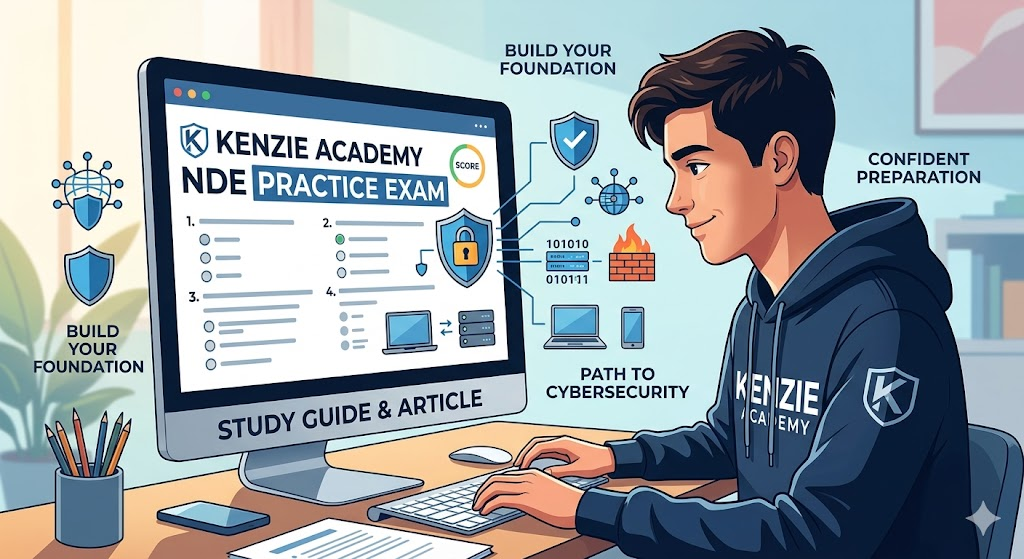
Additional Information
What the Course Entails and Exam Details
The Kenzie Academy NDE course and practice test provide a comprehensive overview of fundamental network defense tenets and skills. Learners will dive deep into twelve core domains:
Network Security Fundamentals: Covering the basic principles of protecting data, understanding the CIA triad (Confidentiality, Integrity, Availability), and the various types of networks and protocols.
Identification, Authentication, and Authorization (AAA): Mastering the critical concepts of controlling access to a network and validating user identities.
Network Security Controls – Administrative Controls: Understanding governance, security policies, regulations, and risk management from a management perspective.
Network Security Controls – Physical Controls: Learning to secure the physical assets of an organization to prevent physical access-based compromises.
Network Security Controls – Technical Controls: Implementing key technical tools like firewalls, intrusion detection and prevention systems (IDS/IPS), virtual private networks (VPNs), and data loss prevention (DLP).
Virtualization and Cloud Computing: Understanding security considerations and best practices for virtual machines and popular cloud deployment models.
Wireless Network Security: SECURING diverse wireless technologies, understanding encryption standards, and identifying common wireless attack vectors.
Mobile Device Security: Learning to manage and secure mobile devices that access corporate networks.
IoT Device Security: Addressing the unique and challenging security landscape of Internet of Things devices.
Cryptography and PKI: Gaining foundational knowledge of cryptographic algorithms and the Public Key Infrastructure.
Data Security: Understanding how to protect data throughout its entire lifecycle.
Network Traffic Monitoring: Learning to analyze network traffic to detect and respond to suspicious activity.
The practice test is meticulously designed to mirror these domains, providing a realistic simulation of the challenges you will face in the final exam. The actual over-arching exam details are as follows (though you should always verify the latest specifics with the exam provider, which is typically EC-Council):
Exam Code: Often identified as something similar to the EC-Council 112-51 for this specific certification level.
Number of Questions: The final exam typically consists of 75 multiple-choice questions.
Test Duration: Students are allotted 2 hours to complete the examination.
Passing Score: The target passing score is generally around 70%.
What to Expect in the Final Exam
When you take the final NDE exam, you can expect a computer-based test composed of multiple-choice and potentially some scenario-based questions. Each question has four options, and you must choose the most correct answer. The exam is often remotely proctored, which means you will be supervised via webcam and microphone throughout the test to ensure integrity. The atmosphere is professional and strictly monitored. You will be tested on your ability to understand the fundamental concepts and, importantly, to apply that knowledge to defend networks effectively. The practice test serves as the ideal sandbox to get comfortable with the pacing and the style of questions, allowing you to fine-tune your exam strategy and build confidence before the big day.
How to Study and Exam Centers
The most critical step in preparing is to engage fully with the Kenzie Academy NDE course content. Thoroughly review all the modules, lesson materials, and any provided study guides. Our practice test is a core part of this strategy; take the practice test multiple times. Review the rationales provided for every question, understanding why the correct answer is correct and why the other options are not. Create your own detailed notes or flashcards for complex topics or key terms. Leverage the hands-on lab components of your Kenzie Academy program, as applying the concepts practically is key for both deep learning and exam success.
The final NDE exam is usually delivered as an online, remotely proctored test. This means you can conveniently take it from the comfort of your own home or an approved location, provided you meet the technological and environment requirements. Pearson VUE or the primary certification body (typically EC-Council) will manage the official scheduling and proctoring. While some traditional Pearson VUE physical testing centers might also offer this specific exam, the remote proctoring option is often the most accessible. Be sure to check with Kenzie Academy or the final certification body for the specific registration process and currently available testing options.
Job Opportunities from the Course
Successfully completing the Kenzie Academy NDE course and passing the corresponding exam is a powerful way to kickstart your cybersecurity career journey. This foundational certification unlocks doors to several compelling entry-level roles, including:
Network Security Specialist
Cybersecurity Analyst
System Administrator (with a strong security focus)
Information Security Technician
Entry-Level Incident Responder
SOC Analyst (Security Operations Center)
Desktop Support Technician (with expanded security responsibilities)
IT Security Specialist (Entry-Level)
This guide, built around the invaluable Kenzie Academy Network Defense Essentials (NDE) Practice Test, is your roadmap to success. Stay focused, embrace the learning process, and leverage all the available resources to build a strong foundation for your exciting future in cybersecurity. Good luck with your studies and your exam preparation!
Frequently Asked Questions
Reviews
5.0
Based on 0 reviews
Leave a Review
No reviews yet. Be the first to review!