
Kettering Mechanical Ventilation Practice Test
$69.00
- Buy to unlock unlimited access to all Quiz questions and Answers in this Quiz.
- After purchase you can print a PDF of the whole quiz at any point. The PDF will contain the questions and the correct answers.
About this Exam
The Kettering Mechanical Ventilation Practice Test is an essential resource for Respiratory Therapy students and professionals seeking specialized mastery in mechanical ventilation. Specifically designed by Kettering National Seminars, this practice exam is targeted toward those preparing for national credentialing through the NBRC (National Board for Respiratory Care). It is intended for aspiring Certified Respiratory Therapists (CRTs) and Registered Respiratory Therapists (RRTs) who must demonstrate a comprehensive understanding of life-support systems to succeed in acute care settings and pass critical licensing exams.
Ready to test your knowledge?
Buy Now to Access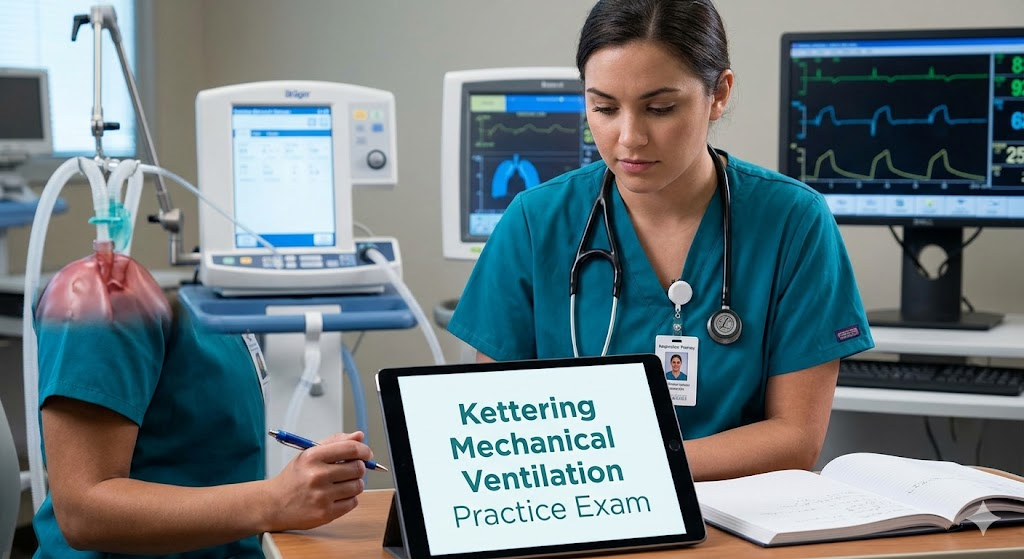
Additional Information
What the Course Entails and Exam Details
As a practice test, this resource covers the entire curriculum of advanced mechanical ventilation management. It simulates the clinical reasoning and technical knowledge required of modern practitioners.
The core areas tested include, but are not limited to:
Establishing and modifying initial ventilator settings based on patient data.
Interpretation of arterial blood gases (ABGs) and subsequent adjustments.
Modes of ventilation (e.g., AC, SIMV, PC, PSV) and advanced settings like PEEP.
Analyzing pulmonary waveforms and loops to identify pathophysiology and ventilator-patient dyssynchrony.
Advanced monitoring techniques and troubleshooting common ventilator alarms.
Weaning protocols, extubation criteria, and management of complex pathologies such as ARDS or COPD.
What to Expect in the Final Exam
When using the Kettering Mechanical Ventilation Practice Test, users should anticipate an experience that closely mimics the actual NBRC Therapist Multiple-Choice (TMC) and Clinical Simulation Examination (CSE).
The format typically includes complex multiple-choice questions that require critical thinking rather than simple rote memorization. Some questions may involve analyzing data from digital ventilator monitors or patient charts. Because this is a practice and study tool, time limits can often be self-managed, allowing students to use it as a timed simulation or a relaxed study session. However, to maximize the benefit, it should be treated as a timed exam to build stamina for the actual certification test.
Kettering provides detailed rationales for correct and incorrect answers, making it a powerful diagnostic tool rather than just a measurement device.
How to Study and Exam Centers
The most effective strategy for studying with the Kettering Mechanical Ventilation Practice Test is a three-step process: diagnose, review, and reassess.
First, take a timed practice test to establish your baseline and identify specific areas of weakness (e.g., waveform analysis or weaning). Second, dive deep into the Kettering study guides, audio lectures, or seminars, specifically focusing on those weaknesses. Third, re-take the practice test to measure improvement. Utilize the explanations provided for every question to truly understand the clinical application of the theory.
As this is a proprietary study tool, the Kettering Mechanical Ventilation Practice Test is accessed primarily through the official Kettering National Seminars online portal. Once purchased, users can access it from any computer, allowing for flexible study sessions at home, in a library, or on campus.
Job Opportunities from the Course
While this practice test is a preparatory tool, successful mastery directly contributes to passing the NBRC credentials. Achieving your RRT and gaining specialized knowledge in mechanical ventilation unlocks a variety of career paths in respiratory care.
Key job opportunities include:
Registered Respiratory Therapist (RRT)
Adult Critical Care Specialist (ACCS)
Neonatal/Pediatric Respiratory Care Specialist (NPS)
Critical Care Transport Therapist (Flight RT)
Respiratory Therapy Clinical Instructor
Cardiopulmonary Department Manager
Sleep Disorder Specialist
Frequently Asked Questions
Reviews
5.0
Based on 0 reviews
Leave a Review
No reviews yet. Be the first to review!