
Key Stage 3 (KS3) Biology Practice Test
$69.00
- Buy to unlock unlimited access to all Quiz questions and Answers in this Quiz.
- After purchase you can print a PDF of the whole quiz at any point. The PDF will contain the questions and the correct answers.
About this Exam
Welcome to our comprehensive study guide for the Key Stage 3 (KS3) Biology Practice Test! This assessment is designed for students in the UK (and compatible international systems) generally aged 11 to 14, typically covering the vital early years of secondary education. The actual KS3 Biology assessments are crucial because they build the essential foundation for GCSE-level science and measure your progress through key biological concepts. This practice test is your best friend in preparation – it's designed to simulate the experience and type of questions you'll face, helping you identify areas where you shine and areas that need a little more focus. If you're a curious student aiming to deepen your biological knowledge and ace your assessments, or a supportive parent looking to help, this guide is for you!
Ready to test your knowledge?
Buy Now to Access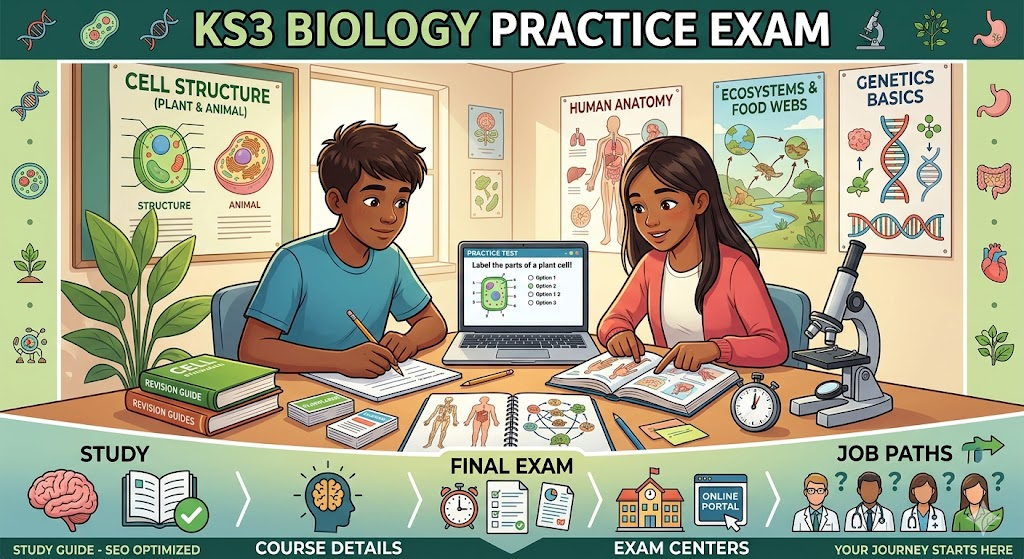
Additional Information
What the Course Entails and Exam Details
Key Stage 3 Biology introduces you to the wonders of life itself. The curriculum, and consequently any comprehensive practice test, covers a wide range of engaging topics. You'll explore the smallest building blocks of life in the 'Cells and Systems' section, learn how living things interact in 'Ecology and Environments', understand how organisms grow and pass on traits in 'Inheritance and Variation', and discover the intricate workings of the human body in dedicated sections like 'Human Anatomy and Physiology'. You'll dive into processes like photosynthesis, respiration, and nutrition, understanding how energy flows through living systems and how ecosystems maintain balance. Beyond purely factual knowledge, the course and the test assess your analytical and practical science skills. This means you will need to interpret data from graphs and charts, apply your understanding to novel situations, and answer questions that relate to common scientific experiments and observations. A complete KS3 Biology Practice Test accurately reflects this curriculum, covering topics from cell structure and microscopes to human digestion, plant reproduction, and genetics basics.
What to Expect in the Final Exam
While actual end-of-stage tests can vary slightly between different schools and assessment providers, a well-structured KS3 Biology Practice Test should closely mimic the common formats you will encounter in your school assessments. You can typically expect a variety of question types designed to thoroughly assess your understanding. This usually includes a healthy mix of multiple-choice questions for quick factual recall, short-answer questions requiring concise definitions or explanations, and more structured questions that may ask you to explain a process, label a diagram, or interpret presented data. The time limit for such tests is often set between 60 to 90 minutes for a single paper, challenging you to manage your time effectively while staying focused. There isn’t a single, universally standardized 'passing score' or accreditation for a KS3 test in the same way there is for professional certifications. Instead, your score is used by your school to assess your attainment and progress, often leading to a level or numerical scale that indicates how well you have mastered the curriculum content. The practice test is a powerful tool to gauge your own understanding against these general expectations. The rules will be the usual formal exam conditions: quiet, no notes, and adherence to time.
How to Study and Exam Centers
Effective studying is key to confidence! Your first and best resource is this very practice test. Use it actively! Don't just take the test once. Revisit incorrect answers and use your textbook or revision guides to thoroughly understand why the correct answer is right. Active recall, a proven technique, is incredibly effective. Create your own flashcards for key terms, use past paper questions (including this practice test!) repeatedly, and even try to explain biological concepts to a friend or family member. Group study sessions can be fantastic for discussing challenging ideas and learning from your peers. Remember to make the most of online resources too! Numerous educational websites offer quizzes, interactive diagrams, and video explanations specifically tailored for KS3. The actual assessments for Key Stage 3 are conducted internally by schools themselves. There are no external, authorized "exam centers" like Pearson VUE for KS3 in the way there are for professional certifications or some standardized admissions tests. For practice tests, you can take them in the comfort of your own home, in the school library, or within structured revision sessions organized by your school. For information about your real end-of-year or end-of-stage biology tests, always consult your school and science teachers directly – they are the experts on your local process!
Job Opportunities from the Course
Remember, a Key Stage 3 test is an internal educational assessment, not a direct job qualification itself. You won't use a KS3 certificate to apply for jobs at this stage. However, mastering the knowledge covered in this guide is the essential, exciting first step on numerous rewarding and vital career paths. Your biological knowledge will be the foundation for your GCSEs, A-levels (or equivalent), and eventually your future career! Here is a inspiring list of future career paths and roles that all begin with the vital understanding you're building right now:
Future Medical Professionals:
Doctor (General Practitioner or Specialist)
Nurse
Surgeon
Dentist
Veterinary Science Specialists:
Veterinary Doctor
Veterinary Nurse
Research & Laboratory Scientists:
Biomedical Scientist (studying disease and health)
Research Assistant (working on cutting-edge research)
Laboratory Technician (essential support for scientific research)
Environmental Scientists & Conservationists:
Ecologist (studying relationships within ecosystems)
Conservation Officer (working to protect wildlife and habitats)
Environmental Consultant
Education:
Biology or Science Teacher
Science Communicator or Museum Educator
Agriculture & Food Science Specialists:
Agricultural Scientist
Food Technologist
Biotechnologists & Geneticists:
Biotechnologist (using living systems to develop products)
Genetic Counsellor or Researcher (with further specialized study)
Your journey in biology is just starting, and every bit of effort you put into understanding these core concepts opens doors to an incredibly diverse and impactful future!
Frequently Asked Questions
Reviews
5.0
Based on 0 reviews
Leave a Review
No reviews yet. Be the first to review!