
Key Stage 3 (KS3) Energy Practice Test
$69.00
- Buy to unlock unlimited access to all Quiz questions and Answers in this Quiz.
- After purchase you can print a PDF of the whole quiz at any point. The PDF will contain the questions and the correct answers.
About this Exam
The KS3 Energy Practice Test is designed specifically for students aged 11 to 14 who are currently navigating the Key Stage 3 Science curriculum in England. This test is a critical stepping stone, allowing students to gauge their understanding of fundamental physics principles before transitioning to more complex GCSE topics. It serves as a diagnostic tool for both teachers and students, highlighting areas of strength and identifying topics that require further revision. By taking this test, students can build confidence and develop essential exam techniques early in their academic journey. It is a vital resource for any Year 7, 8, or 9 student aiming for top marks in their end-of-unit assessments or final KS3 science exams.
Ready to test your knowledge?
Buy Now to Access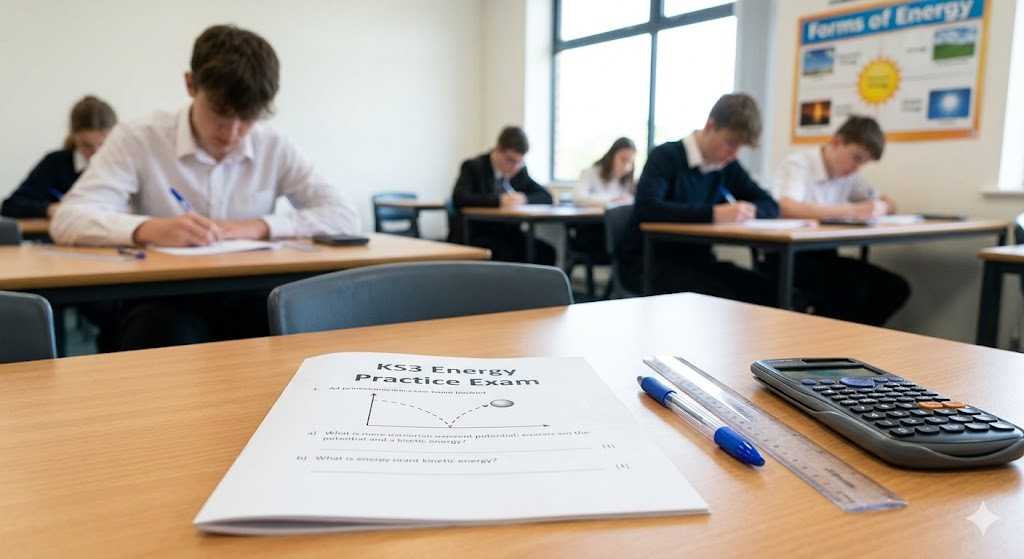
Additional Information
What the Course Entails and Exam Details
The Key Stage 3 Science curriculum aims to develop a deep understanding of the material world. The "Energy" module specifically entails a comprehensive look at how the physical universe functions. The exam details cover essential theoretical concepts and mathematical applications that students are expected to master.
The core syllabus topics tested include:
Energy Stores: Differentiating between kinetic, gravitational potential, elastic potential, chemical, nuclear, and thermal (internal) energy stores.
Energy Transfer: Understanding the mechanisms through which energy is transferred, including by heating (conduction, convection, radiation), waves, electrical work, and mechanical work.
Conservation of Energy: Applying the fundamental principle that energy cannot be created or destroyed, only transferred from one store to another.
Efficiency: Calculating the efficiency of energy transfers in various systems and interpreting Sankey diagrams to visualize energy dissipation.
Energy Resources: Analyzing the advantages and disadvantages of renewable (solar, wind, hydroelectric) and non-renewable (fossil fuels, nuclear) energy resources.
Power and Cost: Calculating power in Watts and determining the cost of running different household electricity appliances over time.
What to Expect in the Final Exam
Since KS3 Energy tests are set internally by individual schools, the exact format can vary. However, students should prepare for a rigorous assessment that mimics standard examination conditions. The test typically has a strict time limit, often ranging from 45 minutes to one hour.
The final exam usually consists of a mix of questioning styles to test different levels of cognitive skill. You should expect multiple-choice questions designed to test rapid recall of facts. A significant portion will be short-answer questions requiring concise definitions, identification of energy stores in specific scenarios, or simple calculations. There will also be longer-response questions (ranging from 4 to 6 marks) where you must explain scientific phenomena, such as how insulation works using ideas about conduction and convection. You are often expected to perform percentage efficiency calculations, so having a calculator is standard. While there is no universal "passing score," schools use the results to set targets for GCSE performance.
How to Study and Exam Centers
Effective preparation is the key to success in the KS3 Energy Practice Test. You should begin by reviewing class notes and textbooks to ensure all core definitions are memorized. Using active recall techniques, such as creating flashcards for key formulas (like energy efficiency) and different energy stores, is highly recommended. Mastering scientific diagrams, specifically drawing and interpreting Sankey diagrams, is crucial, as this is a common source of confusion. You should access practice papers provided by your teacher or utilize reputable online revision resources, such as BBC Bitesize Science, to familiarize yourself with the question formats. Getting into the habit of explaining energy concepts in your own words will prepare you well for the longer exam questions.
Regarding logistics, this is not an external certification taken at a Pearson VUE or specialized testing facility. The exam is taken internally within the specific physical testing centers of a student’s authorized school. Your teacher will administer the test during a regular science class or a scheduled assessment hour.
Job Opportunities from the Course
While a KS3 test itself does not directly lead to professional job roles, it is the foundational prerequisite for GCSE and A-Level Sciences. Mastering energy concepts is essential for pursuing high-paying, exciting careers in the STEM (Science, Technology, Engineering, and Mathematics) sectors. Success in physics opens doors to numerous diverse career paths, including:
Electrical Engineer
Mechanical Engineer
Renewable Energy Consultant
Environmental Scientist
Meteorologist
Aerospace Engineer
Medical Physicist
Civil Engineer
Energy Analyst
Physics Teacher
Frequently Asked Questions
Reviews
5.0
Based on 0 reviews
Leave a Review
No reviews yet. Be the first to review!