
Key Stage 3 (KS3) Physics Practice Test
$69.00
- Buy to unlock unlimited access to all Quiz questions and Answers in this Quiz.
- After purchase you can print a PDF of the whole quiz at any point. The PDF will contain the questions and the correct answers.
About this Exam
Welcome to your comprehensive guide to the Key Stage 3 (KS3) Physics Practice Test. If you are a student in Years 7, 8, or 9 in the UK, or following a similar curriculum, this guide is specifically for you.
This practice test is an essential tool designed to measure your understanding of the foundational principles of physics. It acts as a bridge between the introductory concepts of Key Stage 3 and the more challenging GCSE studies that lie ahead. The test is designed to evaluate not just what you know, but also how you can apply scientific reasoning to everyday phenomena.
Ultimately, this test helps both you and your teachers identify your strengths and any areas that might need extra attention, ensuring you have a rock-solid foundation for future scientific success.
Ready to test your knowledge?
Buy Now to Access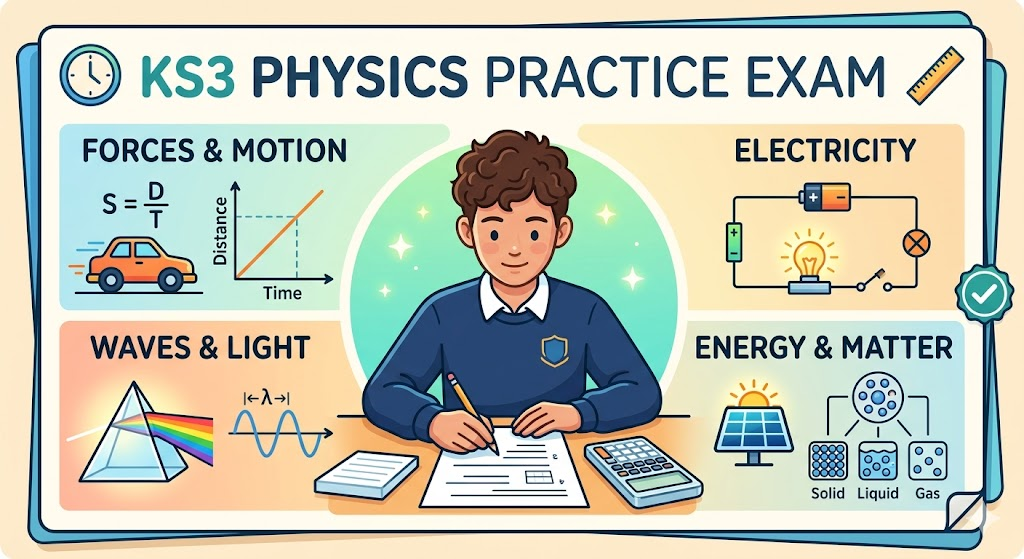
Additional Information
What the Course Entails and Exam Details
The KS3 Physics curriculum is designed to spark curiosity about the physical world. A practice test will cover a broad selection of core topics from across these three crucial years. While individual school syllabi might vary slightly, you should expect to be assessed on these fundamental pillars:
Forces and Motion: Understanding the concepts of balanced and unbalanced forces, measuring speed, interpreting distance-time graphs, the difference between mass and weight, friction, moments, and pressure.
Energy: Recognizing different energy stores (kinetic, gravitational, chemical, thermal, etc.) and understanding how energy is transferred and conserved. This includes learning about efficiency and renewable and non-renewable energy resources.
Electricity and Magnetism: Building and drawing circuit diagrams, understanding the concepts of current, potential difference (voltage), and resistance, and how they behave in series and parallel circuits. It also covers the basics of static electricity and the properties of magnets and electromagnets.
Waves, Light, and Sound: Exploring the properties of sound as a longitudinal wave, including loudness and pitch. You will also learn about light as a transverse wave, its behavior through reflection and refraction, how the eye works, and the nature of the electromagnetic spectrum.
Matter and Particles: Using the particle model to explain the states of matter, density, and changes of state, such as melting, boiling, and condensing.
Space Physics: Understanding the Earth’s place in the solar system, including the causes of day and night, seasons, the moon's phases, and gravity's role in orbits.
What to Expect in the Final Exam
While a 'practice' test is lower-stakes than a GCSE, it is designed to prepare you for that formal environment. Here is what you can expect from a typical comprehensive written KS3 Physics assessment:
Exam Format: The test will primarily be a written paper, which may be split into two parts. Question types will vary and typically include a mix of:
Multiple-Choice Questions: Quickly assessing recall of facts and basic definitions.
Short-Answer Questions: Requiring you to define terms, state a concept, or provide a single-sentence explanation.
Structured Questions: These often use a diagram or an experimental scenario and ask multiple linked parts. You will need to explain phenomena, carry out calculations using given formulas, or analyze data from a table or graph.
Calculation Questions: You will need to select the correct formula (e.g., $speed = \text{distance} / \text{time}$, or $weight = m \times g$), substitute the given numbers, and state your answer with the correct unit. Showing your working is crucial for gaining partial credit.
Passing Score and Grading: Unlike GCSEs, there is no standardized, universal "passing score." Schools set their own boundaries. The objective is to achieve a percentile score that demonstrates secure understanding (often a minimum of $50-60\%$ is considered good progress, but $80\%+$ is an excellent foundation). Results are usually given as a percentage.
Time Limit: A practice test usually lasts between 45 and 60 minutes, though a full, two-part exam may take up to 90 minutes. You must manage your time carefully, not spending too long on single-mark multiple-choice questions.
Specific Rules: You will be expected to remain silent, and no external materials like textbooks, phones, or notes are permitted. You should have a pen, pencil, eraser, ruler, and a scientific calculator, which is essential for the calculation questions.
How to Study and Exam Centers
Preparing effectively is the key to unlocking your potential. Here are actionable strategies to excel in your KS3 Physics Practice Test:
Actionable Study Strategies:
Create a Revision Timetable: Don’t try to learn everything the night before. Dedicate consistent, smaller study sessions to individual topics over a few weeks.
Master the Formulas: This is non-negotiable. Memorize key equations (Speed, Weight, Density, etc.) and practise rearranging them. For each formula, learn its variables and their units.
Focus on Command Words: Learn what terms like "describe," "explain," "calculate," and "suggest" require from your answer. "Describe" means "what does it look like/do," whereas "explain" requires "why" or "how" using scientific reasons.
Practice with Real Questions: Access past papers and specimen questions. This is the single most effective study method. Time yourself and then, most importantly, use the mark scheme to understand exactly what examiners are looking for.
Draw Diagrams: Many concepts are easier to understand visually. Practice drawing and labeling circuits, reflection/refraction ray diagrams, and wave diagrams.
Work on the Particles: Ensure you can confidently use the particle model to explain density differences and changes of state. It underpins many other topics.
Where and How to Take the Exam:
Since this is a Key Stage 3 practice assessment, you will not take this test at an external commercial testing centre like Pearson VUE.
Your School: The practice test will be administered directly by your school. It will likely take place during your regular science lesson time or as part of a formal end-of-term exam week in a classroom or sports hall.
Online Portals: Some schools use internal online platforms or scientific education portals to host online practice assessments. Your teacher will provide all specific access details and logins.
Job Opportunities from the Course
A strong performance in KS3 Physics is not just about a test; it is the first major step toward a vast number of dynamic and well-paid career paths. By choosing to pursue physics to GCSE, A-Level, and beyond, you unlock these job opportunities:
Aerospace Engineer – Designing and building aircraft and spacecraft.
Mechanical Engineer – Designing and manufacturing machines, tools, and mechanical systems.
Civil Engineer – Building and maintaining infrastructure like bridges, roads, and dams.
Electrical/Electronics Engineer – Working on electrical systems, from microchips to power grids.
Nuclear Engineer – Developing safe ways to use nuclear energy.
Medical Physicist – Designing and maintaining technology like MRI scanners and radiotherapy equipment.
Astrophysicist/Astronomer – Researching the universe, from stars to black holes.
Geophysicist – Using physics to study the Earth, for example, in oil and gas exploration or earthquake monitoring.
Data Scientist – Analyzing large and complex datasets.
Financial Analyst/Quant – Using mathematical modeling for financial prediction.
Teacher – Inspiring the next generation of scientists.
Research Scientist – Conduct original research in laboratories and universities.
Frequently Asked Questions
Reviews
5.0
Based on 0 reviews
Leave a Review
No reviews yet. Be the first to review!