
Key Stage 3 (KS3) Plants Practice Test
$69.00
- Buy to unlock unlimited access to all Quiz questions and Answers in this Quiz.
- After purchase you can print a PDF of the whole quiz at any point. The PDF will contain the questions and the correct answers.
About this Exam
Prepare your Key Stage 3 science students effectively with this practice exam focused entirely on the fascinating world of plants. This comprehensive test is specifically designed for students in years 7 to 9 in the UK, typically aged 11 to 14, following the national curriculum. It provides a structured way to gauge understanding, identify knowledge gaps, and build crucial exam confidence ahead of genuine school assessments or future qualifications. Students will engage with key plant biology concepts through a series of relevant and well-crafted questions. This is an essential revision tool to ensure students are well-prepared to demonstrate their knowledge of plant structure, processes, and ecology.
Ready to test your knowledge?
Buy Now to Access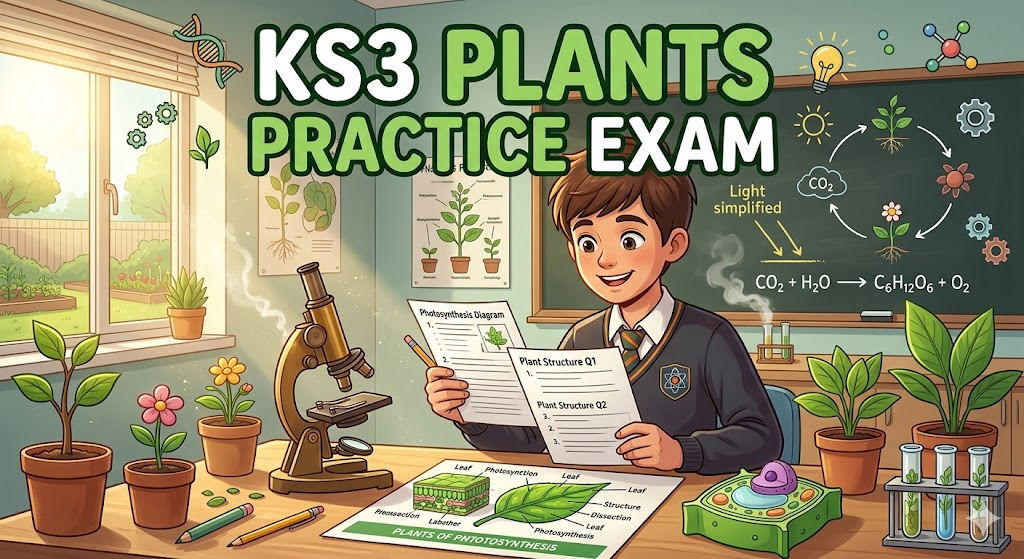
Additional Information
What the Course Entails and Exam Details
This practice exam aligns with the Core Key Stage 3 Biology curriculum in the area of plant life. It covers the fundamental topics and practical skills that students are expected to have mastered at this level. The primary curriculum areas included are:
Plant Cell Structure: Understanding the role of organelles like chloroplasts, the cell wall, and the large vacuole.
Plant Tissues and Organs: Identifying and explaining the function of different parts of the plant, including roots, stems, leaves, and flowers.
Photosynthesis: The chemical process that plants use to make food, including the reactants (carbon dioxide and water), products (glucose and oxygen), and the energy source (light).
Transpiration and Transport: How plants move water and nutrients throughout their structure.
Plant Reproduction: Both sexual and asexual reproduction, including pollination, fertilisation, and seed dispersal methods.
Adaptation and Ecology: How plants are adapted to their environments and their role within ecosystems.
Working Scientifically: Applying scientific methodology to plant-based practicals and interpreting data. The exam details for this practice test are flexible. You might take it in a classroom setting, as a homework assignment, or for self-guided study. The content is comparable to a standard science unit or end-of-year assessment, aiming to cover a broad range of key objectives.
What to Expect in the Final Exam
While the exact format can vary, a typical Key Stage 3 science test on plants often features a mix of question styles to thoroughly assess understanding. You can expect:
Multiple-choice questions to test quick recall and key definitions.
Short-answer questions that require brief explanations or labelling of diagrams (e.g., plant cell, leaf cross-section, parts of a flower).
More extended-answer questions that assess the ability to describe processes like photosynthesis or reproduction in detail.
Questions with data or graphs related to plant experiments, requiring analysis and conclusions. The duration is usually designed to be manageable within a school lesson, typically ranging from 40 to 60 minutes. As a practice exam, there isn't a universally set "passing score" requirement in the way a professional qualification has. Instead, individual schools and teachers will use the results to assign levels, understand progress, and provide feedback. The goal should be to demonstrate clear understanding and achieve as high a score as possible according to the specific marking scheme provided, aiming to show proficiency in the topic area. There are generally no strict, universally applicable "rules" other than those standardly found in test environments, such as completing the work independently within the time limit.
How to Study and Exam Centers
Success in any science exam comes from a combination of active learning and practice. Here are effective strategies for studying for the KS3 Plants Practice Exam:
Active Revision: Use your class notes, textbooks, and trusted online resources (such as BBC Bitesize or school-specific platforms) to review all the core topics.
Visual Aids: Plants are highly visual subjects! Draw and label cell structures, leaf cross-sections, and the lifecycle of a flowering plant.
Mnemonics & Flashcards: Create mnemonics for processes like photosynthesis (e.g., "Water and Carbon, making Glucose, thanks to Light, release Oxygen!") and use flashcards for key terms.
Concept Maps: Build mind maps to link different ideas (e.g., how photosynthesis, respiration, and transpiration are connected in a plant's survival and growth).
Practice Questions: Attempt the practice test questions multiple times, reviewing your answers and understanding the correct solutions. Find and solve past paper questions if available from your school or common exam boards to get accustomed to the question style.
Group Study & Quizzing: Work with friends and quiz each other on definitions, processes, and diagram labels. Regarding exam centers: The KS3 Plants Practice Exam is not administered in a specific external "exam center" like professional certifications. Instead, it is usually taken within your own school environment. This could be in your regular classroom during a science lesson, a designated hall, or at home as a revision task set by your teacher. The key "center" is your learning context. The final, formal assessments at KS3 are typically managed directly by your school. Some schools may use standardized test papers from major UK exam boards to ensure consistency, but the actual sitting of the test is local. You should always clarify the specific arrangements with your science teacher.
Job Opportunities from the Course
A strong understanding of plant biology at Key Stage 3 is not just for doing well in school; it's a vital first step on the pathway to countless exciting and rewarding careers in science, health, and the environment. While the practice test itself doesn't unlock immediate job opportunities, excelling in this area sets the foundation for essential qualifications (GCSEs, A-Levels, and later, degrees or vocational paths) that lead directly to these roles:
Botanist: Specialising in the study of plant life and processes.
Ecologist: Understanding and protecting complex ecosystems, often with a significant focus on plant communities.
Horticulturalist: Applying plant knowledge to plant cultivation, landscape design, and management.
Plant Scientist: Engaging in research to develop new crop varieties, fight plant diseases, and understand plant genetics.
Conservation Officer: Working to protect natural habitats and biodiversity, including plant species.
Environmental Scientist: Dealing with broader environmental challenges, where plant knowledge is crucial for understanding soil health, carbon cycles, and pollution effects.
Agricultural Scientist: Improving farming techniques, crop yields, and sustainability.
Biotechnologist: Using biological processes, often involving plants, to develop new products or processes.
Forensic Botanist: Using plant evidence in legal investigations.
Pharmacologist: Researching and developing medicines derived from plant sources.
Vet: While focused on animals, vets need a solid grounding in biological systems, many of which (like digestion) involve plant interactions.
Science Teacher: Educating the next generation of scientists about the fascinating world of plants.
Wildlife Biologist: Studying all types of wildlife and their interactions, with a major emphasis on the plants that form habitats and food sources.
By excelling in your Key Stage 3 plants study, you are not just passing a test; you are beginning a journey towards these impactful and diverse career opportunities.
Frequently Asked Questions
Reviews
5.0
Based on 0 reviews
Leave a Review
No reviews yet. Be the first to review!