
Key Stage 3 (KS3) Waves Practice Test
$69.00
- Buy to unlock unlimited access to all Quiz questions and Answers in this Quiz.
- After purchase you can print a PDF of the whole quiz at any point. The PDF will contain the questions and the correct answers.
About this Exam
The Key Stage 3 (KS3) Waves Practice Test is a comprehensive
assessment tool designed for students aged 11 to 14 in secondary education
across England, Wales, and Northern Ireland. This test is specifically tailored
to evaluate a student's understanding of foundational physics concepts related
to waves, light, and sound. It is an essential resource for students preparing
for end-of-unit tests, internal school exams, or those simply wishing to
reinforce their knowledge of this critical scientific topic. By practicing with
this test, students can identify knowledge gaps, build confidence, and ensure
they meet the national curriculum requirements. Parents and tutors will also
find this test invaluable for tracking progress and providing targeted support.
Ready to test your knowledge?
Buy Now to Access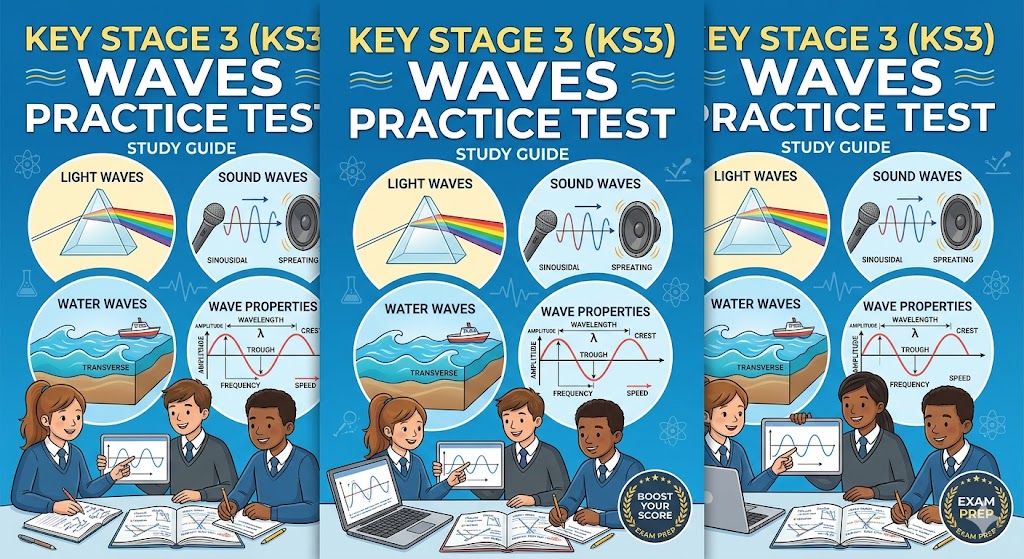
Additional Information
What the Course Entails and Exam Details
This practice exam aligns with the National Curriculum for
Science at Key Stage 3, covering the physics component of the syllabus focused
on waves. The test requires a strong understanding of how energy is transferred
through different mediums. The core topics, key syllabus areas, and skills
assessed include:
Wave Properties: Understanding the basic vocabulary
and properties of waves, including amplitude, wavelength, frequency, and speed.
Distinguishing between transverse and longitudinal waves using relevant
examples.
Light Waves: Master the behavior of light, including
reflection (law of reflection), refraction (change in speed/direction), and how
light travels in straight lines. Students must understand standard ray diagrams
for both.
The Spectrum: An overview of the electromagnetic
spectrum, with focus on visible light, dispersion (splitting white light into
colours using a prism), and common uses or dangers.
Sound Waves: Analyzing sound as a longitudinal wave,
including how it is produced, how it travels, and the properties of pitch
(frequency) and loudness (amplitude). Understanding how human hearing works and
the speed of sound in different materials.
Scientific Enquiry Skills: The test also assesses the
ability to interpret scientific diagrams, make predictions based on physical
models, and analyze experimental data related to wave phenomena.
What to Expect in
the Final Exam
While actual school-based assessments may vary slightly,
this practice test simulates the format students will encounter in a typical
KS3 Science exam. The official national "Sats" style exams were
phased out, but schools still conduct rigorous internal testing to monitor
attainment. This test usually follows a structured paper-based or,
increasingly, a secure online assessment format.
Students should expect:
- Format:
A mix of question types, including multiple-choice, matching definitions,
short structured answers (requiring recall of facts), and
data-interpretation questions based on provided diagrams or graphs.
- Time
Limit: A typical paper of this scope is designed to be completed in
approximately 45 to 60 minutes.
- Scoring:
A numerical score and often a corresponding "Level" or
percentage are provided to indicate attainment.
- Rules:
Standard examination protocols apply; no notes, textbooks, or unauthorized
assistance is permitted during the test. A calculator is typically allowed
for speed and frequency calculations.
How to Study and Exam Centers
Effective preparation is key to mastering this topic. The
best strategy involves consistent revision and, most importantly, active
practice. We recommend a structured study method:
- Revision
Notes: First, consolidate learning using textbooks, school notes, or
authorized online KS3 Science resources (such as BBC Bitesize). Summarize
key formulas (e.g., speed = distance / time, or speed = frequency x
wavelength) and definitions on flashcards.
- Practice
with Diagrams: Practice drawing and labeling clear ray diagrams for
reflection and refraction, ensuring you understand normal lines, incident,
and reflected angles.
- Active
Testing: Taking this Key Stage 3 (KS3) Waves Practice Test is the
single most effective way to prepare. Use the test to build stamina and
practice time management, and thoroughly review the detailed model answers
to understand where you can improve.
- Simulate
Exam Conditions: For the best results, take the practice test in a
quiet environment without interruptions.
Since this is a curriculum-based school assessment, the exam
is typically taken internally within the student's secondary school.
Teachers will administer the test during scheduled science lessons. The results
are used for internal tracking and are reported to parents. For students
home-schooling, or those seeking extra practice, tests are accessible via
secure online education portals (like this one). There is no requirement to
visit specific external centers like Pearson VUE for this age group’s
assessment.
Job Opportunities from the Course
A strong performance at Key Stage 3 is not just about
immediate school results; it is the critical foundation required for success at
GCSE, A-Level, and beyond. This specific wave physics module is the launchpad
for numerous exciting scientific career paths. Achieving proficiency now will
significantly benefit students pursuing qualifications needed for:
- Physicist
and Research Scientist
- Acoustic
Engineer (Sound/Vibration Specialist)
- Medical
Imaging Specialist (e.g., Sonographer, MRI Tech)
- Communication
Technician (Telecommunications/Broadcasting)
- Optometrist
and Optical Engineer
- Laser
Technician
- Meteorologist
- Seismologist
(Analyzing Earthquake Waves)
Frequently Asked Questions
Reviews
5.0
Based on 0 reviews
Leave a Review
No reviews yet. Be the first to review!