
Keystone Ecology Practice Test
$69.00
- Buy to unlock unlimited access to all Quiz questions and Answers in this Quiz.
- After purchase you can print a PDF of the whole quiz at any point. The PDF will contain the questions and the correct answers.
About this Exam
The Keystone Ecology exam is a critical benchmark
assessment designed to measure a student’s mastery of fundamental ecological
principles. This exam is typically administered to high school students, often
as part of state graduation requirements within biology or environmental
science curricula. The primary purpose is to validate that students possess a
robust understanding of how organisms interact with each other and their
physical environment. This certification is essential for demonstrating academic
readiness for advanced scientific study and ensures students possess the
scientific literacy necessary for engaging with complex global environmental
challenges.
Ready to test your knowledge?
Buy Now to Access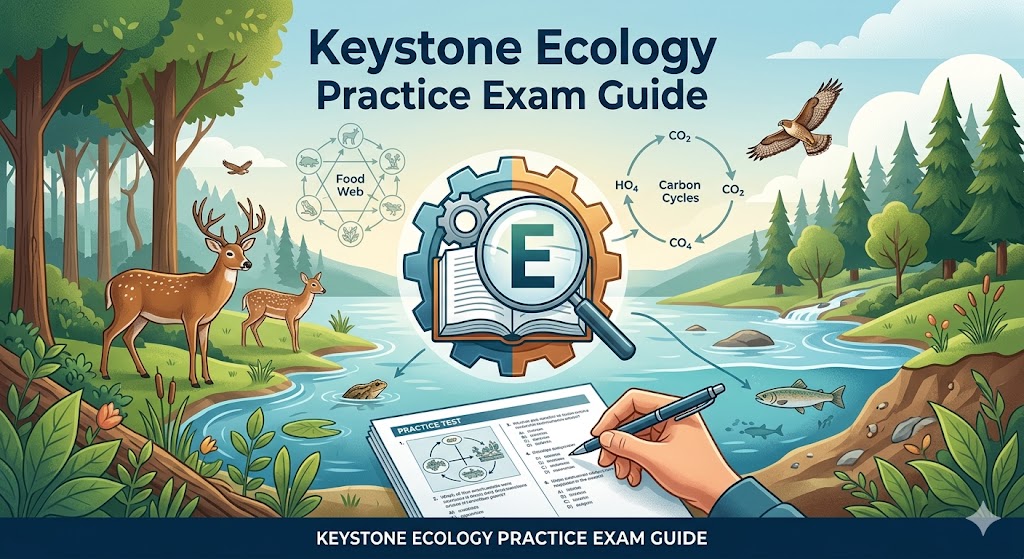
Additional Information
What the Course
Entails and Exam Details
The content of the Keystone Ecology exam is
comprehensive, focusing on the intricate systems that support life on Earth.
Preparing for this assessment requires a deep dive into several core biological
domains, emphasizing both factual knowledge and analytical skills.
The primary areas of focus include:
- Ecosystem
Dynamics: Analyzing how energy flows through food chains, webs, and
trophic levels, as well as the cycling of essential matter through
biogeochemical cycles (such as the carbon, nitrogen, and water cycles).
- Population
Ecology: Studying factors affecting population growth, carrying capacity,
and how limiting factors—both biotic and abiotic—impact the size and
distribution of populations.
- Community
Interactions: Understanding symbiotic relationships (parasitism,
mutualism, commensalism), competition, predation, and the process of
ecological succession within communities.
- Global
Biomes: Recognizing the characteristics of major terrestrial and aquatic
biomes, including how abiotic factors determine the dominant plant and
animal life in each.
- Human
Impact: Evaluating the consequences of human activity on ecosystems,
biodiversity loss, pollution, and the effectiveness of conservation and
sustainability efforts.
What to Expect in
the Final Exam
The actual Keystone Ecology final exam is a rigorous,
standardized test administered in a proctored environment. While formats can
vary slightly by jurisdiction, candidates should anticipate a sophisticated
computer-based assessment.
The exam structure typically involves:
- Format:
A combination of multiple-choice questions (the dominant portion) and
constructed-response questions. Multiple-choice items test breadth of
knowledge, while constructed-response items require candidates to
synthesize information, interpret data charts, or provide written
explanations for ecological phenomena.
- Passing
Score: The benchmark for passing is generally set at a
"proficient" level. Rather than a set raw percentage, the score
is often scaled, with specific thresholds determined by the state board of
education.
- Time
Limit: Candidates are usually allotted a specific time block, often
ranging between 90 and 120 minutes per module or section, with standard
accommodations available for eligible students.
- Specific
Rules: Reference materials are generally not permitted during the
examination, and standard anti-cheat protocols are strictly enforced in
both physical and virtual testing environments.
How to Study and
Exam Centers
Effective preparation for this high-stakes exam requires
a strategic, multifaceted approach. Utilizing a diverse array of study tools
will build both conceptual confidence and test-taking stamina.
Recommended study strategies include:
- Take
Multiple Practice Tests: Engage frequently with a dedicated Keystone
Ecology Practice Test. This is the single best way to familiarize yourself
with the question formats, timing constraints, and difficulty level of the
actual exam. Analyzing your errors on practice tests will highlight
specific domains where you need further review.
- Focus
on Vocabulary: Ecology relies heavily on specific terminology. Create
flashcards for key terms related to ecosystem components, relationships,
and cycles.
- Review
Diagrams and Cycles: Be prepared to interpret food webs, population
graphs, and diagrams of the biogeochemical cycles.
The administration of the Keystone Ecology exam typically
occurs within a student's home high school during scheduled testing windows.
For adult learners or students in alternative programs, the exam may be
administered through state-approved online portals using remote proctoring
technology or at specific physical testing centers designated by the state
department of education.
Job Opportunities
from the Course
While the Keystone Ecology exam itself is a foundational
academic hurdle, mastery of these principles is the essential first step toward
a wide variety of professional careers in the environmental and biological
sciences. Achieving proficiency validates your capability in a field that is
becoming increasingly critical.
This foundational knowledge base is the required gateway
to advanced study and eventual certification for roles such as:
- Environmental
Scientist
- Conservation
Biologist
- Park
Ranger or Interpreter
- Wildlife
Management Specialist
- Water
Quality Technician
- Sustainability
Coordinator
- High
School Biology/Ecology Educator
- Environmental
Consultant
Frequently Asked Questions
Reviews
5.0
Based on 0 reviews
Leave a Review
No reviews yet. Be the first to review!